For astronomers, the direction of the Milky Way’s center has long been a frustrating place to work. Stars pack in so tightly that separating individual ones is a serious challenge. A haze of gas and dust blurs the background, hiding whatever lies deeper in.
But there’s an observing technique that turns this very congestion into an advantage.
In March 2025, ESA’s Euclid space telescope pointed directly at that crowded region — not in spite of the chaos, but because of it. The goal: to find planets that emit no light of their own, by watching for a brief, telltale flicker in the stars behind them.
Why the most crowded part of the sky is also the richest hunting ground
Our solar system sits well out from the center of the Milky Way, a spiral galaxy. Looking toward the galactic core from here, the line of sight passes through an enormous stack of stars layered one behind another. The dense central bulge — astronomers call it simply the bulge — packs stars at densities that dwarf what we see in our local neighborhood.
This density creates an unusual opportunity. When stars are plentiful, so are the moments when a foreground star and a background star line up almost perfectly along our line of sight. These chance alignments happen far more often in a star-rich direction — and they’re exactly what triggers a phenomenon that can expose otherwise invisible objects.
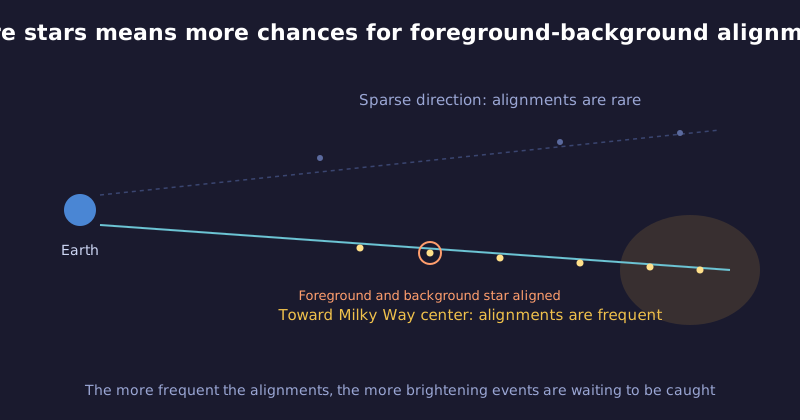
In other words, the congestion that makes this region hard to study is, for one particular technique, the ideal hunting ground. That technique is gravitational microlensing.
Gravity bends light — and that bends everything we know about detecting planets
Gravitational microlensing traces back to Einstein’s general theory of relativity. Massive objects warp the space around them, and because light follows the shape of space, its path bends accordingly.
Put simply, a massive body acts like a lens, curving and concentrating the light from whatever lies behind it. That’s gravitational lensing.
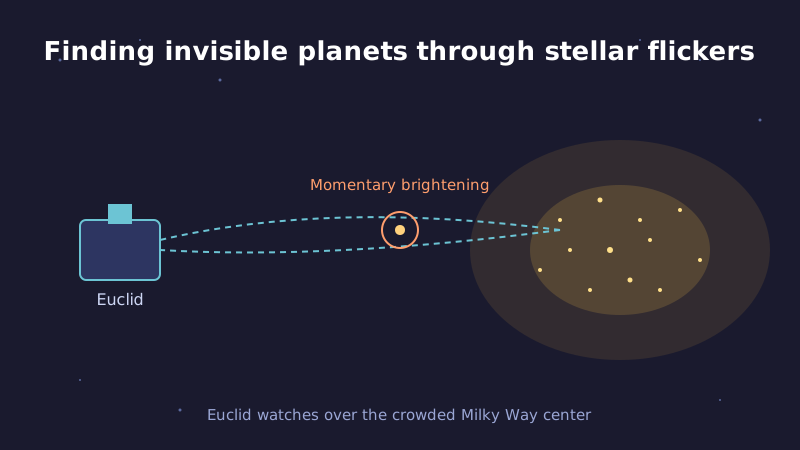
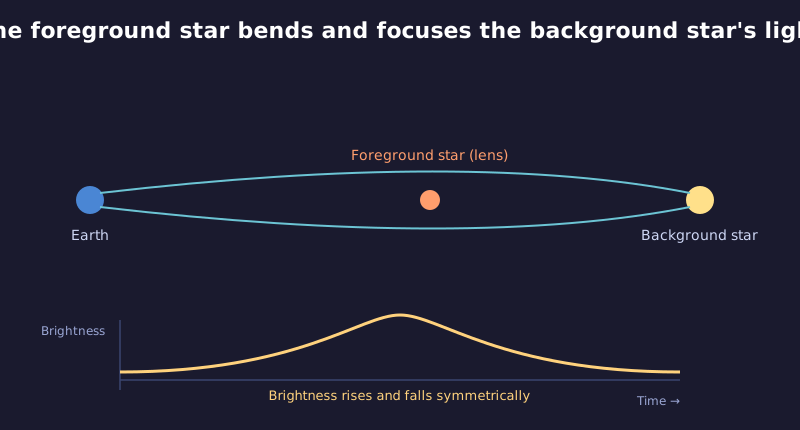
Now imagine a foreground star passing directly in front of a more distant one. The foreground star’s gravity bends the background star’s light toward us, temporarily boosting how bright the background star appears.
I’ll confess: for a long time I thought of this as a rare curiosity, a special-effects trick of the cosmos. It turns out to be something far more practical.
As the alignment develops and then breaks apart, the background star’s brightness climbs gradually over days to weeks, peaks, and falls back to normal. This smoothly symmetric brightening curve is the microlensing signature — its fingerprint.
Now here’s where it gets interesting: what if the foreground star has a planet in tow?
A planet leaves a short spike on the brightening curve
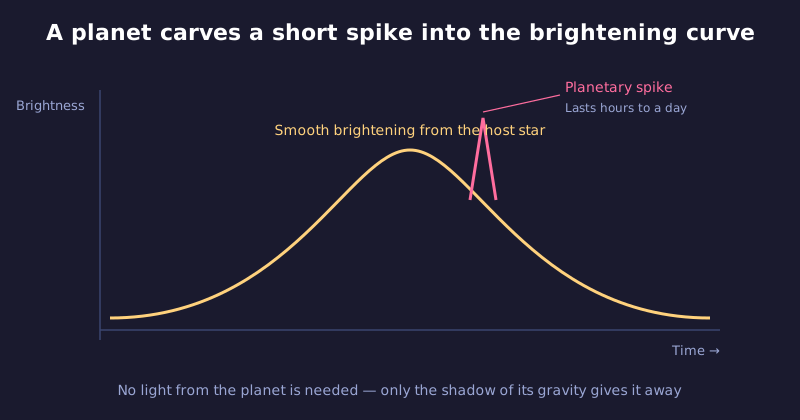
When the lensing star hosts a planet, that planet also bends light — just barely. Its gravitational nudge shows up as a brief spike riding on top of the otherwise smooth brightening curve.
These spikes can last a day at most; often they vanish in just a few hours. Catching one requires watching the same field of stars continuously and without interruption.
This is the defining characteristic of the technique, and honestly the part I find most striking.
Other methods for finding exoplanets have different blind spots. The transit method — where a planet crosses in front of its star and dims it slightly — works best for planets in tight, close-in orbits. Microlensing, by contrast, can detect planets orbiting far from their host stars, and it can even catch free-floating planets: worlds that belong to no star at all, drifting alone through the galaxy.
Better yet, none of the planet’s own light is required. Its gravitational shadow is enough to reveal its presence. A star, in essence, finds a planet around another star. That’s why the technique is sometimes described as “stars finding stars’ planets.”
There is, of course, a catch. Microlensing depends on a chance alignment, which means the same planet can never be observed twice. Miss the brightening event and that planet is gone for good — no second chances. This is precisely why you need a telescope that can monitor a wide field at high resolution, without a break.
Euclid “untangles” the crowd
That’s where Euclid comes in.
Launched on July 1, 2023, Euclid observes from the gravitationally stable L2 Lagrange point, roughly 1.5 million kilometers from Earth. Its primary mission is to map dark matter — the unknown substance that makes up most of the universe’s mass — and dark energy, the mysterious driver of the universe’s accelerating expansion. To do that, Euclid will chart billions of galaxies across more than a third of the entire sky: wide coverage, sharp images.
That same “wide and sharp” capability applies directly to the bulge.
Ground-based telescopes suffer from atmospheric turbulence, which causes densely packed stars to bleed into one another, smearing the field into an indistinct blob. Operating above any atmosphere at L2, Euclid can resolve individual stars even in the most congested regions.
According to ESA, the bulge observations achieved an angular resolution of about 0.16 arcseconds. An arcsecond is an angular unit — one arcsecond equals roughly 1/3600 of the apparent diameter of the full Moon. Think of it as tracing the tip of a needle across the sky.
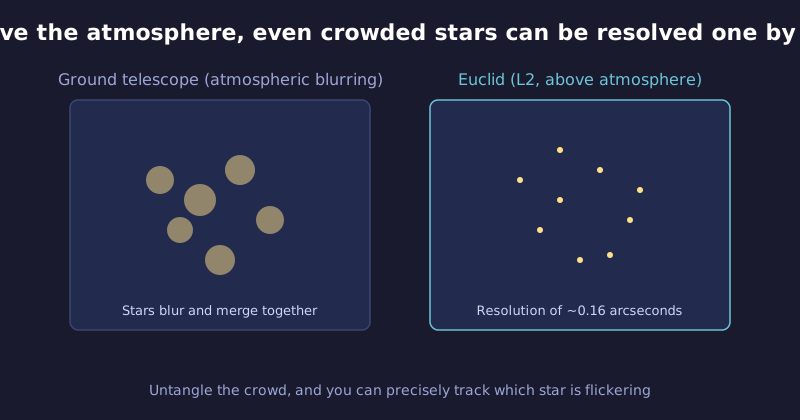
Once you can untangle the crowd and resolve stars one by one, you can precisely track which individual star is flickering — and when. The hunting ground becomes far more usable.
What’s coming on June 24 is still a reconnaissance pass
So what exactly did the March 2025 observations capture?
ESA calls this program the Euclid Galactic Bulge Survey. The March campaign covered nine adjacent fields near the galactic center, together spanning 4.8 square degrees. The full Moon covers roughly 0.2 square degrees, so Euclid imaged the equivalent of just over 20 full Moons’ worth of sky — resolving individual stars throughout.
Each field received sixteen 400-second exposures, totaling about 1.8 hours of accumulated light per region. The observations used Euclid’s VIS visible-light camera.
This dataset will be released publicly on June 24, 2026 as part of “Q2.” But it’s important to be clear about what it is and what it isn’t. A single round of imaging doesn’t produce planetary spikes. Microlensing events evolve over time; detecting planets requires revisiting the same field repeatedly to track how individual stars change in brightness.
What’s being released is better understood as a reconnaissance effort and a star catalog — a precise baseline of what the bulge looks like at a specific moment, and a test of how well Euclid handles the region’s extreme density. If the team confirms that Euclid can work effectively in such a crowded environment, it opens the door to longer, sustained monitoring campaigns. Q2 is where that capability gets demonstrated publicly.
Counting the invisible through someone else’s flicker
Microlensing is a fundamentally counterintuitive technique.
We’re used to finding things by seeing them directly. This method instead tallies planets that emit no light at all, using only the indirect evidence of another star’s momentary brightening. It constructs a census of invisible worlds from the shape of a light curve.
The Milky Way is thought to harbor a large population of free-floating planets — worlds ejected long ago from their birth systems, now drifting through the dark with no host star. The transit method can’t reach them in principle. Microlensing can.
Several telescopes are currently being prepared or proposed with microlensing surveys in mind. Euclid’s bulge observations sit right at the entrance to that era.
The next time Euclid turns its lens toward this same patch of sky, somewhere in that crowded starlight a thin spike might rise for just a few hours. It would be the single trace left behind by a planet that belongs to no one — a gravitational shadow passing once, and never again.