190 light-years from here sits a giant planet that, by all rights, should be utterly alone. And yet, tucked in even closer to the star, a small planet has quietly held its ground.
Hot Jupiters typically fly solo. These massive gas giants orbit so close to their stars that their gravity flings away anything nearby, leaving the neighborhood swept clean. But in the TOI-1130 system, something sits just inside that “cleaner” — a planet about the size of a small Neptune, parked right where nothing should survive. It’s a pairing that, on paper, shouldn’t exist. And yet there it is.
What exactly is a “lonely” planet?
Let’s start with the main character. A hot Jupiter is a gas giant roughly the size of our own Jupiter, orbiting so tight to its star that a year barely lasts a week.
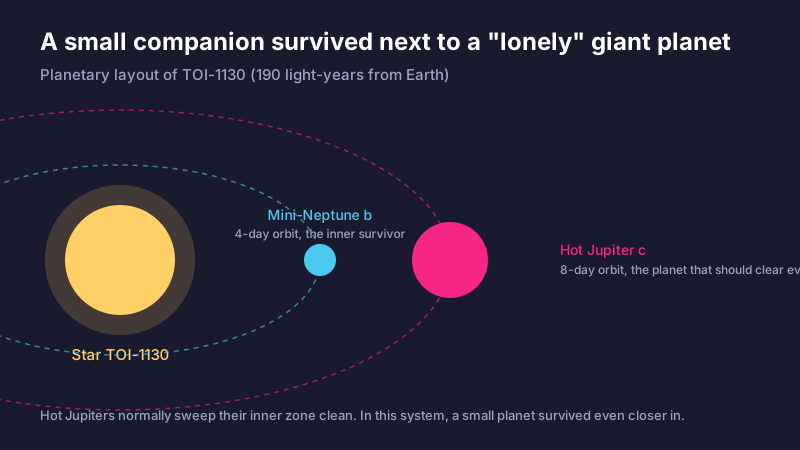
Just how close is TOI-1130’s hot Jupiter, known as TOI-1130c? It completes a full orbit in only 8 days. For comparison, Mercury takes 88 days to circle the Sun — TOI-1130c does it in less than a tenth of that time. Roasting that close to its star, the planet’s surface reaches blistering temperatures.
Here’s the problem. When something this massive sits so near a star, its gravity scatters every small object that drifts too close. In theory, the space inside a hot Jupiter’s orbit should end up completely empty.
And in practice, that’s largely held true. Most hot Jupiters discovered so far turn out to be loners, with no planetary neighbors nearby. The cleaner does its job, and the area gets tidied up. It’s a strange irony: a planet’s sheer size is exactly what isolates it.
Why the inner zone was supposed to be empty
Worth pausing here to ask: why can’t smaller planets survive inside a hot Jupiter’s orbit in the first place?
It comes down to a tug-of-war over gravity. The region close to a star tends to be crowded with material early on. When a Jupiter-mass planet muscles its way into that space, any lighter object orbiting nearby gets gravitationally jostled, and its orbit slowly destabilizes.
From there, a destabilized object usually meets one of three fates: it spirals into the star and gets swallowed, it collides with the giant planet, or it gets flung out of the system entirely. None of those outcomes leave room for a small planet to stick around.
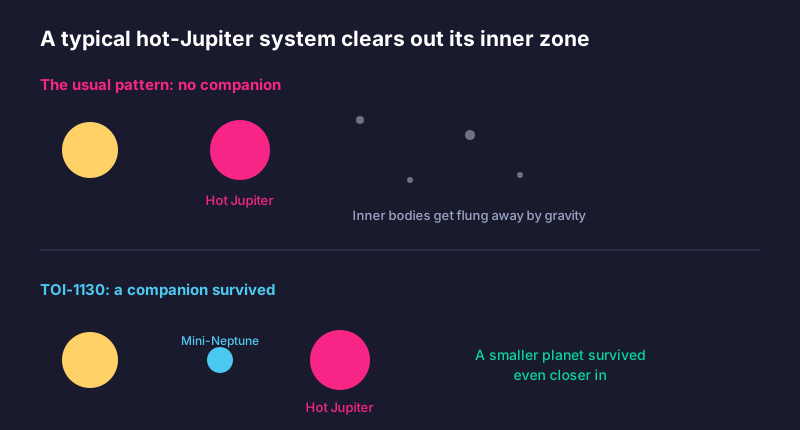
So a small planet surviving inside a hot Jupiter’s orbit is a bit like finding crumbs on the floor right after vacuuming — a scene that, by all expectations, simply shouldn’t happen. I’ll admit it: I assumed every system like this had already been swept spotless.
A small companion that refused to leave
TOI-1130 is the system that broke that assumption.
Astronomers found it back in 2020, when NASA’s Transiting Exoplanet Survey Satellite (TESS) caught the star dimming by a tiny amount — a brief flicker. When a planet crosses in front of its star, it blocks just a sliver of starlight. That dip in brightness is how we spot worlds we can never see directly.
Think of a gnat flitting past a lightbulb — that quick flicker at the edge of your vision. This is the astronomical version of the same trick, except the “lightbulb” sits 190 light-years away, and the watcher is a satellite patiently staring at the same star, refusing to blink, so it doesn’t miss that fleeting dimming. That patience is how invisible planets get unmasked.
Among the team analyzing the TESS data was Chelsea X. Huang, then at the Massachusetts Institute of Technology (MIT). What they found wasn’t just the 8-day hot Jupiter. There was another planet orbiting even closer in, completing a full circuit in just 4 days.
This inner world, TOI-1130b, turned out to be a “mini-Neptune” — a gas-wrapped planet bigger than Earth but smaller than Jupiter, roughly a scaled-down version of our own Neptune.
So there it was: a small planet calmly orbiting inside the territory of a planet that should have cleared it out. For researchers, this wasn’t a tidy answer — it was the start of a new puzzle. Why hadn’t this little world been swept away?
Reading the atmosphere revealed where it came from
This is where things get interesting — honestly, my favorite part of the whole story.
The clue to the mystery turned out to be hiding in the mini-Neptune’s atmosphere. In 2026, researchers used the James Webb Space Telescope (JWST) to observe the moment this planet passed in front of its star. By analyzing the starlight that filtered through the planet’s atmosphere, they could work out what that atmosphere is made of.
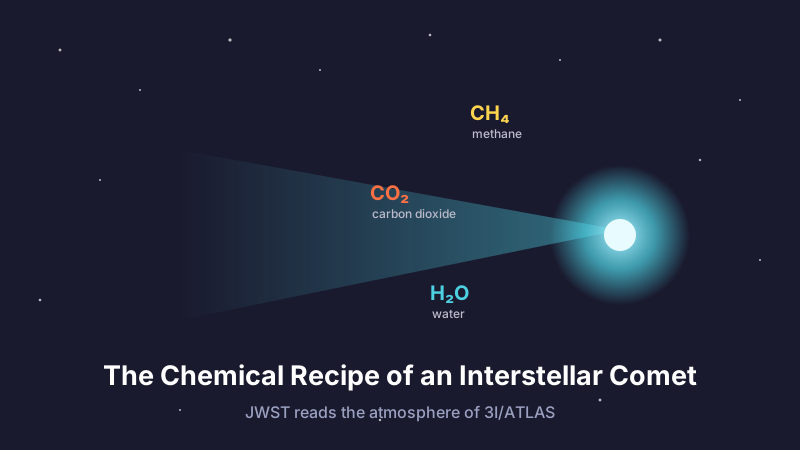
What they found was water vapor, carbon dioxide, sulfur dioxide, and hints of methane. According to the research team, this marks the most detailed atmospheric composition ever measured for a mini-Neptune.
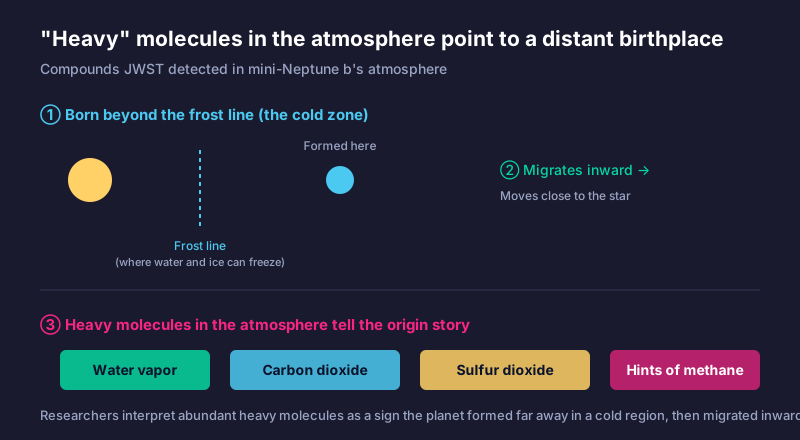
What caught researchers’ attention was just how much of these “heavy” molecules were present. The team argues this composition is hard to explain if the planet formed where it sits today.
The raw material available for building a planet depends heavily on temperature. Far enough from a star — beyond what’s called the frost line — water and carbon dioxide can exist as ice grains. Closer in, where things heat up, those same compounds can’t freeze at all. So a planet rich in heavy molecules likely formed somewhere cold and distant, not in the inferno it now calls home.
The team’s interpretation: this mini-Neptune formed far out in a cold, icy region, then slowly migrated inward toward the star. Its current scorched position was never its birthplace.
Two planets, migrating inward together
So how does this solve the mystery of the surviving inner planet?
The key lies in timing. If the hot Jupiter had moved inward first and the smaller planet arrived afterward, gravity would have scattered it long ago. But if both planets formed together in a calm, distant region and then migrated inward roughly side by side, the outcome changes entirely.
Picture two moving trucks driving the same route, keeping a steady distance apart. As long as nobody swerves into the other lane, both vehicles can arrive at their destination intact. Migrating in formation, rather than one chasing the other, let both planets settle into their current orbits without violently kicking each other out.
The atmospheric evidence JWST gathered — pointing to a distant birthplace — fits neatly with this picture of a calm, joint migration. The research team sees TOI-1130’s odd pairing as the result of exactly that kind of quiet, coordinated journey inward.
Try picturing this for a moment. If you could stand on the surface of that inner mini-Neptune, the sky would show a hot Jupiter looming just outside your orbit — vastly bigger than any full moon you’ve ever seen. The very planet that might once have flung you into oblivion is now your closest neighbor. From the survivor’s point of view, this must be an oddly precarious roommate situation.
What this mismatched pair teaches us
One last thing worth unpacking: why astronomers are paying so much attention to this particular system.
For years, “the area around a hot Jupiter is swept clean” served as a working rule of thumb in planet-formation research. TOI-1130 is a concrete counterexample, proof that the rule doesn’t always hold. The team published these findings in May 2026 in The Astrophysical Journal Letters.

And this study didn’t stop at just flagging a weird configuration. By reading the planet’s atmosphere with JWST, researchers got a handle on why the system looks the way it does. The strange orbital arrangement and the likely explanation behind it — a shared, distant birthplace — came together in a single system. Apply the same approach to other star systems, and atmospheric readings might let us reconstruct the journeys planets have taken across entire careers of migration.
And all of this is unfolding 190 light-years away — a distance so vast that light itself, moving without pause, takes 190 years to cross it. The light reaching our telescopes today left this star system while Darwin was still sailing aboard the Beagle.
Encoded in that ancient light is the record of two planets, born far from home, that traveled inward together, side by side. Right where textbooks insisted a giant planet must stand alone, a small companion has been quietly — but undeniably — holding on.