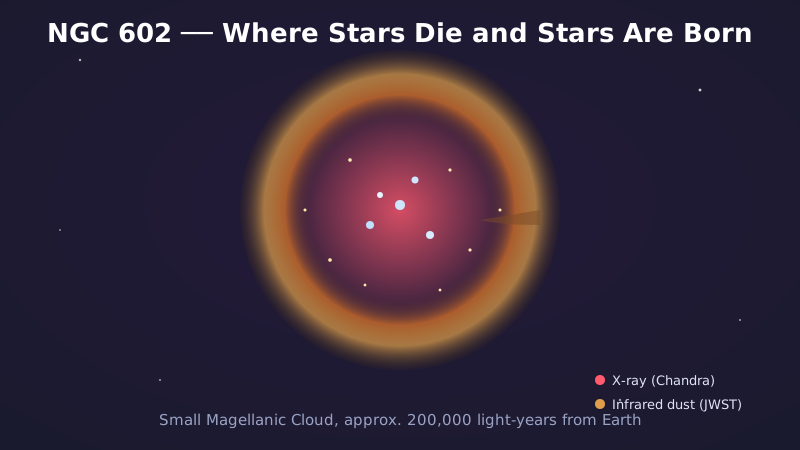
Red-tinged gas surrounds a ring of dust arranged in a near-perfect wreath. Inside that ring, massive stars burn furiously toward their own ends. Along the rim, other stars are just now coming to life.
Death and birth, caught in a single frame.
This is NGC 602, a star cluster nestled in the outskirts of the Small Magellanic Cloud — a small galaxy about 200,000 light-years from Earth. When NASA released the image, my first reaction was that it looked too beautiful, almost artificial. But every detail is real observation data. Let’s take a closer look at this stellar circle of life.
Two Telescopes, One Image
First, let’s unpack what you’re actually seeing in that wreath.
The NGC 602 image is a composite — data from two very different space telescopes layered on top of each other. One is the James Webb Space Telescope (JWST), a joint project of NASA, ESA, and CSA. Webb sees in infrared, a kind of light our eyes can’t detect, roughly analogous to heat signatures.
The other is NASA’s Chandra X-ray Observatory, which captures X-rays — the same high-energy radiation used in medical imaging, but coming from some of the hottest objects in the universe.
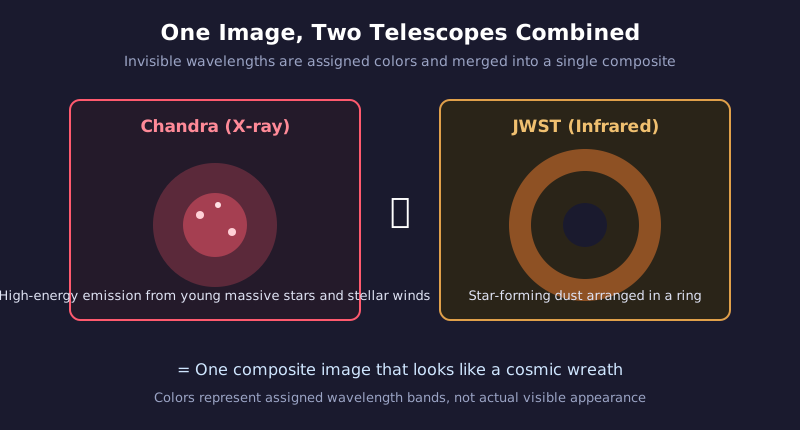
In the final image, the orange and yellow rings of dust come from JWST’s infrared view. The red glow comes from Chandra’s X-ray data. Neither color reflects what you’d see with your eyes — they’re color-coded labels for wavelengths of light that would otherwise be invisible.
Here’s the key thing to hold onto: the orange is the raw material of stars — dust and gas. The red is the X-ray glow of young, blazing stars already burning inside it. One image holds both the ingredients and the finished product. So where exactly are we looking?
A Companion Galaxy, 200,000 Light-Years Out
The Small Magellanic Cloud, home to NGC 602, is a satellite galaxy — a small galaxy orbiting our Milky Way, the way a moon orbits a planet. Its distance from Earth is roughly 200,000 light-years.
That number probably doesn’t land with much weight at first. It didn’t for me either.
Here’s a translation. The Milky Way stretches about 100,000 light-years from end to end. The 200,000 light-years to NGC 602 is more than twice that diameter — we’re not talking about a remote corner of our own galaxy. We’re talking about an entirely different galaxy.
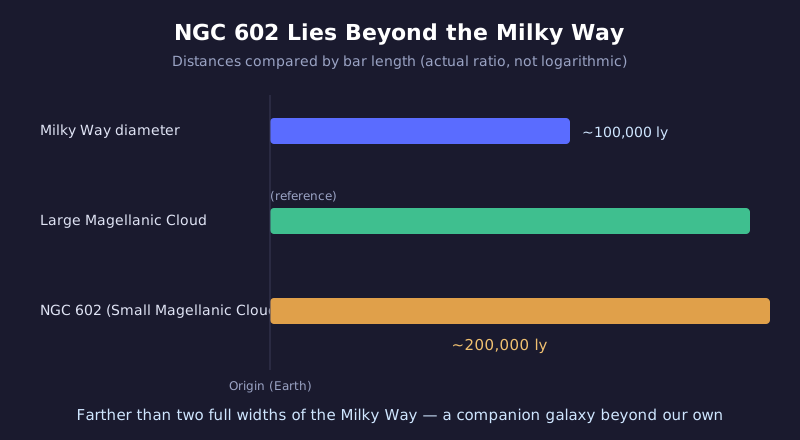
Light travels at 300,000 kilometers per second, and it still took 200,000 years to reach us. The light landing on our telescopes right now left NGC 602 before modern humans existed. It just arrived.
There’s a reason astronomers make the trip out there, so to speak.
Low on Heavy Elements — A Snapshot of the Young Universe
According to NASA, the Small Magellanic Cloud contains far fewer heavy elements than our own cosmic neighborhood. “Heavy elements” here means anything heavier than hydrogen and helium — carbon, oxygen, iron, the periodic table’s richer fare.
This matters more than it might seem.
In the early universe, stars were built almost entirely from hydrogen and helium. Carbon, oxygen, iron — none of that existed yet. Those elements are forged inside stars over their lifetimes, then scattered into space when those stars die. Every subsequent generation of stars inherits a slightly richer cocktail. The more heavy elements in a region, the more stellar generations have come and gone.
So “low in heavy elements” effectively means “chemically young” — closer to the state of the early universe than our own Sun’s neighborhood is. The Small Magellanic Cloud has retained some of that youthful chemistry, and it’s still actively making stars.
The early universe is hard to study directly. The further back in time you look, the dimmer and blurrier everything becomes. But a nearby region — well, 200,000 light-years nearby — with similar conditions lets you observe the same processes up close, in detail. It’s like having a well-preserved sample of the past sitting within reach.
So what exactly is the “circle of life” happening inside that sample?
How Dying Stars Light the Next Ones
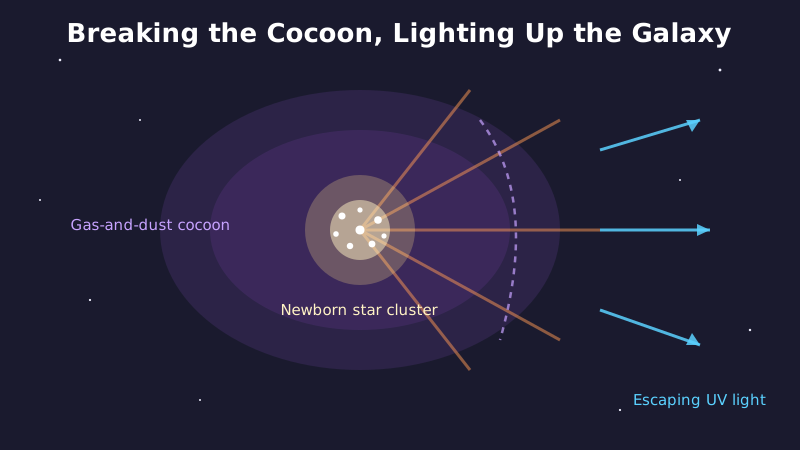
NASA explains that the young, massive stars near the center of NGC 602’s ring blast out intense stellar winds — streams of charged particles flowing outward — along with powerful X-ray radiation. That’s the red glow Chandra is picking up.
Massive stars live fast and die young.
During their brief, furious lives, they push the surrounding gas and dust outward with those winds and radiation. The displaced material piles up along the edges, compressed and dense. Dense enough, in fact, that it begins to collapse under its own gravity — and that collapsing gas is the seed of a new star.
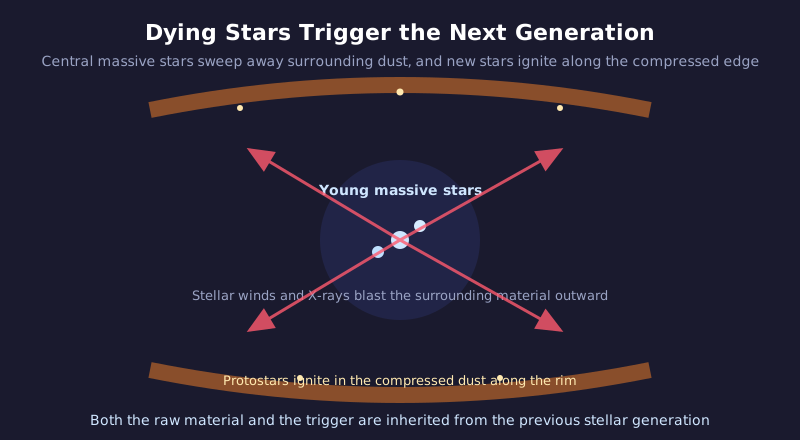
In other words, the older stars’ violence creates the conditions for the next generation. The coexistence of stars heading toward death and stars just being born isn’t a coincidence — it’s a mechanism.
And it gets more interesting. Chandra isn’t just detecting X-rays from the central massive stars. It’s also picking up a diffuse X-ray glow from thousands of lower-mass young stars scattered throughout the cluster. This isn’t a show put on by a few heavy hitters. The entire cluster — small stars included — is newborn.
The raw material, and the trigger for star formation, both come from the generation before. That’s the circle of life.
Why Death and Birth Appear “Simultaneous”
You might wonder: why do stars at such different stages happen to share the same image? Isn’t that a suspicious coincidence?
The answer is in the timescales.
Massive stars burn out fast by cosmic standards — but “fast” still means millions of years by human reckoning. And the process of a new star condensing from a gas cloud takes a long time too. Inside a single star cluster, it’s entirely natural for the oldest stars to be nearing their end at the same moment that the next generation is just getting started.
Think of a city: you’d expect to find elderly people and newborns living in the same neighborhood at the same time. Photograph it and you’ll catch both in the same frame. Star clusters work the same way — just on a much, much slower clock.
NASA’s announcement also highlighted NGC 2264 — the “Christmas Tree Cluster,” about 2,500 light-years from Earth — alongside NGC 602. At roughly 1 to 5 million years old, it’s another very young stellar collection. Comparing several young clusters lets researchers identify the common mechanics of star formation, teasing out what’s universal from what’s unique to each location.
The wreath shape of NGC 602 is not a lucky snapshot. It’s a frame captured at the moment when one stellar generation overlaps with the next.
This Cycle Lives in You Too
All of this may sound like it concerns a distant galaxy with no connection to your daily life. But the cycle doesn’t stop at 200,000 light-years away.
The calcium in your bones. The iron in your blood. The oxygen moving through your lungs with every breath. None of these heavier elements existed at the dawn of the universe. They were built inside stars and scattered into space when those stars died — hand-me-downs from long-dead suns.
Our own solar system formed from a cloud of material left behind by earlier stellar generations. What we’re watching happen in NGC 602 right now is an earlier chapter of the same story that eventually produced us. Honestly, when I used to look at images like this as pretty pictures of a distant universe, that connection was completely invisible to me.
If you could stand on the rim of that wreath, the sky above you would look utterly alien. The chemical environment of an early universe. Dense clusters of blue-white young stars. And just beyond a curtain of dust, the seeds of the next generation beginning, one by one, to ignite.
Light that left NGC 602 200,000 years ago is reaching Earth’s telescopes right now. And creatures with calcium in their bones are looking at it and calling it a wreath.