Picture a metal tube full of Martian rock, streaking toward Earth. You’d assume it lands, gets carried into a lab, and gets opened. Simple enough. But a growing chorus of scientists is saying: not so fast — stop at the Moon first.
In June 2026, a proposal appeared in a scientific journal arguing that samples returned from Mars, and even the Moon itself, shouldn’t go straight to Earth. Instead, they’d first pass through a quarantine facility on the lunar surface. In other words: build a front porch for rocks from space.
It sounds like overkill. Honestly, my first reaction was the same — really, all that for some rocks? But once you look at the history behind it, the idea isn’t nearly as strange as it seems.
Why quarantine a rock in the first place?
Say “quarantine” and most people think of airports — that moment when customs confiscates the fruit or meat you tried to bring home. It’s a barrier against pathogens and pests you can’t see, built to keep them out of a new environment.
The worry with space samples follows the same logic. What if material from another world carries some microbe, and that microbe turns out to be bad news for life on Earth? Researchers call this “back-contamination” — contamination flowing inward, from space to Earth.
Is that actually plausible? Most researchers would tell you the odds are vanishingly small. But small isn’t zero. And this is material from another world entirely — something humanity has literally never held in its hands before.
That’s why spaceflight has long operated under a framework called planetary protection. The 1967 Outer Space Treaty itself calls on nations to avoid harmful contamination of celestial bodies and of Earth. “Be careful what you bring home” isn’t some fringe worry — it’s written into international law.
So how has humanity actually handled this so far?
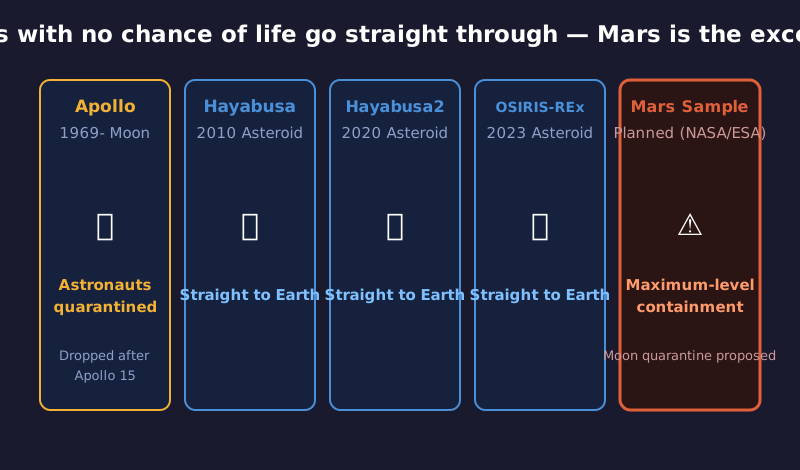
Apollo locked its astronauts up after they came home
Here’s something that surprises people: astronauts returning from the Moon didn’t just walk off the spacecraft and go home.
After the Apollo 11 crew splashed down in 1969, they weren’t reunited with their families right away. Because scientists couldn’t fully rule out unknown lunar microbes, the astronauts spent weeks in a dedicated quarantine facility. The Moon rocks they brought back got the same treatment, handled in sealed environments that kept them from touching open air.
I’ll admit — when I first heard about sample-return missions, quarantining the samples themselves never crossed my mind, let alone quarantining the astronauts. Learning that NASA locked up actual people says a lot about how seriously they took the risk back then.
As it turned out, no trace of life ever showed up in the lunar samples. By the time Apollo 15 flew, the quarantine protocol had been dropped entirely. “The Moon is sterile” became a conclusion built from actual evidence, not assumption.
That precedent raises an obvious question: how has the more recent wave of asteroid sample-return missions been handled?
Hayabusa and Bennu came straight home
In the past two decades, missions bringing back fragments of small bodies have become almost routine.
Japan’s Hayabusa delivered tiny grains from the asteroid Itokawa to Earth in 2010. Its successor, Hayabusa2, dropped a capsule containing samples from asteroid Ryugu into the Australian outback in December 2020. NASA’s OSIRIS-REx followed suit in 2023, landing samples from asteroid Bennu in the Utah desert.
None of these missions made a stop at the Moon. The capsules were sealed with care, but nothing close to Apollo’s astronaut quarantine was ever considered.
Why the difference in caution? The reasoning is simple: asteroids are essentially written off as places life could exist. They’re dry, barren, and lack the raw materials living things need to develop. So the back-contamination risk gets classified as low.
Here’s where it’s worth pausing. Whether the source was the Moon or an asteroid, a direct trip to Earth was considered fine either way. Mars, though, changes the calculation entirely.
Why Mars samples get treated differently
Mars is the exception because scientists take seriously the possibility that it once hosted life.
NASA and ESA (the European Space Agency) have spent years developing a large-scale plan to bring Martian material back to Earth. The rover Perseverance has already been drilling and sealing rock and soil samples inside Jezero Crater — a site believed to have held a lake billions of years ago.
Rock from a place that once had water, and maybe even the first stirrings of life. If there’s any trace of unfamiliar microbial life buried in that material, that single possibility is enough to put Mars in a category of its own. As a result, the plan calls for examining Martian samples inside the highest tier of biocontainment facility — the kind normally reserved for pathogens like Ebola.
To be clear: nobody has found evidence that living microbes exist on Mars today. This is a “we can’t rule it out, so we prepare for the worst case” stance, not a confirmed finding. It’s worth keeping the observed facts and the precautionary planning in separate mental boxes.
The real question is where that maximum precaution should happen. Until now, the working assumption was to build an extremely secure facility somewhere on Earth. This new proposal interrupts that assumption with a simple counter-argument: why not do it off Earth entirely?
The Moon as a front porch
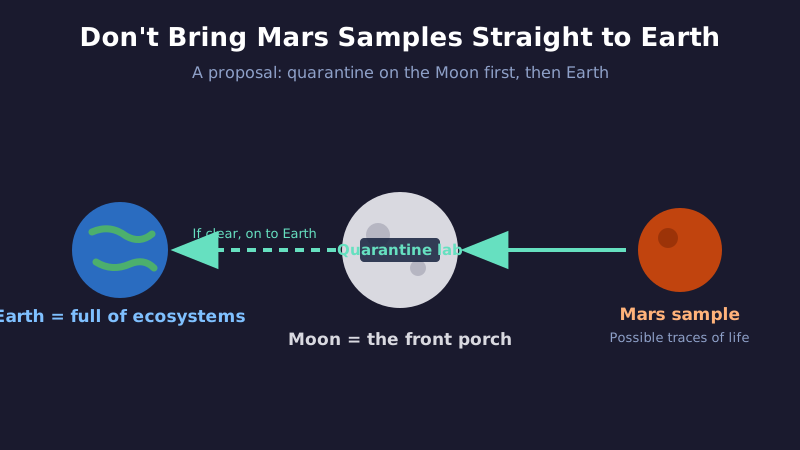
The core of the proposal is straightforward. Before Mars samples enter Earth’s environment, quarantine them in a lab on the lunar surface first. Only after they’re cleared does the material make the trip to Earth.
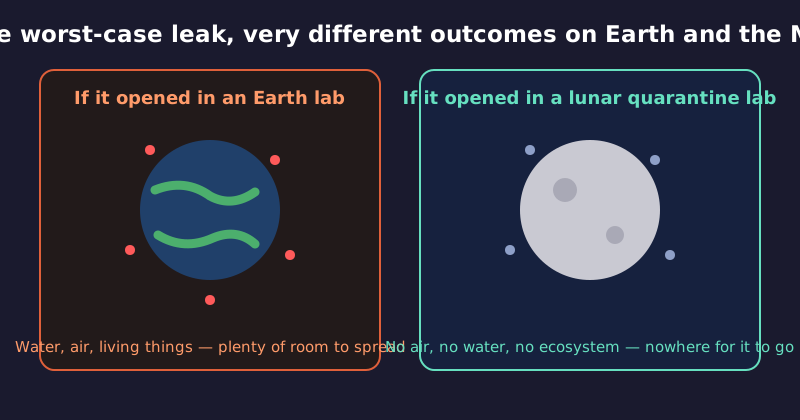
What makes the Moon useful here is what it lacks: an entire biosphere. No atmosphere, no water, no living systems for anything to spread into. Even if something did leak out of a sample, it wouldn’t be like spilling water on a desert — it would be more like spilling something onto bare, airless rock. There’s nothing there for it to take hold of.
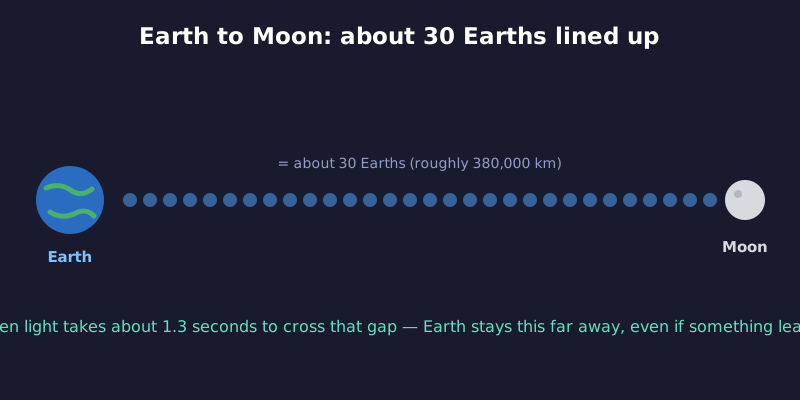
And then there’s distance. The Moon sits roughly 380,000 kilometers from Earth — about 30 Earth diameters stacked end to end. Even light takes about 1.3 seconds to cross that gap. That’s an entirely different order of separation than a single wall inside a terrestrial lab.
Try picturing it: you’re standing in a lunar quarantine lab, holding a reddish Mars rock through sealed gloves. Out the window, Earth hangs like a blue marble about the size of your fist. Even in the worst-case scenario — if this rock turns out to be carrying something — that blue sphere is still 380,000 kilometers away. Somehow, that distance might let your shoulders relax a little more than doing the same work back on Earth ever could.
Personally, I think there’s something almost elegant about this “wipe your feet at the door before coming inside the house” logic. But elegant ideas usually come with a catch.
Still, nothing about this is simple
For starters, the cost and logistics are staggering.
Building one containment facility on Earth is one thing. Building and running a functioning lab on the Moon is an entirely different order of magnitude. Samples would need to travel twice — Mars to Moon, then Moon to Earth — adding complexity at every stage. More handoffs mean more opportunities for something to go wrong along the way.
Nobody has even settled whether this lunar lab would run unmanned or need a permanent crew. Remote operation from Earth means dealing with a roughly 1.3-second one-way communication delay, which makes fine motor work through robotic gloveboxes genuinely difficult. Staffing it with astronauts solves that problem but adds the enormous burden of supporting human life and safety on the Moon around the clock. And every time a container gets moved between locations, keeping the seal intact becomes a bigger challenge than it would be in a single Earth-based facility.
There’s a scientific tension here too. These samples are irreplaceable records of extraterrestrial chemistry. If handling them on the Moon introduces contamination from Earth-origin material, or if the lunar environment alters them in some way, the very data scientists are trying to protect could get corrupted. Preventing biological risk and preserving scientific integrity are two goals that don’t always pull in the same direction.
And there’s a more fundamental question lurking underneath all of this: is any of it actually necessary? Plenty of researchers argue a sufficiently secure Earth-based facility would do the job just fine. This proposal isn’t presented as the only answer — it’s one serious option now sitting on the table alongside the rest.
What’s interesting is how proposals like this emerge from taking worst-case scenarios seriously, even when the actual risk is close to nil. Spaceflight has always built its safety culture around preparing for the unlikely disaster, and now that instinct might be finding a new use for the Moon itself.
The next time a tube of Martian rock heads toward Earth, will it come straight home — or will it make a stopover on a gray rock 380,000 kilometers away first? That question is still wide open.