Twenty-five light-years away, astronomers found a star system that looks a lot like ours. The planet receives about 90% of the light Earth gets from the Sun — smack in the middle of the habitable zone, the distance band where liquid water can exist.
And yet the first question the discovery team at UC Irvine asked wasn’t “could there be life here.” It was: “is there even any air left?”
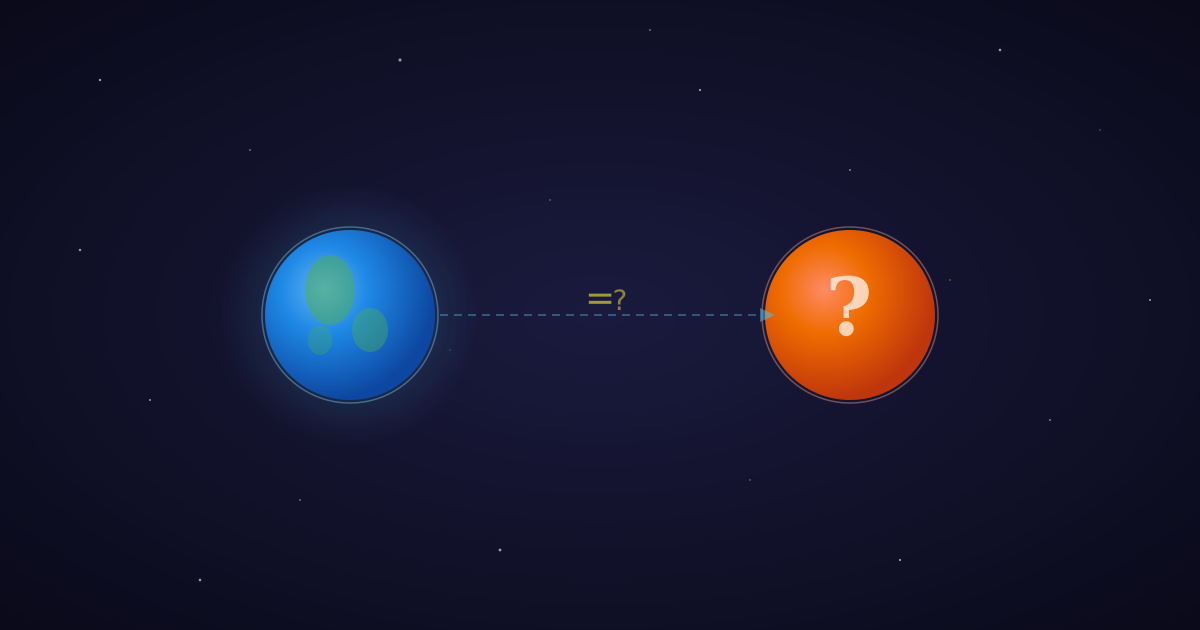
Right in the habitable zone, but nobody knows if it has air
The planet is called GJ 3378 b. Announced on June 30, 2026, with the discovery paper published in The Astrophysical Journal, it’s roughly twice Earth’s size and at least twice Earth’s mass — a “super-Earth.”
Its host star is a small, dim, red M dwarf — cooler and fainter than the Sun. GJ 3378 b orbits at just the right distance for liquid water to survive there. On paper, it looks like a strong candidate in the search for life.
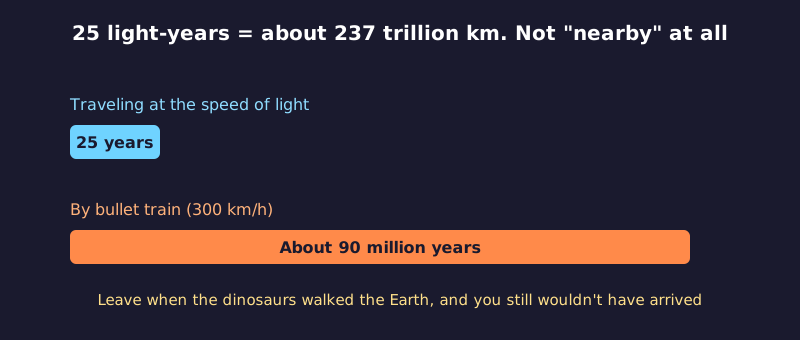
Twenty-five light-years might sound like it’s practically next door, but that distance is staggering. Even at the speed of light, it takes 25 years to get there. Swap to a bullet train and you’re looking at roughly 90 million years — leave when dinosaurs still roamed the Earth, and you still wouldn’t have arrived.
Normally, that would be the whole story: “another Earth-like planet found.” But this research team’s real interest lay elsewhere. What caught their attention was that GJ 3378 b sits right on the edge — the line between keeping its atmosphere and losing it.
”The right distance” is only half the test
This is a good moment to question the habitable zone, the yardstick astronomers have leaned on for decades. In short, it’s the distance band that’s not too close to a star and not too far — where water neither freezes nor boils away. It’s a single ruler, measuring one thing: distance.
The trouble is, that ruler alone can’t predict a planet’s fate. We don’t have to look far to see why — the proof is right next door.
Both Venus and Mars sit near the edges of our solar system’s habitable zone. Yet Venus ended up smothered in a crushingly thick atmosphere, baking under a runaway greenhouse effect. Mars went the opposite way, losing nearly all its air — what’s left today is less than 1% as thick as Earth’s atmosphere. Researchers suspect Mars may once have had an atmosphere much like our own.
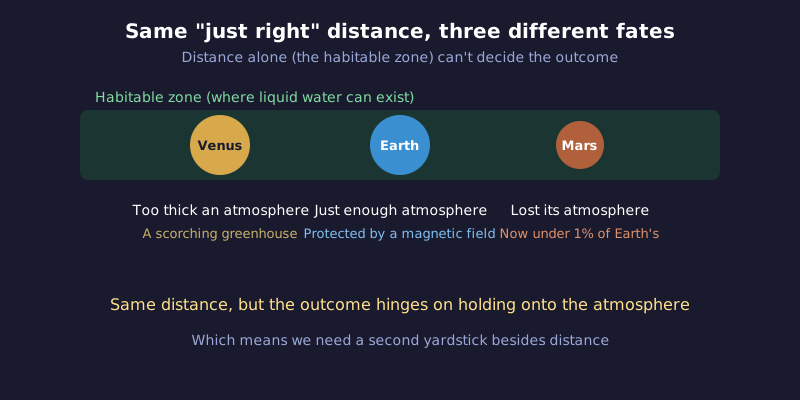
Three planets, all at roughly the “right” distance, ended up looking nothing alike. Passing the distance test turned out to be no guarantee of holding onto an atmosphere — that’s a separate exam entirely.
In other words, distance only gets you halfway to a pass. To measure the other half, astronomers reached for a new tool.
The cosmic shoreline: a tug-of-war between stripping and shielding
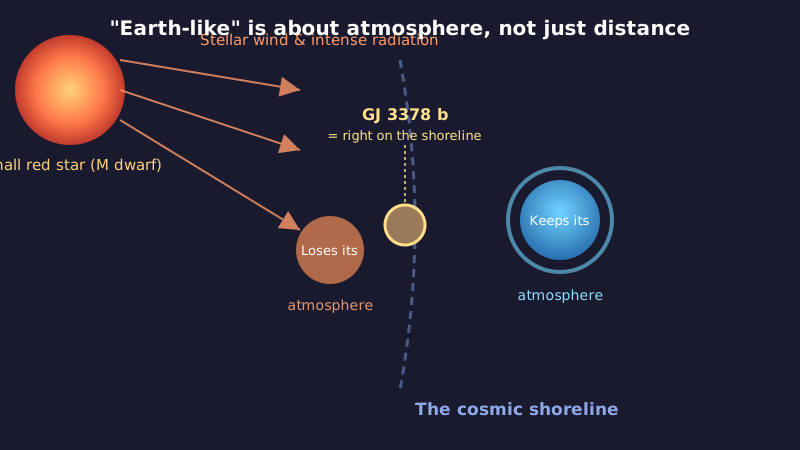
That tool is called the cosmic shoreline. The first time I heard the term, I thought: that’s a clever way to put it. It’s the line — like a beach at the water’s edge — that separates planets that keep their atmospheric “ocean” from those left high and dry.
An atmosphere’s fate comes down to a tug-of-war between two forces. On one side: the intense radiation and stellar wind (a stream of fast-moving charged particles) pouring off the host star, working to strip the atmosphere away into space. On the other: the planet’s own gravity and magnetic field, holding the air in place and deflecting the incoming particle wind.
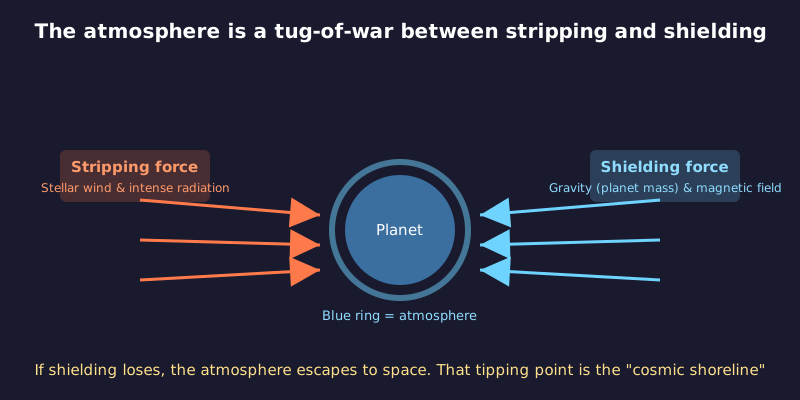
When the shielding wins, the atmosphere survives. When the stripping wins, it slowly leaks away into space. The line where the balance tips is the “shoreline.” Closer to the star than that line, atmospheres get swept away like sand at high tide.
Planetary mass matters a lot in this tug-of-war. Heavier planets have stronger gravity, which holds atmospheric molecules down more firmly. Lighter planets lose that grip — even a little extra heat is enough to let molecules drift off into space. One reason Mars couldn’t hold onto its atmosphere is thought to be its smaller size and weaker gravity compared to Earth’s. So at the same distance from a star, a heavier planet has a better shot at staying on the safe side of the shoreline.
Here’s an everyday way to picture it: sunscreen. We can walk around under intense ultraviolet light without getting fried because Earth’s atmosphere and magnetic field act like a thick layer of sunscreen. Strip that sunscreen away, and the ground beneath is left exposed. Being on the near side of the shoreline is exactly that — the sunscreen peeled off.
GJ 3378 b is standing right on that shoreline
Now for the heart of the matter — and honestly, my favorite part. According to the research team, GJ 3378 b sits right on the edge of this cosmic shoreline. Not clearly on the side that keeps its air, not clearly on the side that loses it. It’s standing right at the water’s edge.
This next bit gets a little technical, but skip it and the rest won’t quite land. M dwarfs like GJ 3378 b’s host star are small and dim compared to the Sun, but they’re also known for throwing off powerful flares and radiation, especially when young. And the closer a planet orbits, the more of that radiation it takes head-on.
So while being at “just the right distance” is good news for GJ 3378 b, it also means sitting uncomfortably close to a star that’s actively stripping atmospheres away. The discovery paper leaves open whether the planet has an atmosphere at all, and if so, how much of it remains. The research team itself calls this the planet’s single biggest mystery.
If you could somehow stand on the surface of GJ 3378 b, you’d see a red sun in the sky, delivering about 90% as much light as ours does here on Earth. But whether there’s any air above your head to breathe — nobody can say yet.
So how do you find out if there’s air?
Settling which side of the shoreline a planet falls on ultimately requires checking whether it actually has an atmosphere. But confirming the air around a small planet 25 light-years away is still beyond what current instruments can do.
GJ 3378 b was discovered using two instruments: the Habitable-zone Planet Finder on the Hobby-Eberly Telescope at McDonald Observatory in Texas, and the NEID spectrograph on the WIYN Telescope at Kitt Peak Observatory in Arizona. Both work by detecting the tiny wobble a planet’s gravity induces in its host star — a technique that confirms a planet exists and reveals its mass, but tells us nothing about what’s in its atmosphere, if anything.
Probing the atmosphere itself will fall to the next generation of telescopes. The one the research team points to is NASA’s Habitable Worlds Observatory, currently planned for launch sometime in the 2040s. That telescope is expected to be capable of directly imaging planets like GJ 3378 b and determining whether they have atmospheres at all. If one turns up, the search could then move on to looking for signs of life.
Until then, we’re stuck estimating which side of the shoreline a planet falls on based on how active its star is and how much the planet weighs. Still, having a target just 25 light-years away is a real advantage — many candidate planets are too distant to even attempt direct imaging. GJ 3378 b is well positioned to be one of the first worlds the next generation of telescopes turns its attention to.
The real answer is still more than a decade off. But knowing exactly where to look to settle the question is progress in its own right.
The old yardstick just got quietly rewritten
For a long time, hearing “Earth-like planet” made us picture distance first: the right spot from a star means water, and water means the possibility of life. That was the whole sequence.
What GJ 3378 b makes clear is that the sequence was missing a step. Being at the right distance means nothing if a planet can’t hold onto its atmosphere — no atmosphere, no water, no life. Alongside the single ruler of distance, we now have a second one: can this world keep its air. From here on, the shortlist of candidates for life will likely be sorted by which side of the shoreline they fall on.
Next time you’re outside at night, think about the ultraviolet radiation constantly bathing our planet. The only reason we get away with a sunburn instead of something far worse is that the air and magnetic field over our heads are still intact today. Twenty-five light-years away, on a shoreline we can barely make out, that same ordinary, everyday air is hanging in the balance — there or not, nobody yet knows.