The nearest star system is four light-years away. On an astronomical scale, 28 light-years is practically the backyard.
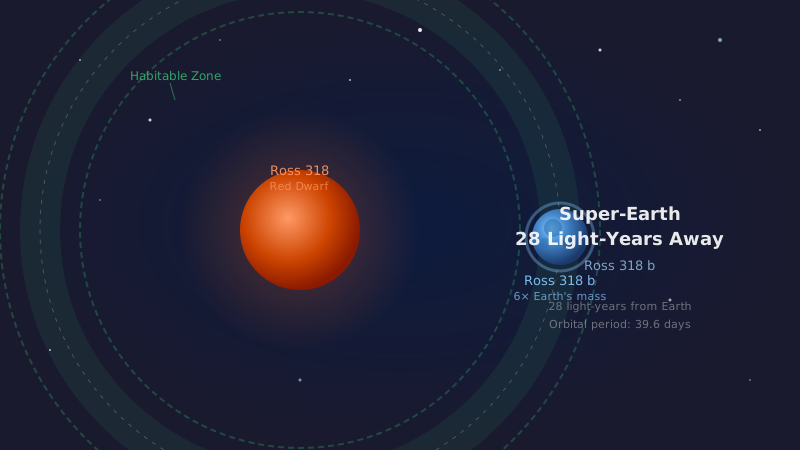
In May 2026, a planet turned up right there — one that meets the conditions for liquid water on its surface. It’s called Ross 318 b, a super-Earth with more than six times Earth’s mass. The name is understated, but the discovery is anything but: in the long history of exoplanet hunting, this one stands out.
Is 28 Light-Years “Close” or “Far”?
Honestly, by human standards, 28 light-years is incomprehensibly distant. Light itself takes 28 years to make the trip, and no spacecraft we have could do it in less than tens of thousands of years.
But in exoplanet research, 28 light-years counts as “nearby.” The Milky Way spans roughly 100,000 light-years; our best observational tools reach out a few hundred light-years at most. Within that limited sphere, 28 light-years is exceptionally close to home.
Ross 318 itself is a red dwarf — an M-type star, spectral class M3.5V — in the direction of the constellation Lepus. Its surface temperature sits around 3,000–3,500°C, far cooler than the Sun’s roughly 5,500°C, and it shines at only about 1.5% of the Sun’s luminosity.
That dimness, though, turns out to be an asset for planet hunters. Most detection methods work by measuring changes in starlight, and a smaller, fainter star makes a planet’s gravitational tug or transit shadow proportionally more detectable.
What Is a Super-Earth?
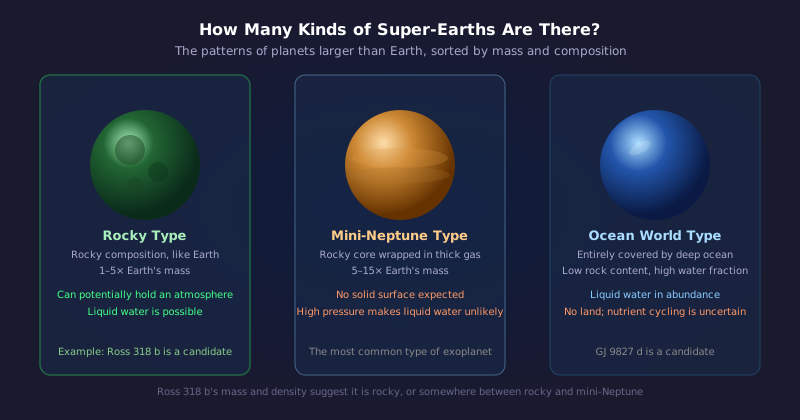
Ross 318 b belongs to a category called super-Earths — exoplanets with roughly 1 to 10 times Earth’s mass.
Don’t let the name mislead you. “Super-Earth” doesn’t necessarily mean “Earth, but bigger” or “a planet like ours.” The category covers three quite different types. Rocky super-Earths are built from stone and metal, much like our own world. Mini-Neptunes have a rocky core buried under a thick gas envelope. Ocean worlds are blanketed entirely in deep global seas, with very little rock at all. Which type a planet ends up being depends on its mass, density, and where in its planetary system it formed.
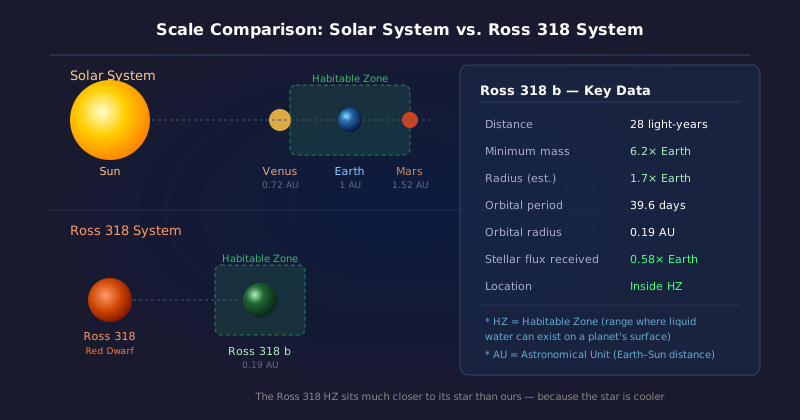
Ross 318 b has a minimum mass of about 6.2 times Earth’s and an estimated radius around 1.7 times Earth’s. That mass-radius combination led the research team to flag it as a strong candidate for a planet with a thick atmosphere — larger mass means stronger gravity, which means a better grip on whatever gases surround it.
One odd footnote: our own solar system has no super-Earths at all. There’s a large gap between Earth (roughly 1 Earth mass) and Uranus and Neptune (14–17 Earth masses), and nothing in between. Super-Earths are among the most common planet types in the galaxy, so why the Sun’s family skipped them entirely remains one of astronomy’s open puzzles.
The Habitable Zone: Where Liquid Water Can Exist
The most attention-grabbing part of this discovery is where Ross 318 b sits: inside the habitable zone.
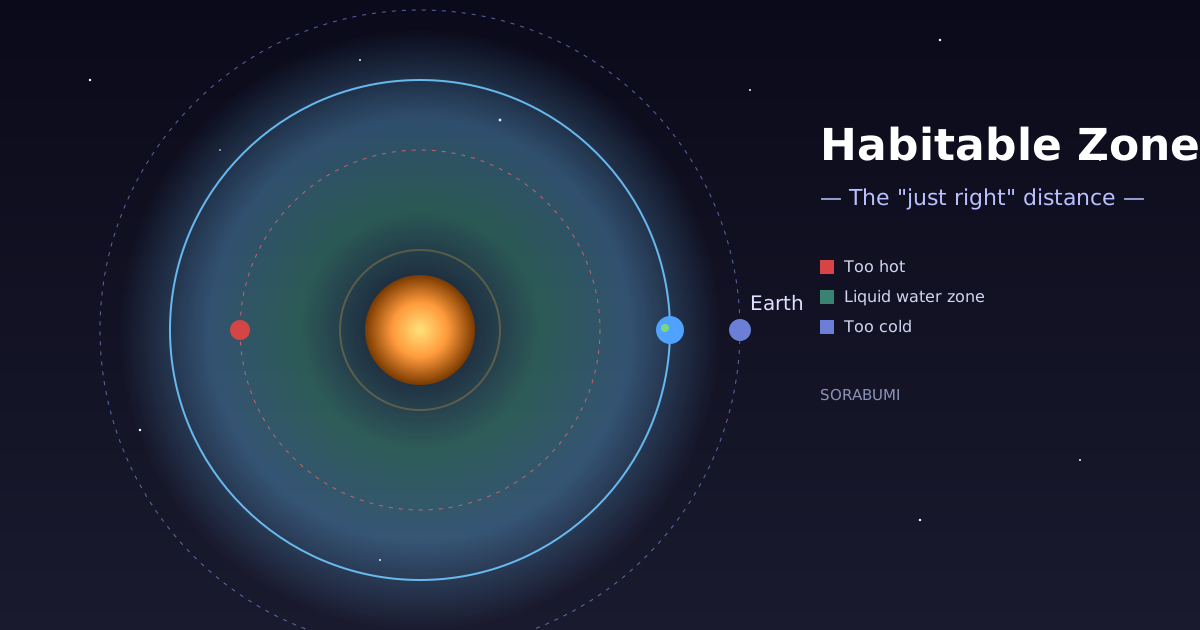
The habitable zone is the range of distances from a star where surface temperatures allow liquid water — not boiling, not frozen, but somewhere in between. Too close, and water evaporates; too far, and it freezes. The habitable zone is the “just right” band in between.
Here’s the twist: the habitable zone shifts dramatically depending on what kind of star you’re orbiting. Around a bright star like the Sun, it extends far out. Around a dim red dwarf, it huddles in much closer.
Ross 318 b orbits its star at just 0.19 astronomical units (AU), completing a full orbit every 39.6 days. That’s even closer to Ross 318 than Mercury is to our Sun (0.39 AU). But because Ross 318 is so faint, the planet actually receives only about 0.58 times the stellar energy Earth gets from the Sun — which lands it squarely in the habitable zone.
Close orbit, yet the right temperature. It sounds paradoxical, but the star’s dimness makes it work.
Can Anything Live Around a Red Dwarf? Challenges and Reasons for Hope
Being in the habitable zone is one thing. Whether life could actually survive there is a much harder question — and among researchers, both optimism and skepticism run deep.
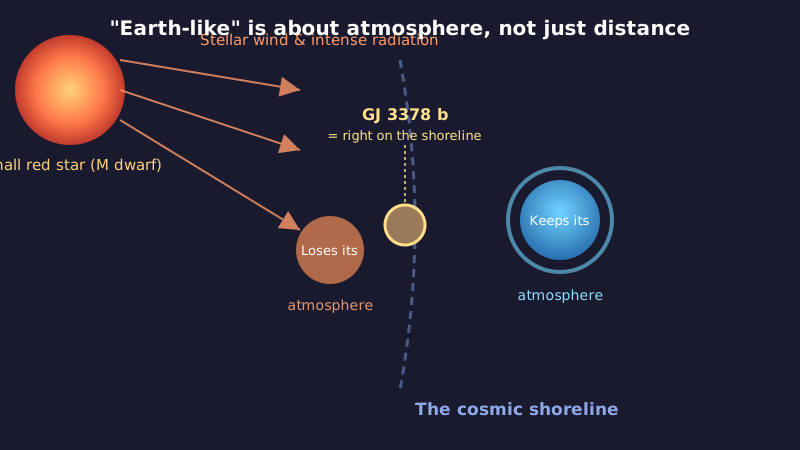
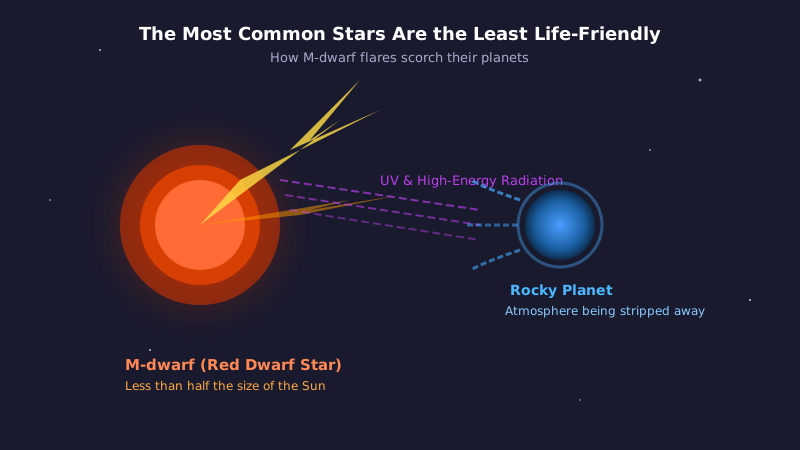
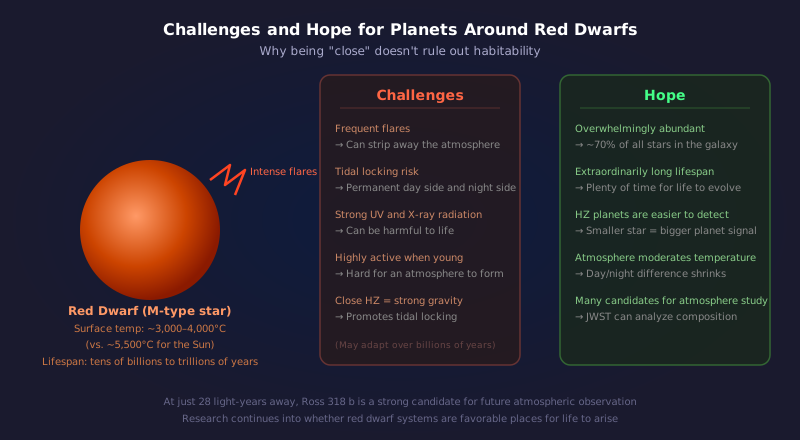
On the pessimistic side is the “flare problem.” Young red dwarfs erupt frequently, releasing blasts of energy that can gradually erode a planet’s atmosphere. The cosmic radiation from magnetic storms adds another layer of hostility for both atmospheres and any organisms trying to live beneath them.
There’s also tidal locking to worry about. A planet orbiting so close to its star tends to end up with one face permanently turned toward it, the way the Moon always shows the same side to Earth. The result is a permanent dayside and a permanent nightside — a temperature split that could disrupt atmospheric circulation and make large regions of the planet uninhabitable.
But there are reasons to be hopeful, too. Computer simulations show that even a tidally locked planet with an atmosphere can redistribute heat efficiently enough to moderate those extreme temperature contrasts. And red dwarfs are by far the most common stars in the galaxy — roughly 70–75% of all stars in the Milky Way are red dwarfs — with lifespans stretching from tens of billions to trillions of years. There’s no shortage of time for life to evolve.
For Ross 318 specifically, the planet’s existence was confirmed using 15 years of observational data, and the star itself appears to be in a relatively quiet phase of magnetic activity. That’s a point in the optimists’ column.
Why Discoveries Like This Are Coming So Fast
Ross 318 b was identified using data from three instruments: the CARMENES spectrograph in Spain and Chile, the HIRES spectrograph in Hawaii, and NASA’s TESS space telescope. Fifteen years of observations, combined and cross-checked, made the case.
That much effort is necessary because we can’t see the planet directly. Super-Earths are far too dim compared to their stars for current telescopes to image. Instead, astronomers rely on the radial velocity method — detecting the tiny gravitational tug a planet exerts on its star by measuring the resulting Doppler shift in the star’s spectrum. Even with six Earth masses, Ross 318 b only nudges its star by a few meters per second. The research team spent 15 years confirming that the signal was consistent and real before pinning down the orbit.
The recent surge in super-Earth discoveries around red dwarfs reflects two things coming together: steadily improving spectrograph precision and the accumulation of long-term observation archives. TESS’s all-sky survey keeps adding to the pile of planet candidates. And the James Webb Space Telescope (JWST), operational since 2022, can directly analyze the atmospheric composition of nearby exoplanets. At 28 light-years, Ross 318 b falls within JWST’s reach — putting it on the shortlist of targets for future atmospheric characterization.
”Potentially Habitable” Is Not the Same as “Habitable”
One thing deserves to be said plainly before closing.
Ross 318 b has not been confirmed as a world where life could live. What we know right now is that the planet is inside the habitable zone, that its mass and estimated radius are consistent with having an atmosphere, and that it’s close enough to study in detail. That’s it.
Whether an atmosphere actually exists, what it’s made of, whether liquid water is present, whether any signs of biology are detectable — all of that is still ahead of us, waiting on future observations.
But “potentially” is itself meaningful in modern planetary science. While distant planetary systems thousands of light-years away get a lot of the headlines, a world meeting the basic requirements sits practically next door, just 28 light-years out.
That’s a small but real piece of evidence that the universe may be a more hospitable place than we once imagined.
The paper describing Ross 318 b: Detection and Characterization of the Temperate Super-Earth Ross 318 b (arXiv:2605.11123, May 2026)