The nearest star to our Sun is Alpha Centauri, about 4.2 light-years away. By cosmic standards that’s practically next door — and yet light still takes more than four years to make the trip.
In other words, the Sun’s neighborhood is, by any reasonable measure, spectacularly empty.
But the universe has places where that emptiness is shattered almost beyond imagination. The globular cluster NGC 6441, photographed by the Hubble Space Telescope, is one of the most extreme examples. The best way to picture it: a cosmic apartment block where 1.6 million suns are squeezed into the same building.
1.6 Million Suns, One Address
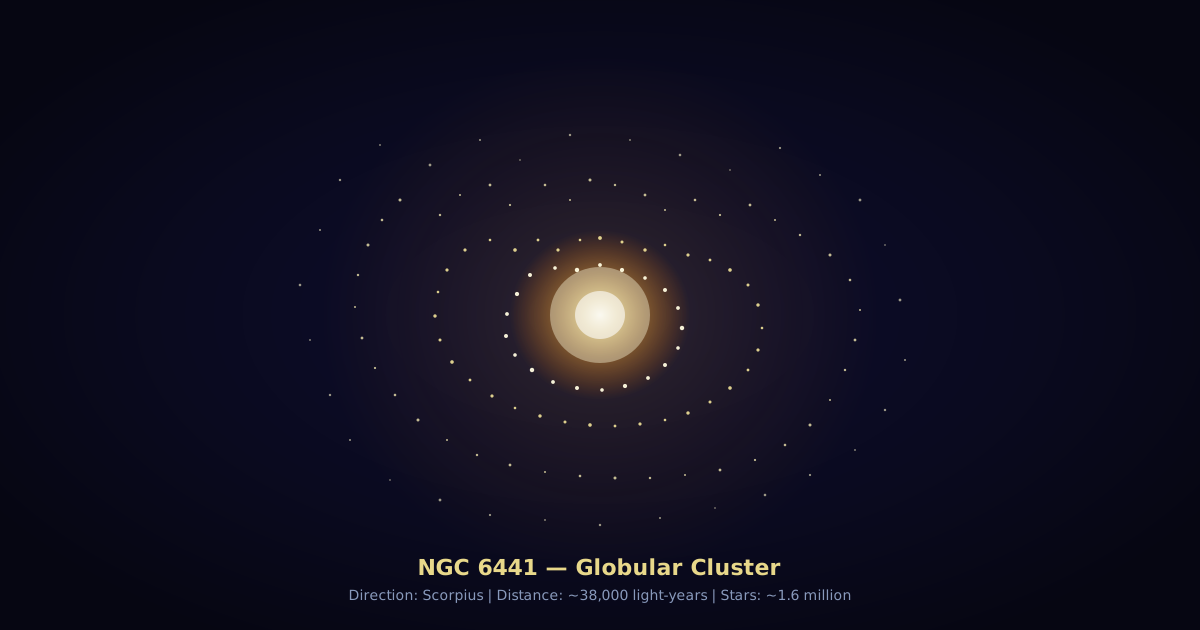
NGC 6441 sits in the direction of Scorpius, about 38,000 light-years from Earth — deep inside the Milky Way, orbiting close to the central bulge.
The cluster holds an estimated 1.6 million stars. That number alone is hard to grasp, but the real jaw-dropper is how small a space they all fit into.
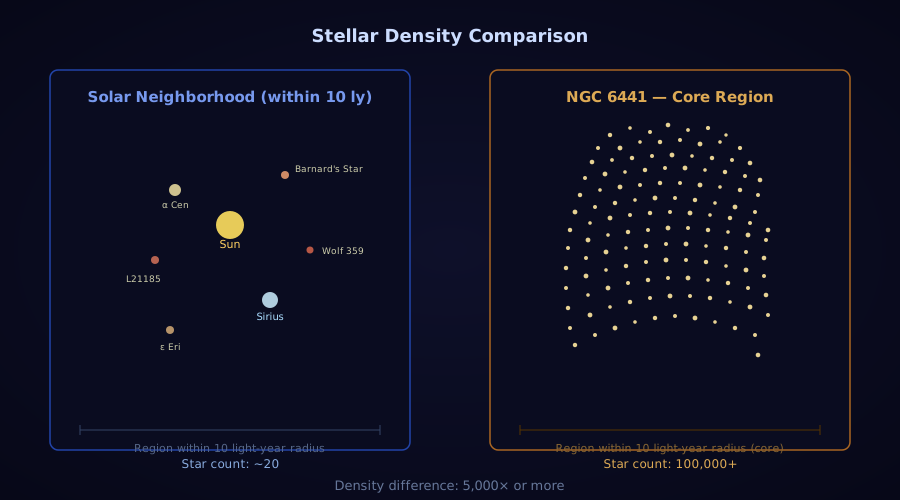
NGC 6441 spans roughly 180 light-years across. Compare that to our solar neighborhood: within 10 light-years of the Sun, there are only about 20 stars. Do the math near NGC 6441’s core, and you get a stellar density more than 5,000 times that of our local corner of the galaxy.
I’ll be honest — when I first saw that figure, I had to sit with it for a moment. 5,000 times isn’t a rhetorical flourish. It literally means that many more stars packed into the same volume of space.
What Is a Globular Cluster, Exactly?
A globular cluster is a gravitationally bound group of stars — anywhere from tens of thousands to several million of them — arranged in a roughly spherical shape. The Milky Way alone hosts more than 150 confirmed globular clusters.
What makes them genuinely strange is how old they are. The stars inside globular clusters tend to be ancient. NGC 6441 is estimated to be about 13 billion years old — in a universe that is itself only 13.8 billion years old. This cluster was already forming when the cosmos was just a few hundred million years into its existence.
The current leading theory holds that in the early universe, enormous gas clouds collapsed rapidly, giving birth to hundreds of thousands — or even millions — of stars nearly simultaneously. Those stars have remained gravitationally bound ever since, orbiting the galaxy’s outer halo for over 13 billion years.
In that sense, globular clusters are the fossils of the early universe. The conditions of the first star-forming epoch are preserved in them, still intact.
When Stars Get This Close, They Collide
Back to that density. What actually happens when stars are packed 5,000 times more tightly than usual?
Under ordinary conditions, stars almost never physically collide. The distances between them are measured in light-years — and even when gravity pulls two stars toward each other, they typically just swing past and move on. Think of throwing a marble into the space between the Sun and Alpha Centauri: it would almost certainly sail through without hitting anything.
In a dense globular cluster like NGC 6441, though, stellar collisions and close encounters become a normal part of life — at least on astronomical timescales. And those interactions produce some genuinely weird objects.
The most famous example is the blue straggler. Old stellar clusters should only contain aging, reddish stars — so why do some clusters have a scattering of young, hot, blue ones? For decades it was a mystery. The current explanation: when two stars collide or merge, the combined object gains fresh hydrogen fuel and effectively “de-ages.” The blue stragglers in NGC 6441 are, essentially, stars that cheated time.
Globular clusters are also known for containing an unusual number of pulsars — rapidly rotating neutron stars. At least four have been confirmed in NGC 6441. Again, the high-density environment and its history of stellar mergers is likely the reason they’re there.
There’s one more oddity worth noting: NGC 6441 contains planetary nebulae — glowing shells of gas shed by dying stars. Finding them inside a globular cluster is relatively rare, and their presence is another marker of just how unusual this cluster’s environment is.

The Significance of Its Location Near the Bulge
Astronomers are also interested in NGC 6441 because of where it orbits. Most globular clusters cruise through the galaxy’s remote outer halo. NGC 6441, by contrast, traces an orbit that brings it close to the galactic bulge — the dense, central knot of the Milky Way. That means it spends time in a region of much stronger gravitational influence.
That proximity may also explain why NGC 6441 is unusually metal-rich by globular cluster standards. In astronomy, “metals” means any element heavier than hydrogen and helium. The bulge region sees rapid stellar generations cycling through — stars live, die in supernova explosions, and scatter heavy elements into surrounding space. Later-generation stars forming in that environment absorb those elements, ending up more metal-rich than stars born in quieter corners of the galaxy.
A cluster’s metal content is essentially its résumé — a record of where, when, and under what conditions it was born. NGC 6441 is an unusual entry in that record, which makes it a valuable data point for understanding how globular clusters form in the first place.
What Hubble Sees: “Cosmic Snowflakes”
In May 2025, NASA released a new Hubble image of NGC 6441 under the headline “Hubble Catches Cosmic Snowflakes.” Looking at the image, you can see why: the density rises smoothly toward the center and fades toward the edges, giving the whole thing a crystalline, almost perfectly symmetrical appearance.
Of course, it only looks tranquil from 38,000 light-years away. If you could somehow drop into the cluster’s core, the view would be nothing like standing under Earth’s night sky. Stars would blaze in every direction at once. You might not experience darkness at all — just an unbroken wash of starlight from every angle.
That image is a little vertiginous to sit with. A place where “night” may not exist. Thirteen billion years old. Held together by gravity. Still orbiting the Milky Way tonight, somewhere in the direction of Scorpius. The sheer timescale of it — that’s where the strangeness really hits.
What Globular Clusters Teach Us
One last thing, on the scientific side: globular clusters punch well above their weight in modern astronomy.
First, they give us a lower bound on the age of the universe. Measure the age of the oldest stars in a globular cluster, and the universe must be at least that old. The older a cluster’s stars, the tighter the constraint. NGC 6441’s estimated age of 13 billion years feeds directly into our best estimates for the age of the universe itself (13.8 billion years).
Second, they serve as natural laboratories for stellar evolution theory. Because all the stars in a cluster formed from the same gas cloud at roughly the same time, you can directly compare stars of different masses as they age — like studying classmates at a reunion. When observations diverge from theoretical models, globular clusters are often the first place the discrepancy shows up.
So: 1.6 million stars in one place, surviving together for more than 13 billion years, still orbiting quietly in Scorpius — 38,000 light-years and a 38,000-year light-travel time away.
Looks like a simple old cluster of stars. But inside it, pulsars spin, stars merge, planetary nebulae glow, and blue stragglers defy their age. The universe’s most crowded neighborhood turns out to be surprisingly lively.