A single lightning bolt on Earth is already terrifying. One discharge — roughly a gigajoule of energy — tears through the atmosphere in an instant, enough to power a small town for a few hours.
On Jupiter, that same lightning can pack more than a million times that punch. When I first saw that number, my immediate reaction was that someone had misplaced a decimal. They hadn’t.
NASA’s Juno spacecraft detected 613 radio pulses buried deep inside Jupiter’s clouds, and those pulses back up a scale of destruction that barely fits in the imagination.
For Decades, Jupiter’s Lightning Was a Mystery
The idea that Jupiter might have lightning goes back to 1979. When Voyager 1 flew past the planet, cameras caught faint flickers on the nightside of the atmosphere. Were they lightning? Scientists couldn’t be sure.
On Earth, the recipe for lightning is well understood: water-laden thunderclouds, ice crystals colliding, charge separating. In short — you need water, you need ice, you need collisions.
Jupiter’s atmosphere is about 90% hydrogen and 10% helium. Almost nothing like Earth. The question of how lightning could even form in a world so short on water nagged at planetary scientists for decades after Voyager.
The answer was hiding deeper than anyone had looked.
There’s Water — You Just Have to Dig for It
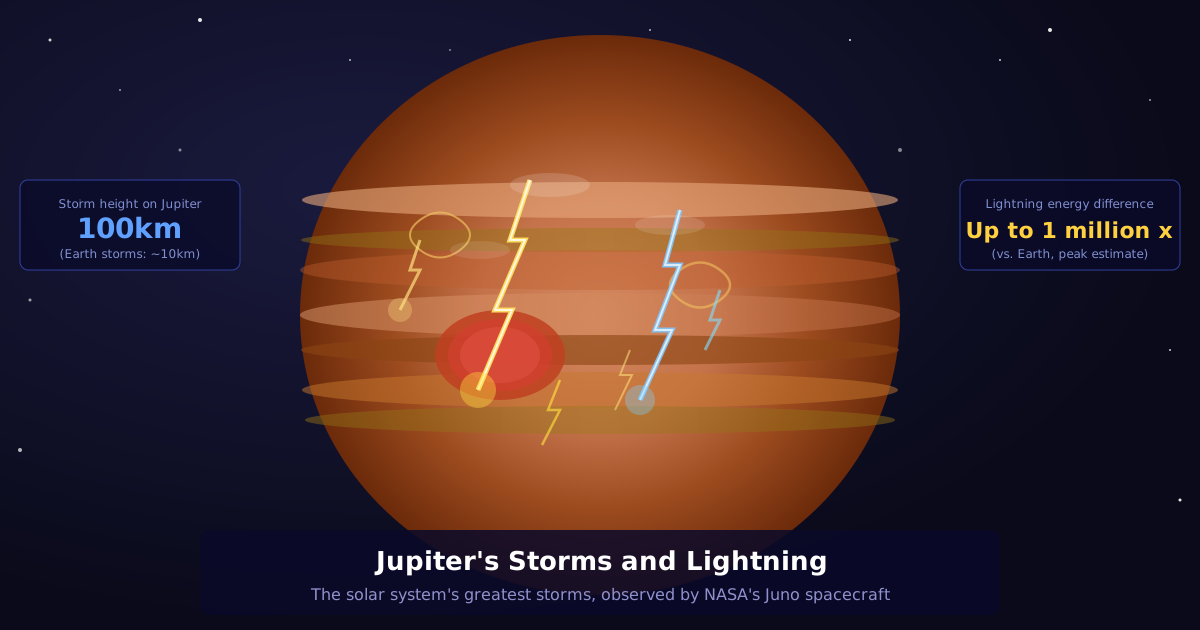
Jupiter’s atmosphere is vast in a way that’s hard to picture. Earth’s air fades into space within about 100 kilometers. Jupiter’s goes on for thousands. There’s no solid surface to stop it — just gas, forever.
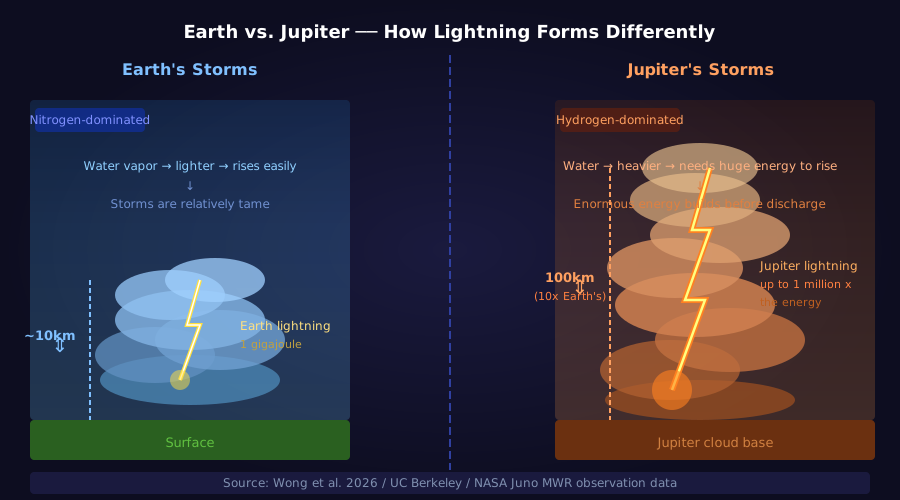
But around 50 to 70 kilometers below the visible cloud tops, conditions change. Temperature and pressure reach the point where water vapor condenses and forms clouds — real water clouds, not the ammonia-ice layers we see from outside. It’s a thin sliver of the planet’s total atmosphere, but it’s enough. Water droplets and ice particles collide, charge separates, and the same basic physics that drives a Florida thunderstorm kicks in on Jupiter too.
So the mechanism is essentially the same as on Earth. The question is why the result is so much bigger.
Water Is Heavy Here — and That Changes Everything
On Earth, water vapor is lighter than the surrounding air. Nitrogen weighs in at molecular mass 28, oxygen at 32, water at 18. Moist air rises easily, and that’s precisely why thunderstorms billow upward so aggressively — convection is cheap.
Jupiter flips this relationship. The dominant gases are hydrogen (mass 2) and helium (mass 4). Water, at mass 18, is much heavier than everything around it. Getting water vapor to rise in a Jovian atmosphere requires brute-force convection — the kind of updraft that makes Earth’s strongest tornadoes look like a fan left running in a corner.
Think of it like trying to lift something denser than the air itself, not a few meters, but hundreds of kilometers. Ice particles slam into each other at enormous speeds. Charge separation happens on a scale that has no Earthly reference point. By the time the discharge finally comes, the energy is staggering.

613 “Cracks” That Juno Heard
The team that put numbers to all of this was led by Michael Wong at UC Berkeley. Their tool was Juno’s Microwave Radiometer, or MWR — a six-channel instrument that essentially listens to different depths of Jupiter’s atmosphere simultaneously, from the shallow ammonia clouds all the way down to the water layer.
Observing Jovian lightning from Earth is painfully difficult. The optical flashes are swallowed by thick cloud layers, and radio signals attenuate badly over the 778 million kilometers to Earth. Juno skims just above the cloud tops on each close pass, which is the only vantage point that works.
Wong et al. (2026) identified 613 lightning-generated microwave pulses in the MWR data — the most systematic Jovian lightning catalog ever assembled. The energy distribution across those pulses spans a huge range: some are roughly comparable to Earth’s lightning; others clock in at more than a million times the energy.
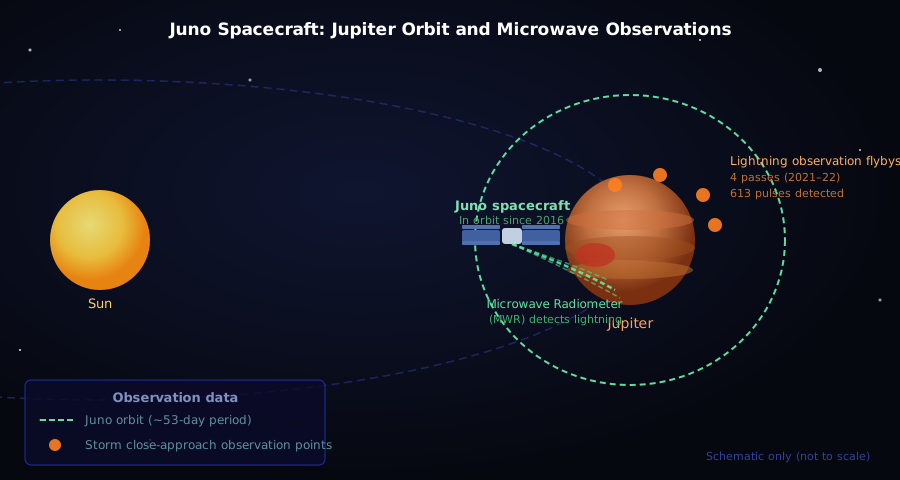
A note worth making here: not every one of those 613 events is a million-times monster. The distribution is wide. Jupiter’s lightning is not always that extreme — it just reaches that extreme at its upper end. Still, even the typical Jovian bolt would be an extraordinary event by Earth standards.
Why the Poles Get Hit Harder
One of the cleaner findings from the MWR survey is that Jupiter’s lightning concentrates at mid-to-high latitudes, not near the equator. That’s the opposite of Earth, where the tropics — baked by direct sunlight — produce the most lightning per square kilometer.
The reason ties back to how distant Jupiter is from the Sun. At 778 million km, it receives about 1/25th the solar energy Earth does. Even that meager sunlight warms Jupiter’s equatorial upper atmosphere enough to create a stable layer — and stable air suppresses convection.
At higher latitudes, solar heating is weaker still. What drives the atmosphere instead is heat leaking up from Jupiter’s interior — the planet radiates roughly 1.7 times more energy than it receives from the Sun, a relic of its formation billions of years ago. That internal heat punches through the atmosphere most effectively where the Sun’s stabilizing influence is smallest, which is why the poles crackle and the equator stays comparatively calm.
If Jupiter had a weather service, the forecast might read: “High latitudes — severe lightning warning. Scale: tens of thousands of times Earth’s average. No sheltering possible.”
What the Storm Planet Is Actually Telling Us
Cataloging Jupiter’s lightning isn’t just a spectacle. Lightning distribution is a proxy for where water lives in the atmosphere, how vigorously convection is running, and how much heat the interior is venting. The MWR data give scientists a new lever for constraining the water abundance in Jupiter’s deep atmosphere — a question that connects directly to how the planet formed and where in the early solar nebula it came together.
The ripples extend outward too. Saturn has confirmed lightning of its own, and the Jovian mechanism gives researchers a sharper framework for interpreting Saturnian storms. Uranus and Neptune almost certainly have analogous processes, but neither has had a dedicated orbiter pass nearby. When one eventually does, expect surprises.
Wong’s team is continuing to mine the MWR archive, looking at how Jovian lightning varies over time and with latitude. Juno entered orbit in 2016 and has operated well beyond its original mission plan, accumulating nine-plus years of data. That long baseline should reveal patterns invisible in any short snapshot.
Earth’s thunder is close enough to feel in your chest. But spend a moment imagining the sky above Jupiter — where a hydrogen ocean stretches for thousands of kilometers and water, the heaviest thing around, finally tears loose. A million-volt flash, by comparison, starts to seem almost quaint.