Somewhere out in space, right now, a spacecraft is still flying. Voyager 1 sits roughly 23 billion kilometers from Earth — farther than any object humanity has ever sent — and it is slowly running out of power.
A Mission That Was Only Supposed to Last Five Years
Voyager 1 and 2 launched in 1977, eight years after Apollo 11 landed on the Moon. Their original assignment was a close flyby of Jupiter and Saturn, and they were designed to last about five years.
Forty-eight years later, they’re still going.
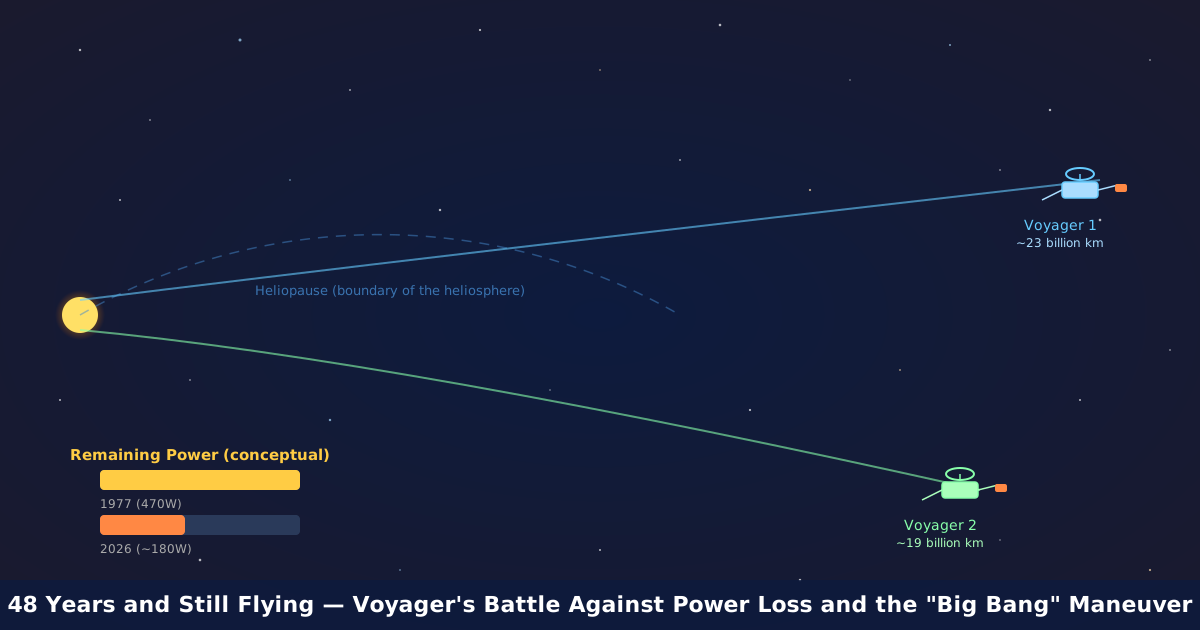
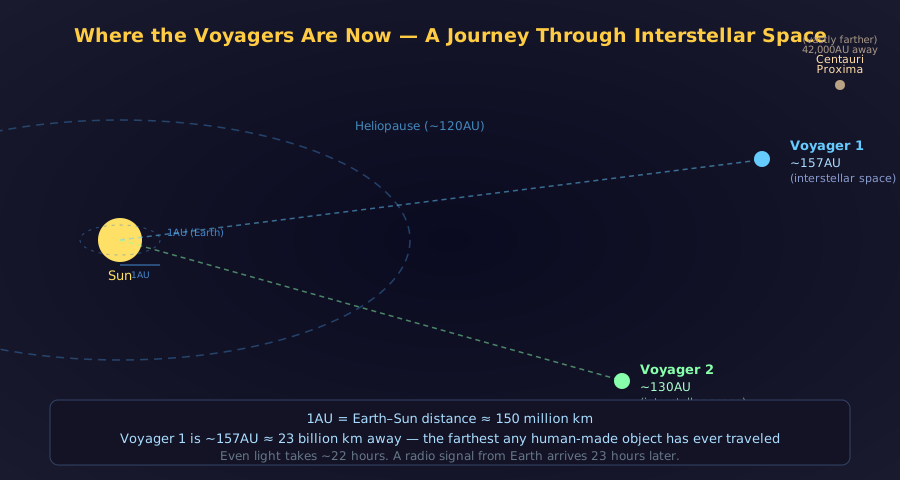
Voyager 1 is currently around 157 AU from the Sun. One AU is the distance from Earth to the Sun — roughly 150 million kilometers — so that puts Voyager 1 about 23 billion kilometers out. A radio signal takes 23 hours just to make the one-way trip. Space, it turns out, is very large.
It Doesn’t Run on Batteries. It Runs on Plutonium.
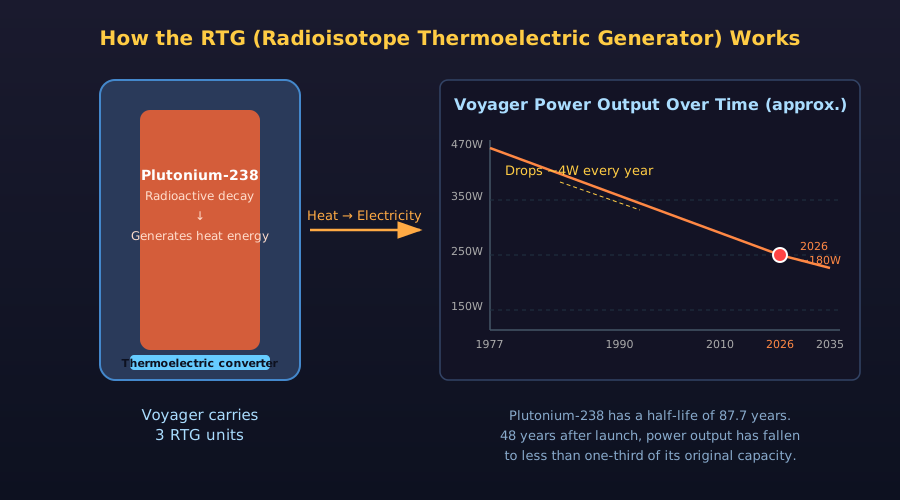
There are no conventional batteries aboard Voyager. Instead, each spacecraft carries three RTGs — Radioisotope Thermoelectric Generators. The basic idea: plutonium-238 decays naturally, releasing heat. That heat runs through thermoelectric converters and becomes electricity. Solar panels would be useless this far from the Sun, so this was the only viable option.
At launch, the RTGs produced about 470 watts — roughly what a household microwave draws. But plutonium-238 has a half-life of 87.7 years. As the decades pass, the decay slows, the heat drops, and so does the power. By 2026, output had fallen to around 180 watts, and it keeps dropping at a rate of about 4 watts per year.
Four watts might not sound like much — it’s about one small LED bulb. But it’s gone forever, every single year.
Turning Things Off, One by One
Less power means fewer instruments. The Voyager team has been managing this reality for years, methodically shutting down science tools to keep the spacecraft alive a little longer.
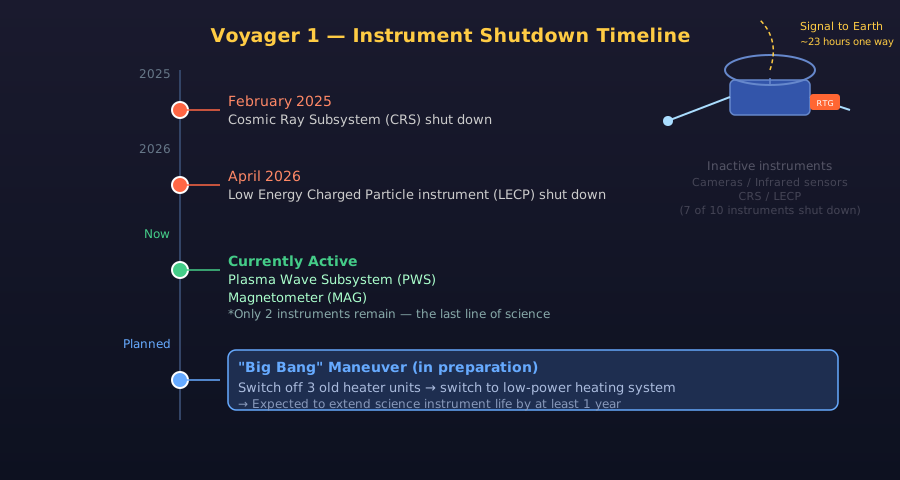
In February 2025, Voyager 1’s Cosmic Ray Subsystem (CRS) was switched off — an instrument that had been measuring cosmic rays in interstellar space for over 40 years. That same year, in March, Voyager 2’s Low Energy Charged Particle instrument was shut down as well.
Then, in April 2026, another step was taken. Voyager 1’s Low Energy Charged Particle (LECP) instrument was powered down. A routine roll maneuver in February had caused power to dip unexpectedly close to a level that would have triggered the spacecraft’s fault protection systems, and the team decided to act before that happened.
Of the ten science instruments originally aboard, seven are now offline.
Two Instruments Left — and They’re Keeping Watch
What’s still running on Voyager 1? Just two things: the Magnetometer (MAG), which measures magnetic fields, and the Plasma Wave Subsystem (PWS), which monitors plasma waves. Those two instruments are the only source of direct measurements from interstellar space, and they’re still sending data back to Earth.
Interstellar space is the region beyond the heliopause — the boundary where the stream of particles flowing outward from the Sun finally stalls against the pressure of the surrounding galaxy. Voyager 1 crossed that boundary in 2012, becoming the first human-made object to enter interstellar space. Voyager 2 followed in 2018.
No other spacecraft in existence has crossed that threshold. That’s why NASA wants to keep these two alive for as long as possible, and why the situation feels genuinely urgent.
What the “Big Bang” Maneuver Is Actually About
To save power, you have to reduce consumption. But the tricky part is that not all power goes to science. A significant portion heats the spacecraft.
Out in deep space, temperatures approach absolute zero (−273°C). If the fuel lines running to the thrusters freeze, Voyager loses attitude control — and without attitude control, the antenna can no longer point at Earth. Communication ends. So the spacecraft has to stay warm, and warmth costs power.
The maneuver that engineers at NASA’s Jet Propulsion Laboratory (JPL) have been planning — informally called the “Big Bang” — is an attempt to solve this problem. The plan is to switch off three aging heater units and replace them all at once with a newer, more efficient heating system. If it works, the spacecraft could save roughly 10 watts, potentially extending the life of the science instruments by at least a year.
The nickname “Big Bang” was coined by the team itself. It’s not an official designation, but the name captures something real: switching multiple critical components simultaneously carries genuine risk. You do that kind of thing when you don’t have a safer option.
A 23-Hour Wait to Find Out If It Worked
The operation is not simple to execute. A command sent from Earth takes about 23 hours to reach Voyager 1. Then you wait another 23 hours to see how the spacecraft responded. That’s nearly two full days for a single exchange — and if something goes wrong, the team has to troubleshoot across that same 46-hour round-trip delay.
In 2025, an unexpected error in part of the communication system sent the team on a months-long hunt for the cause. Think of it as remote surgery on a patient who is 23 billion kilometers away, using software written 48 years ago.
It’s hard not to feel a little dizzy thinking about it. Many of the engineers working on Voyager at JPL today weren’t even born when the spacecraft launched.
A Machine That Works Until It Can’t
NASA’s goal is for Voyager to keep returning some form of science data into the 2030s. The team hopes both spacecraft will still be functional when they reach 200 AU — possibly around 2035. Whether the power runs out first, or a component fails, or a thruster line finally freezes — it’s an ongoing race against several different clocks.
What makes this story worth thinking about goes beyond the fact that a machine outlived its design by a factor of nearly ten. There’s a quieter question embedded in it: how long do you keep something going, and when does keeping it going become its own kind of purpose?
When the last instrument finally goes dark, Voyager won’t stop moving. It’ll continue in a straight line through interstellar space — silent, receiving nothing, sending nothing. Just a piece of metal traveling at 17 kilometers per second.
That’s a strange thing to sit with.
The original mission — those close flybys of Jupiter and Saturn — ended long ago. The spacecraft crossed the edge of our solar system, then kept going. Today, the farthest object humanity has ever built is still moving, still in contact, still doing science. A little dimmer every year. But not done yet.