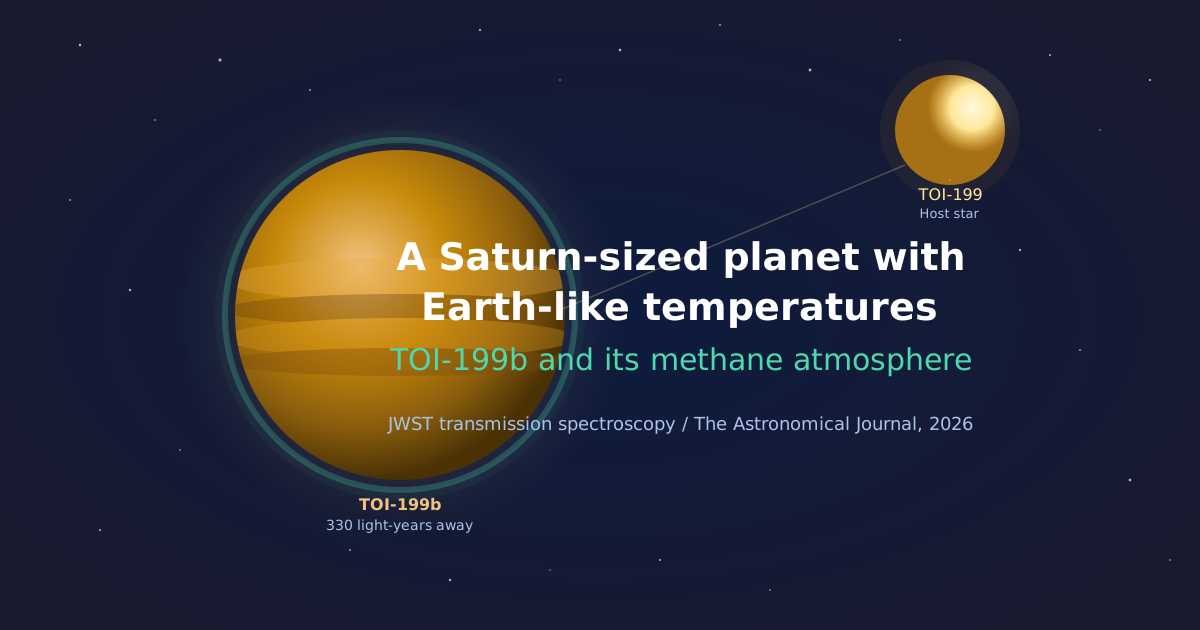
330 light-years away, there’s a planet that doesn’t quite fit anywhere.
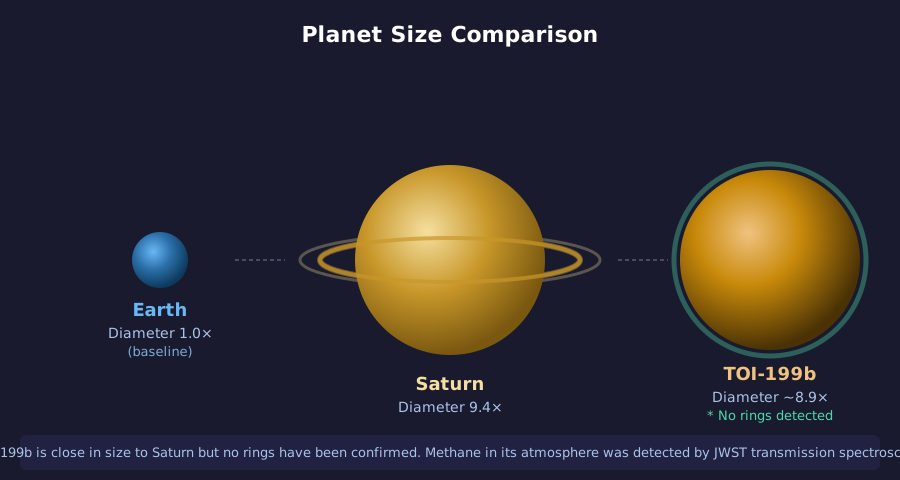
It’s roughly the size of Saturn. Its temperature sits around 79°C — not scorching, not frigid. And its atmosphere, we’ve recently learned, contains methane. That might not sound remarkable at first, but it really is. For a planet this size, directly measuring the atmosphere like this has never been done before.
Why Exoplanets Tend to Be Extremes
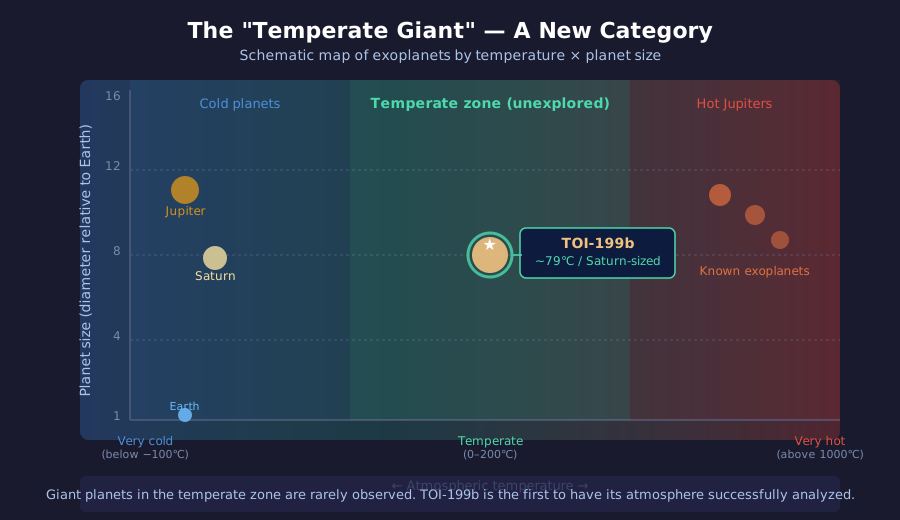
When you sort through the exoplanets discovered so far, two types dominate the population.
On one end: hot Jupiters. These are giant gas planets — Jupiter-scale — orbiting absurdly close to their host stars, with surface temperatures that can exceed 1,000°C. On the other end: cold giants like our own Jupiter and Saturn, orbiting far enough out that their atmospheres are frigidly cold.
The middle ground — what you might call “temperate giant planets” — has been largely empty, at least in our catalogs.
Part of that is a real physical rarity, but part is an observation problem. Temperate giants tend to have orbital periods around 100 days or more. That makes them harder to catch with the transit method, which looks for the brief dip in starlight as a planet crosses in front of its star. Long orbits mean fewer transits, which means fewer opportunities to detect them.
TOI-199b is one of the rare exceptions.
79°C — An Oddly Comfortable Temperature
TOI-199b’s atmospheric temperature is estimated at around 79°C. That’s just below the boiling point of water, and while “temperate” might be a stretch, it’s nowhere near the hundreds to thousands of degrees you’d find on a hot Jupiter.
The planet orbits its host star TOI-199 with a period of about 105 days. It’s a large, slow-moving world keeping a comfortable distance from its star.
What drew researchers to it was the chance to actually test theoretical models of temperate gas giant atmospheres — models that, until now, had nothing real to check against. When they looked, though, things got interesting.
How JWST “Smelled” the Atmosphere
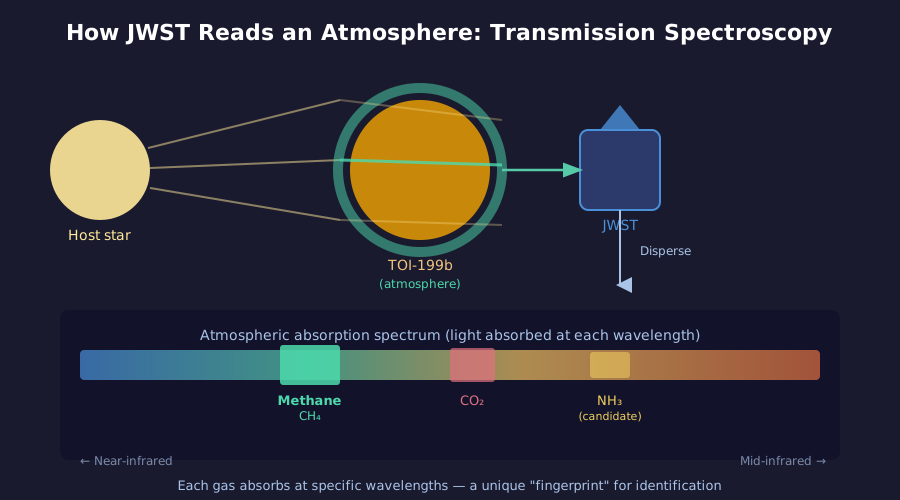
The technique JWST used is called transmission spectroscopy — or transit spectroscopy, if you prefer.
When a planet crosses in front of its star, a sliver of the starlight filters through the planet’s atmosphere before reaching the telescope. JWST captures that light and breaks it apart by wavelength, the way a prism splits white light into a rainbow. Certain wavelengths come through weaker than others — absorbed by gas molecules in the atmosphere. And since each gas has its own unique absorption pattern, a kind of spectral fingerprint, you can work out what’s there and roughly how much.
In this observation, methane (CH₄) showed up clearly. Carbon dioxide (CO₂) was also present. There were hints of ammonia (NH₃) too, though that one isn’t confirmed yet — more observations will be needed.
The transit observation ran for about seven hours, longer than a typical hot Jupiter transit, but it yielded a scientifically meaningful result.
One wrinkle: the observation didn’t go smoothly from the start. A problem with JWST’s target acquisition caused the data noise to swell to four or five times the expected level. The research team spent considerable effort cleaning up that noise to extract the usable signal. That kind of painstaking work is what science actually looks like most of the time.
Why Methane Isn’t Obvious Here
You might think: of course a Saturn-like planet has methane. Jupiter, Saturn, Uranus, and Neptune all do. But the logic doesn’t transfer cleanly to exoplanets.
On ultra-hot planets like hot Jupiters, methane breaks apart. It can’t survive those temperatures. And until recently, directly observing the atmospheres of cold distant giants was technically out of reach. The practical result was a gap in the data: no actual detections of methane in temperate gas giants.
A researcher at Penn State put it plainly: theory predicted temperate gas giants should have methane, so it’s good to confirm it. That’s what “testing a theory” looks like when it actually works.
A New Drawer in the Cabinet
What this observation really opens up is a new category in planetary science — and the implications are broader than they might seem.
For the first time, we can measure the actual atmospheric composition of a giant planet in the temperate zone and compare it to theoretical predictions. That’s not a small thing.
Take the ratio of carbon to nitrogen in the atmosphere. That ratio is sensitive to where and how a planet formed — what material it gathered, at what distance from its star. If we can pin down the methane abundance in TOI-199b precisely, it starts to tell a story about where this planet was born and how it ended up where it is today.
There’s also a bigger picture here. Understanding the early chemical conditions of giant planet atmospheres gives us context for how planetary systems develop in general — including how something like an Earth-like atmosphere might come to exist at all.
Rare, or Just Hard to Find?
It’s worth pausing on something: we don’t actually know whether temperate giant planets are genuinely rare, or just hard to spot with current tools.
The transit method is biased toward short-period planets. Wide-field survey telescopes like the Vera Rubin Observatory (LSST), which will repeatedly scan the sky over years, should start turning up longer-period planets in larger numbers. Some researchers think the apparent scarcity is mostly a detection artifact — that these planets are out there, and we’ve just been looking with the wrong tools.
TOI-199b, in that sense, isn’t just “a rare planet found.” It’s “a rare planet properly studied for the first time with the technology that now makes it possible.”
It’s also worth a quick comparison to our own backyard. Saturn’s atmosphere hovers around −178°C — cold enough for methane to form clouds. At TOI-199b’s 79°C, methane stays gaseous. Same size, same molecule, completely different atmospheric behavior. Being able to compare these temperature regimes directly is one of the core things JWST has made possible.
What We Still Don’t Know
To be honest with you, this discovery is a beginning, not an answer.
Methane is confirmed. CO₂ and NH₃ are still tentative, pending follow-up observations. The vertical structure of the atmosphere — how the composition changes with altitude — is largely unmapped. Whether TOI-199b has rings or doesn’t is an open question no one has looked at yet.
I find myself wanting to follow the next round of data as it comes in. Every result on this planet feels like turning a page.
There’s something almost poignant about the scientists who first realized, back when exoplanet astronomy was young, just how diverse planetary systems could be. The researchers working on data like this today probably carry something similar — that same sense of opening a door and not quite knowing what’s on the other side.
Source note: This research was conducted by a team at Penn State and NASA JPL and published in The Astronomical Journal in May 2026. Observations were made using the NASA/ESA/CSA James Webb Space Telescope.