In May 2026, SpaceX is preparing for Starship’s twelfth test flight — Flight 12. But this isn’t the same Starship we’ve been watching. This is V3, a completely new vehicle.
You might assume it’s just a minor update to V2. Honestly, I thought the same thing at first. Then I started looking at the details. The engines are different, there are fewer grid fins, and even the launch pad is new. Why go to all that trouble? The answer is “to build a rocket you can actually mass-produce,” and that’s what makes this story worth paying attention to.
The Engine Is Fundamentally Different
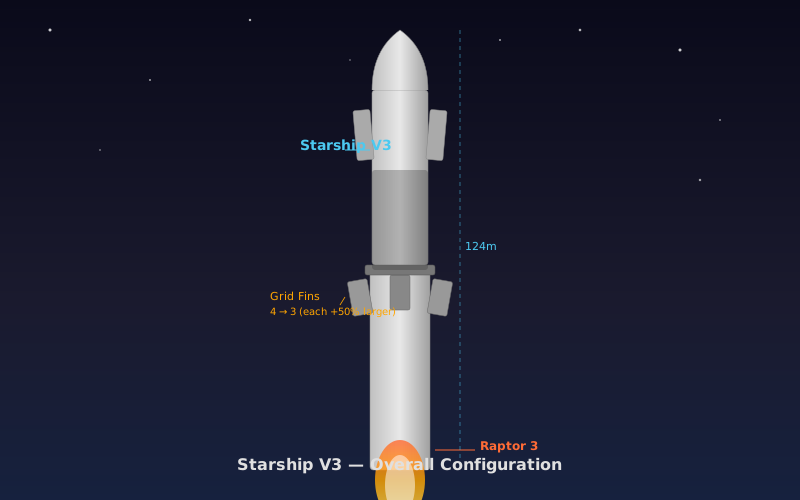
The heart of V3 is Raptor 3 — the third generation of SpaceX’s methane-fueled engine. Each unit produces around 280 tonnes-force (tf) of thrust. That’s up from 185 tf for the original Raptor and 230 tf for Raptor 2 — roughly a 50% increase over the first generation.
But the thrust number isn’t the most important part. The bigger change is what’s gone missing: all that exposed plumbing.
On Raptor 1 and 2, the gas generators and fuel lines ran along the outside of the engine, bare to the world. Every launch exposed them to extreme heat, so each of the 33 engines on the Super Heavy booster needed its own metal shroud for protection. Putting on shrouds, taking them off, inspecting everything, putting them back — that maintenance loop alone consumed enormous amounts of time.
Raptor 3 moves all of that plumbing and the gas generator inside the engine body itself. The shrouds are gone, and the engine now looks like a clean, solid piece of metal. This matters way beyond aesthetics. Without the shrouds, the vehicle is lighter. With fewer parts to remove between flights, turnaround time drops. “Time to next launch” gets shorter.
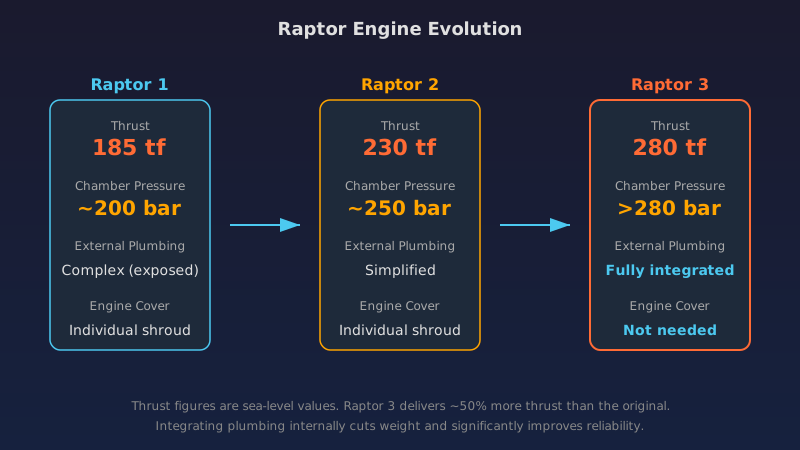
Chamber pressure exceeds 280 bar. In rocketry, higher pressure means better efficiency — but it also means more ways for things to break. SpaceX apparently cleared that bar through materials advances and manufacturing improvements. Official details are sparse, but it’s confirmed that the total part count has dropped dramatically compared to the original Raptor.
Why the Grid Fins Went from Four to Three
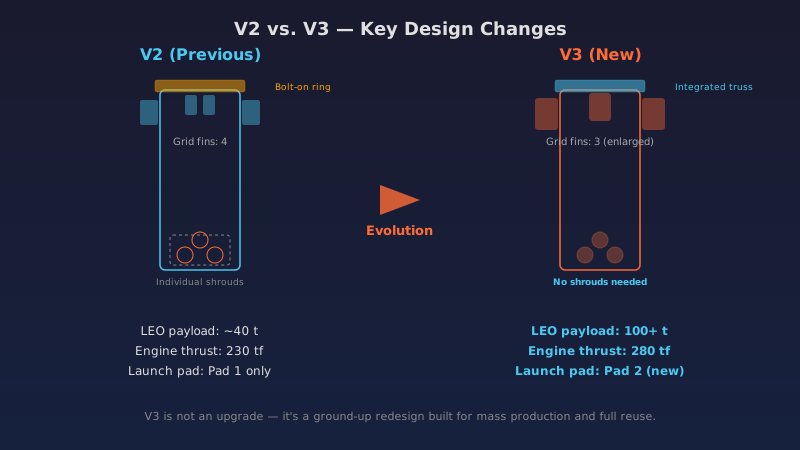
Those lattice-like fins on top of the booster — the grid fins that steer the vehicle as it descends through the atmosphere — went from four on V2 to three on V3.
Sounds like a downgrade. But each fin is 50% larger and structurally stronger. Three fins still deliver the same control authority. On top of that, mounting them lower on the booster keeps them further from the hot-staging exhaust — the blast from igniting the upper stage’s engines before separation.
This circles back to maintenance, again. Fins that take heat damage every flight become a recurring replacement cost. Moving them to a cooler location and cutting the count by one reduces inspection points. It’s unglamorous, but it’s exactly the kind of thinking a mass-production design demands.
Integrating the Hot-Stage
On V2, the hot-stage ring — the hardware that manages the separation of upper and lower stages — was a separate component bolted onto the booster. It took wear every flight and needed inspection or replacement each time.
V3 replaces it with a “hot-stage truss” that’s built into the booster itself, similar in concept to the structure used on Russia’s old N1 rocket. The exhaust now impinges on the booster’s upper dome, which has additional steel plating to handle the heat.
Why bother with this level of complexity? Same reason as everything else: to eliminate the step where you unbolt the ring, inspect it, and decide whether it needs replacing. If it’s integrated, there’s nothing to remove. Fewer inspection points. Less time between flights.
The Propulsion System Got a Redesign Too
V3’s propulsion system is a clean-sheet design on the booster side.
The methane tank is shorter; the liquid oxygen tank is longer. The propellant feed lines are new, and for the first time all 33 Raptor 3 engines can ignite simultaneously. V2 lit them in sequence; V3 can fire them all at once.
This affects not just ascent efficiency but landing as well. The inner cluster of ten engines can re-ignite together for the boostback burn, which improves landing accuracy. Catching the booster with the launch tower’s mechazilla arms requires precision on the order of tens of centimeters — propulsion reliability feeds directly into that.
There’s another benefit. The new system leaves fewer enclosed cavities in the aft section. On V2, those spaces tended to trap propellant leaks, which contributed to explosion risk. V3 eliminates that risk at the structural level.
Over 100 Tonnes to LEO
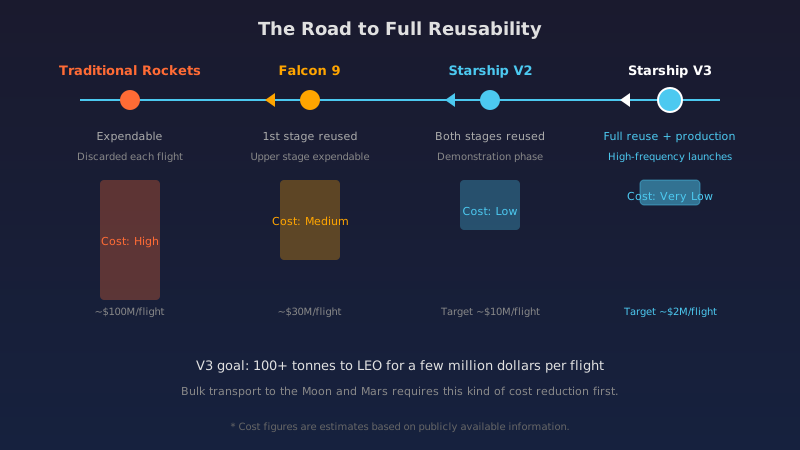
In reusable mode, V3 carries over 100 tonnes to low Earth orbit (LEO). In expendable mode, the number is around 200 tonnes. Compare that to V2’s reusable payload of roughly 35–40 tonnes, and you’re looking at more than a 2.5× increase.
Where does that gain come from? Better engine thrust, lower vehicle dry weight, more propellant volume. All three contribute — but the biggest drivers are the shroud elimination and the grid fin reduction. In rocketry, shaving one kilogram off the vehicle can translate into several additional kilograms of payload. Small wins multiply.
What does 100 tonnes to LEO actually unlock? You can deploy dozens of Starlink satellites in a single pass. You can haul large quantities of cargo to the lunar surface in one mission. The orbital refueling runs needed to send humans to Mars become fewer. The knock-on effects compound.
A New Launch Pad
Flight 12 will lift off from Pad 2 (OLM-B), a newly constructed site at Starbase designed specifically for V3. The mechazilla catch arms respond faster, and the propellant loading rate has increased.
Two active pads means one can be in maintenance after a flight while the other is ready to launch. If SpaceX is serious about flying to the Moon many times a year, parallel launch infrastructure isn’t optional — it’s a requirement.
The sound and thermal suppression system (the water deluge) has also been upgraded. V3 produces more thrust than V2, which means more energy hitting the pad at liftoff. The improvements reflect lessons fed back from Flights 1 through 11.
”Mass-Production Design,” Not an Upgrade
Step through every change in V3 and you notice they all point in the same direction: fewer steps between landing and the next launch.
Remove the engine shrouds. Drop a grid fin. Integrate the hot-stage. Seal off the spaces that could trap leaks. Simplify the propellant lines.
This isn’t about squeezing more performance out of a rocket. It’s the result of asking a different question: what does a vehicle need to look like if it’s going to fly tens or hundreds of times with the same hardware?
The airline analogy gets used a lot, but it’s apt. A commercial jet can fly multiple routes per day because nobody disassembles it between flights. A rocket pursuing reuse has to achieve something similar. V3 may be the first rocket designed from the start around the principle of “don’t take it apart.”
Flight 12 is still a test flight. The V3’s first launch has already slipped multiple times due to weather and technical issues. This vehicle won’t be flying dozens of Moon missions next month. But at the level of design philosophy, SpaceX has made a clear turn — from prototype to production article.
If the cost of reaching space drops by an order of magnitude, questions like “should we build a lunar base?” or “should we send humans to Mars?” shift from “whether” to “when.” V3 is the rocket standing at that inflection point.