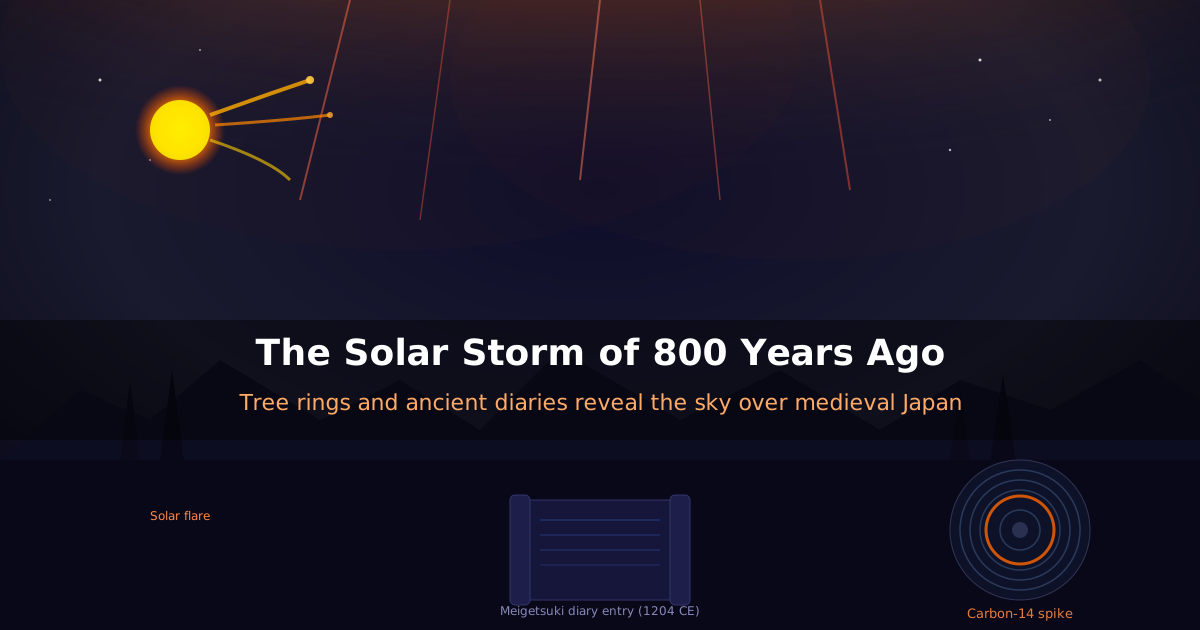
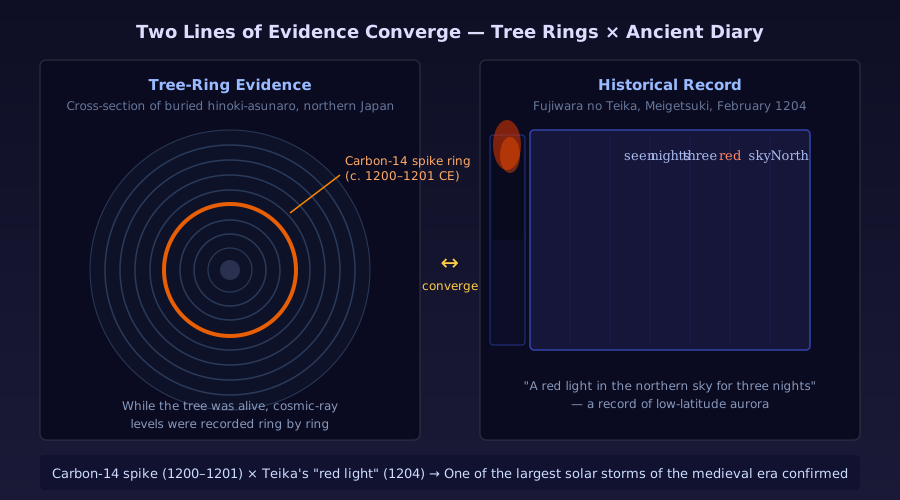
In February 1204, the Japanese poet and courtier Fujiwara no Teika made an unusual entry in his diary — three consecutive nights of it. “A red light was visible in the northern sky.” He had no idea what he was seeing.
Eight hundred years later, that entry became the corroborating witness to a scientific discovery.
The Cosmic Record Hidden in Tree Rings
A paper published in April 2026 by a team led by Professor Hiroko Miyahara of OIST (Okinawa Institute of Science and Technology) landed with considerable impact. The team had been analyzing a buried hinoki-asunaro — a cypress-like conifer — unearthed in northern Japan. In the rings that correspond to around 1200–1201 CE, they found something striking: a sudden, sharp spike in carbon-14 concentration.
Carbon-14 is a radioactive form of carbon produced when cosmic rays collide with the atmosphere. Plants absorb it through photosynthesis, locking a year’s worth of cosmic-ray activity into each annual ring. When the Sun releases an unusually large burst of energy, more cosmic rays reach Earth, and that year’s carbon-14 level climbs. In other words, the tree had been quietly writing down the year the Sun went wild.
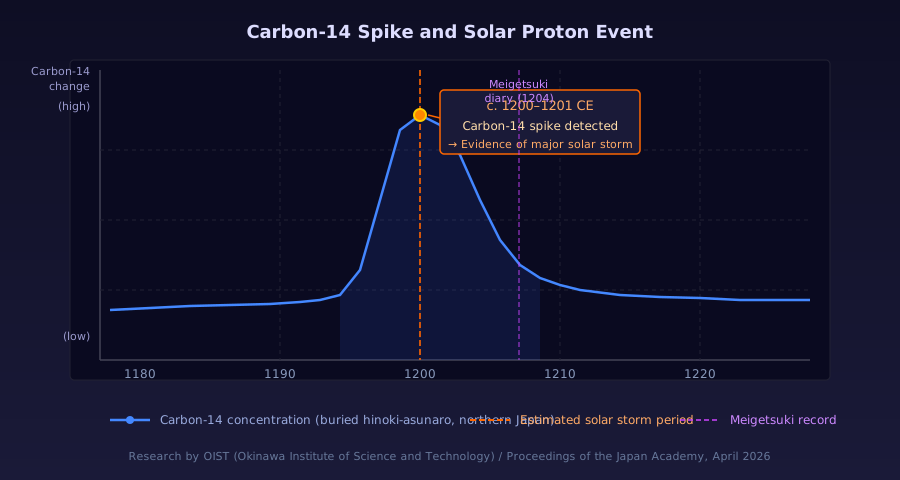
The team used what they call “ultra-precise carbon-14 measurement,” a technique sensitive enough to catch subtle fluctuations that older methods would have missed entirely. It’s now uncovering traces of “sub-extreme” solar storms that previous research had overlooked.
What the Three-Year Gap Between the Diary and the Tree Rings Actually Means
Here’s where things get interesting.
The carbon-14 spike points to roughly 1200–1201 CE, but Teika wrote about the red light in 1204. That’s a gap of three to four years — which sounds like a contradiction, but isn’t.
Low-latitude auroras don’t necessarily happen right on the heels of a solar storm. When the Sun is broadly active, large storms can cluster over years or even decades. According to the researchers, the Sun was in an exceptionally energetic state for a roughly 30-year stretch from around 1190 to 1220. Their analysis also suggests the solar cycle of that era ran about 7–8 years — shorter than today’s 11-year average. The Sun was, in some sense, running hot.
Teika’s “red light” was probably a later chapter of that prolonged active period, not a direct aftereffect of the 1200–1201 event itself. Still, his diary gave the researchers a signal: this is the era worth digging into.
The Weight of “14 Times”
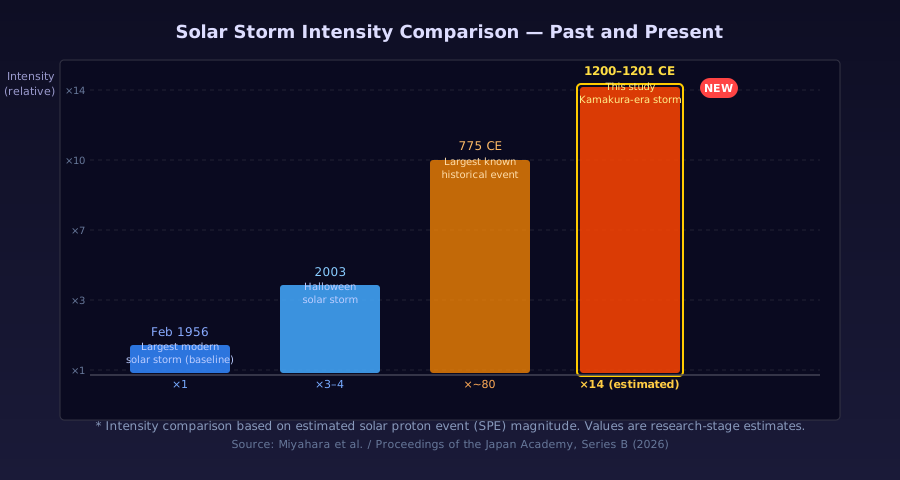
The paper, published in Proceedings of the Japan Academy, Series B on April 10, 2026, estimates that the 1200–1201 solar storm may have been roughly 14 times as powerful as the February 1956 event — currently considered the most intense modern solar storm on record.
Fourteen times. That number is hard to feel in the abstract, so let’s put it concretely. The 1956 storm caused serious disruptions to radio communications and electrical systems. Scale that up by 14, and the picture shifts dramatically: satellites losing function, widespread grid blackouts, GPS going haywire, aircraft communications cut off. Astronauts aboard a space station would face serious radiation exposure risk.
That said, the researchers classify this as “sub-extreme” — roughly 10–30% the magnitude of truly extreme events. The largest solar storm in the historical record, from around 775 CE, dwarfs even this one. Sub-extreme or not, the danger is real.
“Rare” Is Not a Reason to Relax
The significance of this research isn’t that it happened 800 years ago, so we can breathe easy. It’s precisely the opposite.
The research team’s position is that building a catalog of solar activity reaching back 10,000 years directly improves the precision of modern space-weather forecasting. Each newly identified medieval storm adds another data point to the statistical picture of how often, and how severely, the Sun can erupt.
To put it plainly: Earth lives next door to the Sun. One hundred and fifty million kilometers sounds like a lot, but on a cosmic scale, that’s essentially your next-door neighbor. When the Sun sneezes, something reaches us.
We can’t stop a solar storm from happening. What we can do — when we see one coming — is reorient satellites, switch power grids to protective modes, and get astronauts to safer positions. All of that depends on forecast accuracy, and better statistics mean better forecasts.
For the Record-Keepers of 800 Years Ago
Reading this research, I kept circling back to one thought.
Teika wrote about the red light for three nights running. He didn’t know what it was. He certainly never imagined his words would one day serve as evidence in a scientific paper about solar physics. Chinese historical records and European chronicles from the same era also noted anomalous low-latitude auroras — other people doing the same unconscious archiving. And somewhere in northern Japan, a tree fell, got buried, and spent eight centuries preserving its rings, waiting to be read.
None of these people set out to document something for science. And yet the documentation became proof.

There’s something genuinely remarkable about that. A record doesn’t need to be understood by the person making it to become evidence later. In space science, the observations, notes, and preserved materials left by people long dead routinely become the starting point for researchers working today.
Where Solar Storm Research Goes from Here
The team’s next step is to combine tree-ring data with ice cores and coral records from multiple regions around the world, building a comprehensive catalog of solar activity across the past 10,000 years. The goal is a statistically solid picture of how frequently sub-extreme solar storms occur.
Each individual data point looks modest — an old tree stump, a bubble trapped in Antarctic ice, the skeleton of a tropical coral. The raw materials are unassuming. But put enough of them together, and the Sun’s long history comes into focus. Right now, carbon-14 measurement from tree rings is in what may be its most productive era yet.
At the end of that catalog lies something practical: the ability to protect power grids before the next storm arrives. It’s a rather dramatic image — the sky over medieval Kamakura and the satellites of the future, connected by the slender bridge of a tree ring.
Reference: Miyahara et al., “Extremely Active Sun from 1190 to 1220 in the Medieval Period,” Proceedings of the Japan Academy, Series B, published April 10, 2026. OIST (Okinawa Institute of Science and Technology) press release.