When I first heard the phrase “a comet breaking apart,” I had to pause. Planets splitting, asteroids shattering — sure. But a loose ball of ice and rock just… coming undone in open space? What does that even mean?
Turns out, it’s a fascinating story. A comet’s breakup isn’t just a cosmic accident. It’s a window into what the solar system is made of and how it has recorded four-and-a-half billion years of history. When a comet tears open, the frozen record inside spills out into space — and we get to read it.
What a Comet Actually Is
Comets are essentially leftover rubble from the solar system’s birth 4.6 billion years ago. Rock and ice that never got swept up into planets drifted outward and collected in two distant reservoirs: the Oort Cloud, far beyond the planets, and the closer Kuiper Belt.
Occasionally something nudges one of these objects onto a new path, sending it falling toward the inner solar system. That’s what we call a comet. The solid core — the nucleus — is a lumpy snowball a few to several dozen kilometers across, made of water ice laced with volatile compounds like carbon monoxide, carbon dioxide, and ammonia.

As the comet swings closer to the Sun, those ices begin to vaporize. Inside roughly 3 to 4 AU — one AU being the Earth-Sun distance — water ice starts boiling off in earnest, and the comet grows its famous tail. Researchers sometimes call this the “Hello Zone,” the threshold where a comet finally makes itself visible. Two distinct tails form: a curved dust tail and a straight ion tail of electrically charged gas. Each has its own story, but that’s a separate topic.
The problem is that every pass through the inner solar system takes a toll. The comet weakens a little more each time. Eventually, it doesn’t come back in one piece.
Three Ways a Comet Comes Apart
There are three main routes to destruction.

The first is tidal disruption.
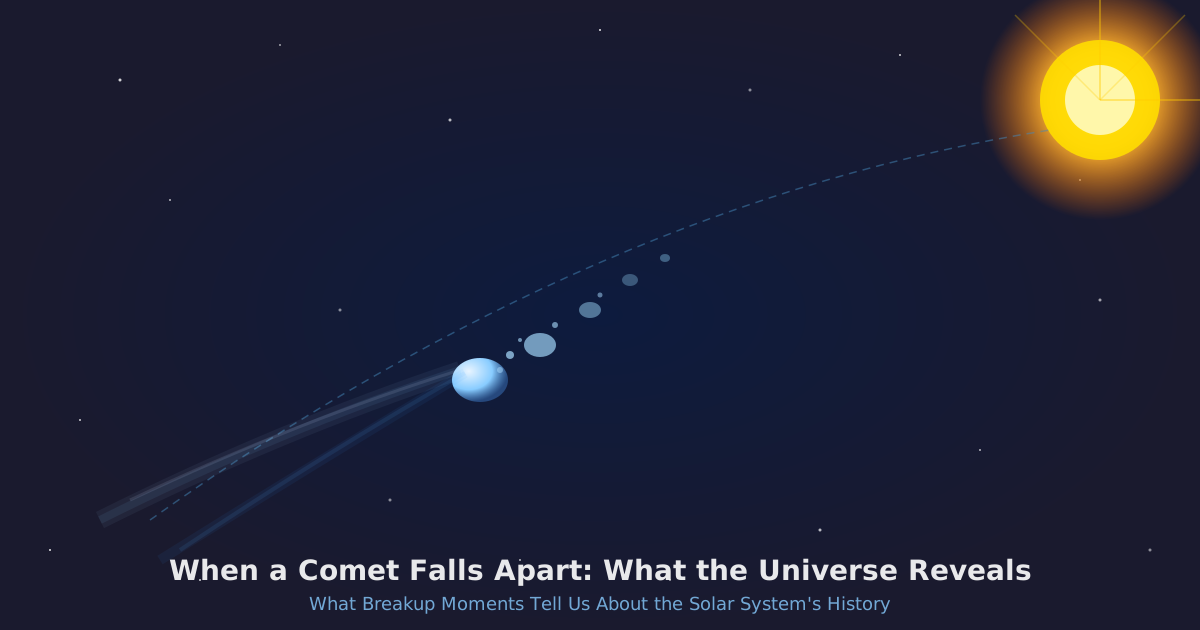
Tidal force is what happens when gravity pulls unequally on two ends of an object. The same mechanism drives Earth’s ocean tides — the Moon tugs harder on the ocean nearest to it than on the far side. For a comet approaching a planet or the Sun, that differential pull stretches the nucleus. If it gets close enough, the comet simply gets ripped apart.
Comet Shoemaker-Levy 9 is the textbook case. In 1992, a close flyby of Jupiter broke its single nucleus into 21 distinct fragments — a chain so evenly spaced it was immediately nicknamed the “String of Pearls.”
The second mechanism is thermal explosion.
A comet’s interior is dramatically colder than its surface. Heat conducts inward slowly, so even as the surface warms in sunlight, the core can still be frozen solid. When a comet dives rapidly toward the Sun, the interior ices begin vaporizing fast. Water ice expands to hundreds of times its original volume when it becomes gas. If the surrounding rock can’t contain that pressure, the nucleus blows apart from the inside.
This is thought to explain outbursts — sudden surges in brightness that sometimes precede a breakup. The comet is essentially venting, and sometimes the plumbing can’t hold.
The third is spin-up.
This one is more subtle. As a comet vents gas, those jets act like tiny thrusters. If the outgassing is symmetric, the forces cancel out. But it rarely is. Uneven jets apply a torque that gradually changes the comet’s rotation rate. Spin fast enough, and centrifugal force overcomes gravity — material flies off the surface, and eventually the nucleus flies apart.
These three mechanisms don’t always act alone. Often they pile onto each other, accelerating the inevitable.
What Shoemaker-Levy 9 Showed the World
The July 1994 impact of Comet Shoemaker-Levy 9 into Jupiter remains one of the most dramatic events in astronomical history.
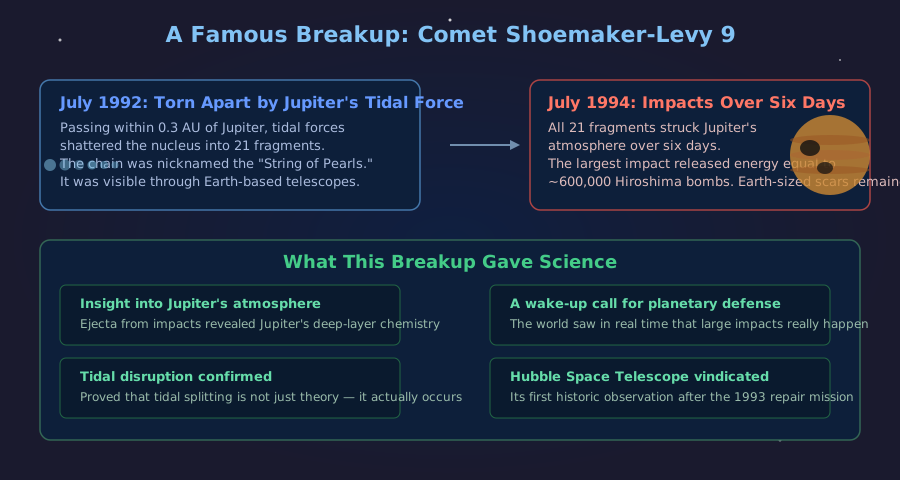
After the 1992 tidal disruption, the 21 fragments spent two years orbiting Jupiter like a temporary moon system, gradually spiraling inward. Then, over six days in July 1994, they crashed one after another into Jupiter’s atmosphere.
The largest fragment — designated G — struck with energy estimated at roughly 600,000 times the Hiroshima bomb. The impact scar it left was roughly the size of Earth and remained visible for weeks.
The science that came out of this was significant on two fronts. First, the impacts dredged up material from deep in Jupiter’s atmosphere — layers we’d never had direct access to before. The ejecta gave astronomers a chemical snapshot of Jupiter’s interior.
Second, planetary defense became real. Before 1994, “a large body hitting a planet” was something most people associated with the dinosaur extinction 65 million years ago — geological time, not human time. Watching it happen live, on a planet right next door, changed that. The question shifted from “could it happen?” to “are we ready if it does?”
A side note worth mentioning: this was also the Hubble Space Telescope’s moment of vindication. Hubble had been repaired just months earlier in 1993, with a corrective optics mission to fix its famously blurry mirror. The Shoemaker-Levy 9 impacts were among its first major observations post-repair, and the crisp images it returned announced to the world that the fix had worked.
The Debris Becomes Meteor Showers
When a comet breaks up, its fragments don’t just disappear. They scatter along the comet’s original orbit, forming a long stream of debris that keeps circling the Sun.
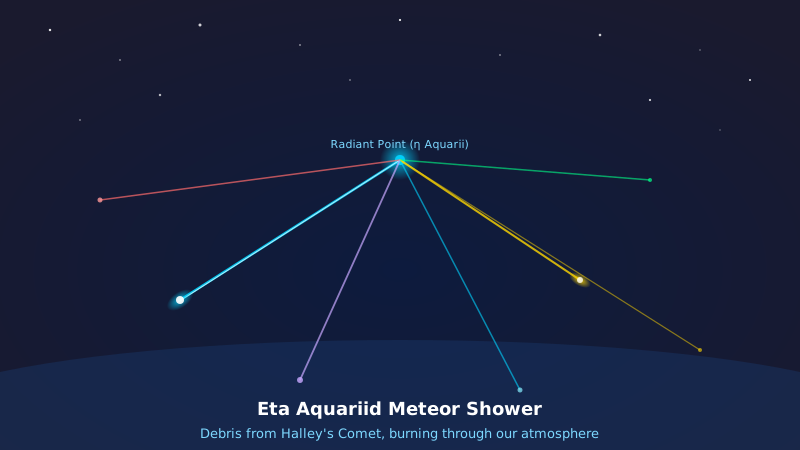
Every year, Earth crosses those debris streams at predictable times. When it does, particles burn up in the upper atmosphere and we watch them as meteors. The Eta Aquariids in May trace back to Halley’s Comet. The Perseids in August come from Comet Swift-Tuttle.
Seen in that light, a shooting star is the comet’s breakup — replayed in miniature, night after night, in Earth’s atmosphere. There’s something quietly poetic about that.
Breakup as Information Release
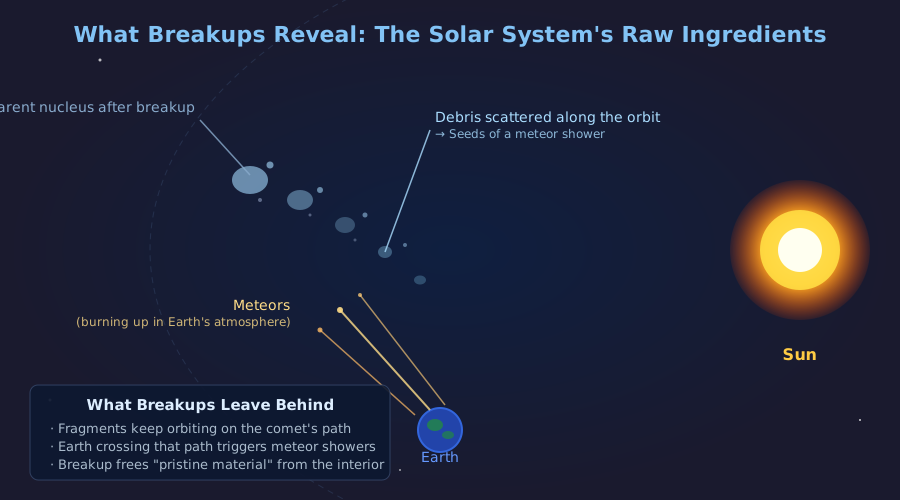
Whether you frame a comet’s breakup as destruction or disclosure makes a real difference in how you think about it.
The interior of a comet is essentially a time capsule. The surface gets cooked by solar radiation with every pass, but deep inside, material has stayed frozen since the solar system formed. When the comet splits open, that pristine interior — water ice, organic molecules, silicate minerals — gets released into space. These are the kinds of compounds that could, under the right conditions, seed a planet with the building blocks of life.
The idea that comets delivered water and organic material to early Earth remains one of the more compelling hypotheses in planetary science. Fragments of broken-up comets reaching Earth’s surface may have carried some of those ingredients with them.
The Hubble Space Telescope has caught several comet breakups in progress. In 2020, Comet ATLAS (C/2019 Y4) fell apart while approaching the Sun, and Hubble documented the nucleus splitting into multiple pieces. Researchers think it was a combination of thermal expansion and spin-up acting together.
Predicting breakups is still notoriously difficult. Without knowing a comet’s internal structure, there’s no reliable way to say when or how it will fail. The Rosetta mission by ESA landed on Comet Churyumov-Gerasimenko and mapped its surface in extraordinary detail. But the interior remained opaque. Future missions will need to go deeper — literally — to answer that question.
How Things Break Apart Matters
A comet’s final moments are also the moment its secrets get out. Ice that formed 4.6 billion years ago burns across tonight’s sky as a meteor. That’s not just destruction — it’s more like a handoff. A message passed forward through time.
Every comet that falls apart is leaving a kind of legacy: “Here is what the solar system was made of.” And Earth receives a piece of that legacy every time it crosses a debris trail and the sky lights up overhead.
At SORABUMI, we want to keep following stories like this — how things in space break apart, and what those breakups reveal. Next up: the individual meteor showers born from broken comets, and what each one carries.