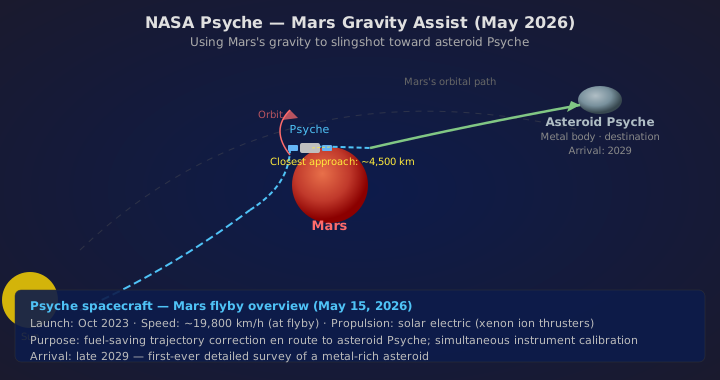
On May 15, 2026, NASA’s Psyche spacecraft skimmed past Mars at an altitude of 4,500 kilometers.
Its speed at closest approach was roughly 5.4 kilometers per second. Not a milligram of propellant was consumed. Yet the spacecraft came out faster on the other side, its trajectory bent precisely toward its destination. This is gravity assist — also called the gravitational slingshot. Most people have heard of it; many feel like they sort of understand it. But “sort of” is where it usually stops. Let’s dig a little deeper.
The Art of Getting a Free Ride in Space
First, some context: moving a spacecraft in deep space is expensive — in every sense of the word. The more fuel you carry, the heavier the rocket, the more it costs to get off the ground. So spacecraft engineers are always hunting for ways to fly farther on less propellant.
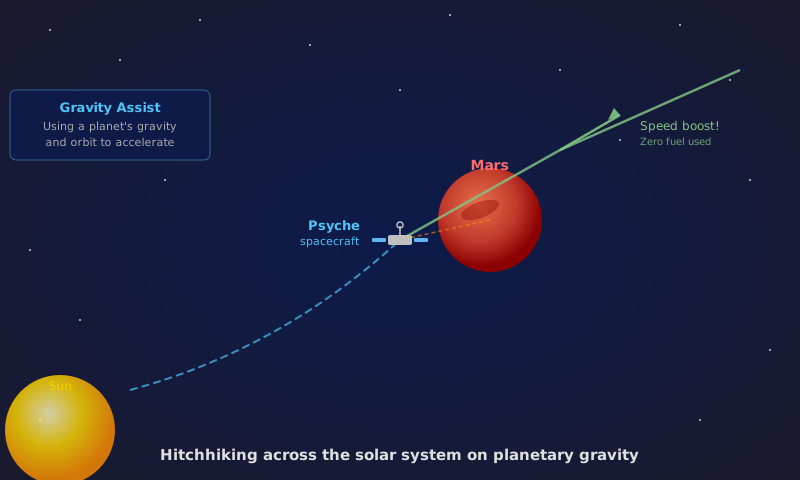
Gravity assist (sometimes called a gravitational slingshot) is one of the most elegant answers to that problem. The basic idea: use a planet’s gravity and its orbital motion to accelerate — or decelerate — a passing spacecraft, with no engine burn required.
On first instinct, this sounds suspicious. “If a spacecraft swings around a planet and leaves again, shouldn’t it come out at the same speed it went in?” In a sense, yes — and that’s exactly what makes this trick so interesting.
Why the Planet’s Frame and the Sun’s Frame Tell Different Stories
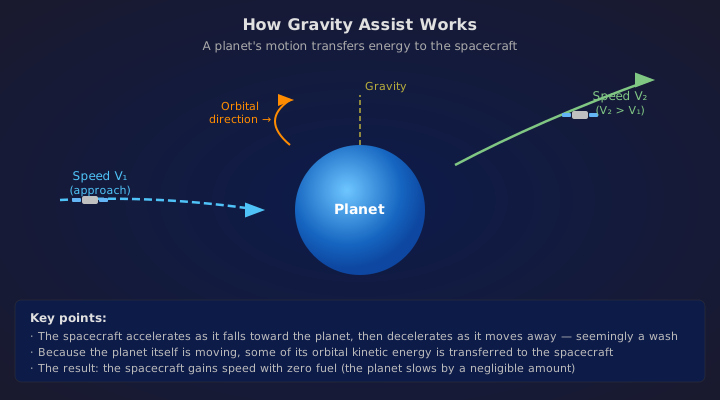
Here’s where it gets good. From the planet’s point of view, the spacecraft’s speed coming in and going out is essentially the same. Gravity pulls it in on approach and tugs it back on departure — the energy bookkeeping looks balanced.
But shift your perspective to the Sun, and everything changes.
Planets aren’t sitting still; they’re screaming around the Sun at enormous speeds. Earth’s orbital velocity is about 30 km/s. Jupiter’s is still 13 km/s. These are staggering numbers.
Now imagine a spacecraft approaching a planet from the front — the side the planet is moving toward. The spacecraft swings around behind the planet as the planet barrels forward in its orbit. At that moment, a tiny fraction of the planet’s enormous kinetic energy gets transferred to the spacecraft. From the Sun’s perspective, it looks like the planet flung the probe forward. That’s the essence of gravity assist.
The planet loses an infinitesimal amount of speed — completely negligible given its mass — while the spacecraft gains dramatically. Conservation of energy holds perfectly. No physics is being bent here; it’s just geometry and momentum done right.
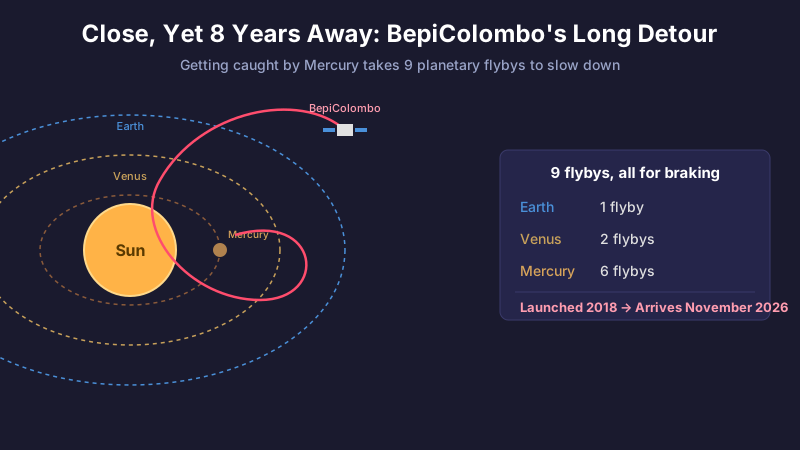
The same logic works in reverse: design the approach from the back side, and you can intentionally bleed off speed. Spacecraft headed for Mercury do this repeatedly, because without active braking they’d fall too fast into the Sun’s gravity well.
Voyager 2 and the Grand Tour
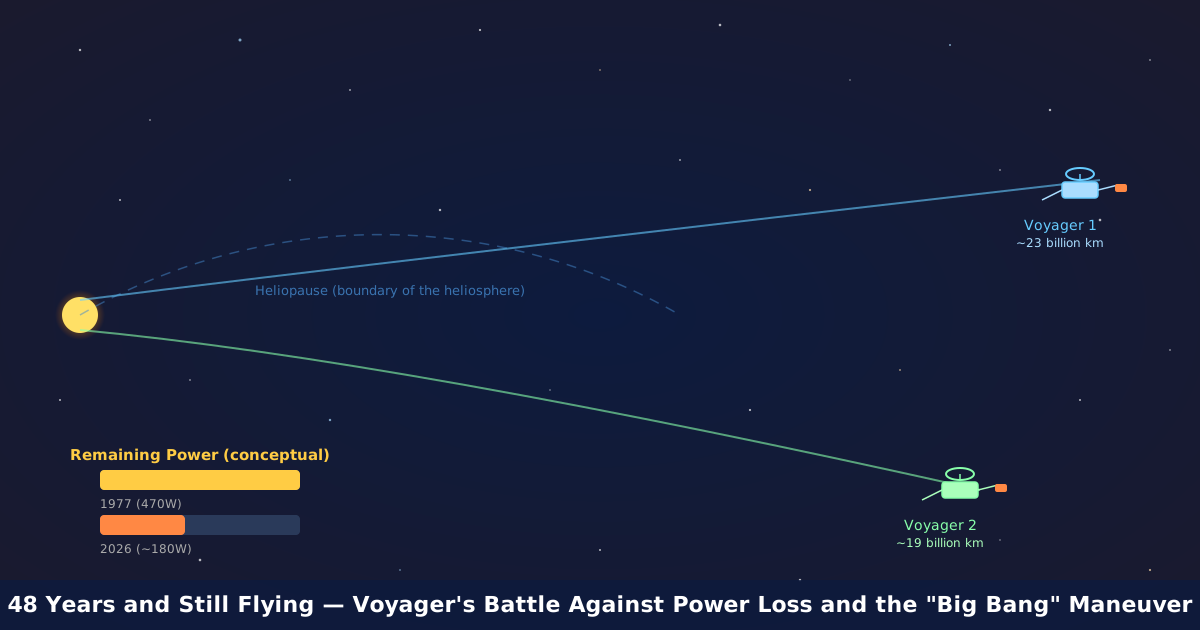
The theory was spectacular on paper. Voyager 2, launched in 1977, turned it into history.
Voyager 2 executed four back-to-back gravity assists — Jupiter, Saturn, Uranus, Neptune — and sailed out of the solar system without burning any significant extra fuel. The mission was called the Grand Tour, and it was possible only because those four planets happened to be lined up in a configuration that occurs once every 175 years. The 1977 launch window was one of those rare moments.
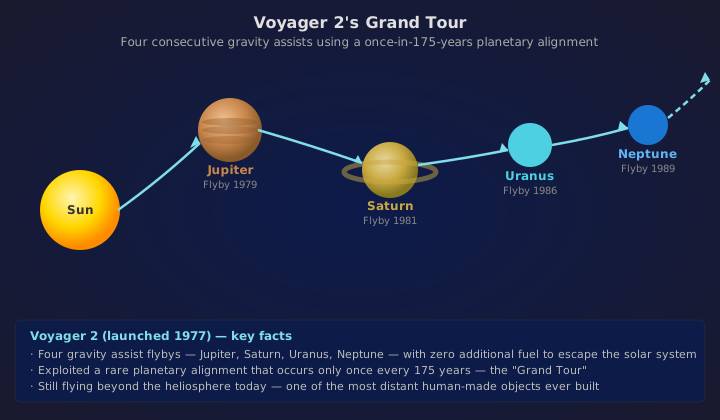
Without gravity assist, reaching interstellar space with 1970s technology would have required the equivalent of dozens of additional rocket stages. It was essentially impossible by any other means.
Gravity assist didn’t just help Voyager — it made the mission exist.
The Orbital Math Is Harder Than It Looks
“So you just aim near a planet and it speeds you up?” Not quite.
How much velocity you gain depends critically on your approach angle, closest-approach distance, and relative speed. A few degrees off on the entry vector can send you to the wrong place entirely. The margin for error is brutally small.
On top of that, you need precise models of the planet’s actual gravitational field — not just its average pull but the subtle variations caused by its shape, internal mass distribution, and moons. Planets aren’t perfect spheres; their gravity tugs differently depending on which way you approach. Modern orbital mechanics software accounts for all of this, but there’s always some irreducible uncertainty until the flyby actually happens and the telemetry comes in.
The fact that Psyche took about two years from its October 2023 launch to line up for the Mars flyby reflects exactly this precision. You’re not just flying through space — you’re computing bus stops that don’t have signs, and you have to arrive at the right nanosecond.
What Psyche Is Actually Doing Right Now
The Mars flyby wasn’t only about picking up speed.
While it swung past, Psyche’s multispectral imager collected thousands of images of Mars. These weren’t sightseeing photos — they were a real-world test of the instrument suite before the spacecraft reaches its actual destination. The magnetometer and gamma-ray spectrometer were also gathering calibration data.
During the closest approach, Mars would have appeared as a thin crescent from Psyche’s vantage point — the spacecraft was coming in from the night side, with only a sliver of Mars catching direct sunlight. Those images, if they’re ever released in full, should be something to see.
The destination itself is asteroid 16 Psyche, a roughly 220-kilometer-wide body that appears to be made almost entirely of iron and nickel — the same stuff you’d find at the core of a terrestrial planet. The leading hypothesis is that Psyche was once the core of a protoplanet that got stripped of its rocky mantle through ancient collisions. If that’s right, it’s the closest we’ve ever gotten to visiting a planetary interior.
Arrival is scheduled for late 2029. Whatever Psyche turns out to be, it’s going to rewrite something.
A Toolkit, Not Just a Trick
Gravity assist has become a standard tool of the trade, not an occasional shortcut. A few examples worth knowing:
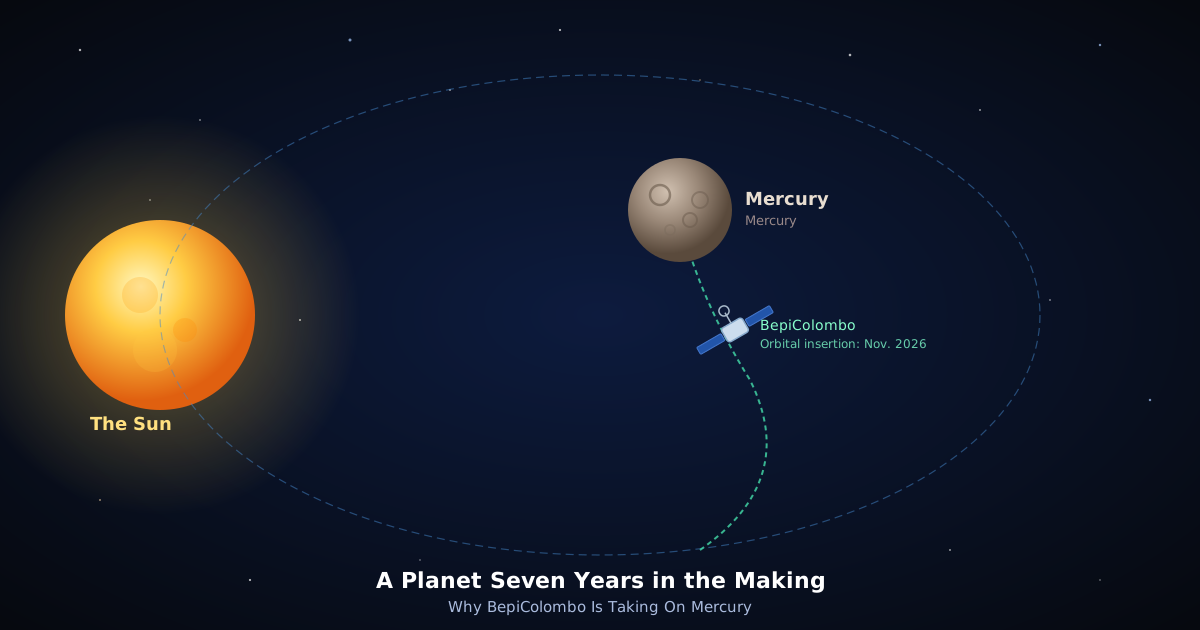
BepiColombo (ESA/JAXA): On its way to Mercury, the spacecraft needed to slow down — not speed up — to avoid overshooting into the Sun. It used one Earth flyby, two Venus flybys, and six Mercury flybys before finally entering Mercury orbit in 2025.
Cassini (NASA): En route to Saturn, Cassini swung past Venus twice, then Earth, then Jupiter. The Jupiter flyby alone added about 2 km/s to its speed — for free.
Juno (NASA): A Jupiter orbiter that, counterintuitively, looped back to Earth first to pick up a gravity-assist boost. In space, the long way around is sometimes the only way around.
Looking at these missions together, gravity assist starts to look less like a clever trick and more like critical infrastructure. Without it, the budget and physics of most outer solar system exploration simply don’t work.
Earth Is in on It Too
One last thing worth saying: gravity assist isn’t just about distant giants.
Earth’s own gravity gets used as a slingshot too. Juno is the obvious example, but it’s common practice for missions headed to Jupiter or beyond to swing past Earth for an extra kick before continuing outward. The planet that holds us to its surface is also the planet that helps us leave the solar system.
There’s something quietly satisfying about that. The same gravitational pull that keeps life anchored here also serves as the launching pad for machines we send to the edge of everything.
Psyche is out there now, riding the momentum Mars gave it, slowly closing the distance to a metal world. Three years to arrival. Whatever it finds at 16 Psyche, none of it would have been reachable without that free ride.