Midori Takada is, by any measure, an ordinary housewife. She just happens to have recently moved to space.
Her new address: Unit 208, Block B, Cosmos Estate — a residential complex in a mid-sized city on Ceres-3, near the trailing edge of the Orion Arm. Rent came out to roughly 60,000 yen a month in Earth currency, which was an almost suspiciously good deal. The property had ranked first on SpaceHome, the space-relocation listings site, for seven consecutive years. Admittedly, ninety percent of the reviewers had already moved out by the time she read those reviews. She found that out after signing the lease.
The problem was the distance to her neighbor.
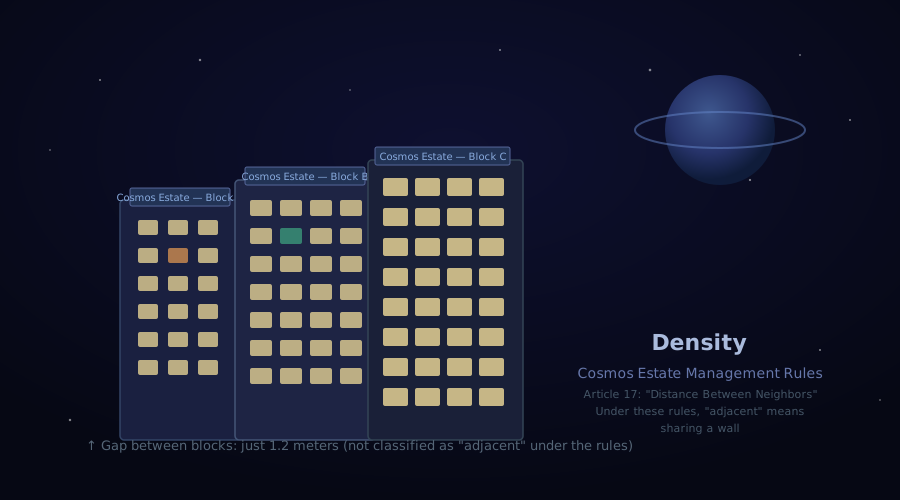
Cosmos Estate ran six blocks — A through F — lined up in a row. The average gap between blocks was 1.5 meters. Between Block B and Block C, it was 1.2 meters. Enough for one person to squeeze through sideways. Midori did exactly that every morning on her way to work, turning her shoulders at an angle.
“I can reach their window from mine,” she told the residents’ association complaint line. “The person in Block C once opened my window trying to ventilate theirs.”
The man on the other end — Tanaka — went quiet for a moment.
“Under the bylaws,” he said, “a gap of 1.2 meters or more does not qualify as ‘adjacent.’ Were you aware of that?”
“I was not.”
“The bylaws define ‘adjacent’ as sharing a wall. Since 1.2 meters is open space, it technically isn’t adjacency.”
“Then what is it?”
“It falls under ‘proximity.’”
So her neighbor, who was too close, was not legally a neighbor at all — just a proximate resident. Midori held the phone and said nothing for a while.
“But the sound carries straight through. I know what the people in Block C, Unit 208 had for dinner last night.”
“Ah, well —” She heard Tanaka typing. “Right, Block C, Unit 208 merged with Unit 209 last month, and Unit 215 joined them this month as well. Three residents now.”
“What do you mean, merged?”
“It’s when multiple tenants voluntarily consolidate their units. Happens a lot here, actually. Splits the costs.”
Now that she thought about it, the notice board outside the building manager’s office had a sign that got swapped out regularly: “New unit mergers this month: 3.” She had seen it in passing. Apparently that’s what it meant.
“Why do the mergers keep increasing?”
“Higher density strengthens the gravitational pull, in a manner of speaking. People gather where people already are. It’s something like a law of nature.” Tanaka paused. “Ms. Takada, what was the main point of your complaint again?”
“My neighbor is too close.”
“Right. Well —” She heard him checking something again. “Looking at the complex-wide data, Unit 208 in Block B actually has the closest proximity to another block of any unit in the estate.”
“What does that mean?”
“Block B, Unit 208 is the nearest unit to Block C. Which is to say — you’re the one doing the approaching, in a sense. Just slightly.”
Midori stood there with the phone in her hand and looked out the window. Block C, Unit 208 was 1.2 meters away. A light glowed behind the curtains. A smell drifted over — something cooking. Curry, probably.
”…Can I transfer to a unit that’s farther away?”
“Of course,” said Tanaka, and pulled up the floor plan for Block D. Block D sat 0.3 meters farther from Block C than Block B did.
This story is set on a fictional planet with no connection to any real celestial body. It was born from the thought that in a globular cluster, a space this dense might simply be everyday life.