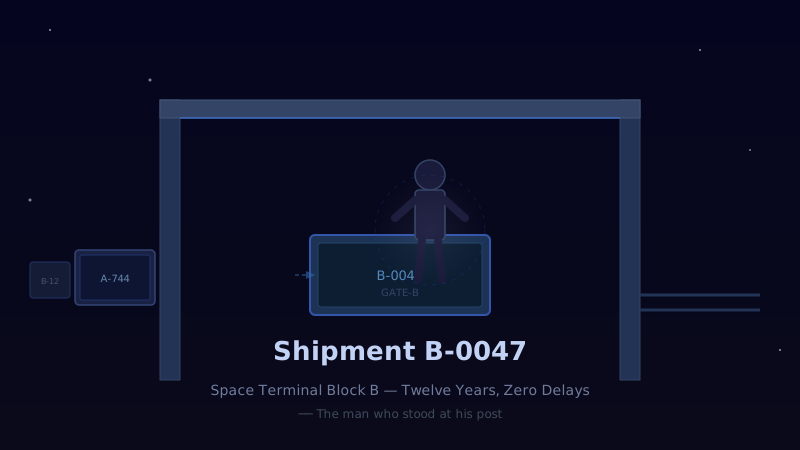
The week Tazawa retired, three delays hit Block B of the space cargo terminal.
On its own, that wouldn’t be unusual. But when his supervisor pulled up the records during the handover, she found something odd: in the twelve years Tazawa had been assigned there, Block B had logged exactly zero delays. All three had started the day he left his post.
“What was he actually doing over there?” asked Miyamoto, the new hire taking over.
“No idea,” said the supervisor. She didn’t look into it further.
Block B was a waypoint off the main Moon-Mars corridor — quiet, unglamorous, nothing like the busy A and C blocks nearby. At most two hundred cargo containers passed through on any given day. It was the kind of assignment that didn’t go anywhere. Tazawa had reported there every morning for twelve years without a word of complaint.
His job was to “watch the flow.” That was the official description. Gate timing, pressure shifts in the dock, the weight distribution of incoming loads — he’d feel for small irregularities and make tiny adjustments: a slight reorientation here, a nudge in spacing there. Most days he barely moved at all. Moving too much, he said, made things worse.
“I’m reading the wind,” he once explained to a new hire. There’s no wind in space, of course. What Tazawa meant, as best anyone could tell, was something like the invisible interplay of forces — containers interacting, micro-drafts in the dock atmosphere, small pressures that didn’t show up on any readout.
He was never quite able to explain it better than that. Most new hires nodded and went to find someone else to learn from. Tazawa seemed fine with that.
One year he was hospitalized for three weeks — gallstones. Other staff rotated through Block B in his absence. Seven delays occurred during that stretch. The operations log noted “increased cargo volume.” Cargo volume that year was up 1.2 percent over the previous year. When Tazawa came back and took his position again, delays returned to zero. Nobody connected the dots at the time.
On his last day, he and Miyamoto stood together in Block B for two hours. The operations manual said only: Personnel shall stand at the designated post. Every person who’d ever taken over from Tazawa had gotten stuck on that sentence, and Tazawa had always struggled to explain it.
“Where exactly should I stand?” Miyamoto asked.
Tazawa moved to a spot slightly off-axis from the gate — diagonal, maybe two steps to the side. “Here. You can see the containers as they come through, and you can hear the dock.”
“Why there specifically?”
“I don’t know. I just feel steadier when I stand here.”
Miyamoto looked puzzled. That’s fine, Tazawa thought.
Just then, container B-0047 rolled out from the back of the dock toward the gate, swaying more than it should. It was a weekly shipment Tazawa had always watched with a quiet kind of tension — badly loaded, center of gravity off.
He started forward, then stopped. “Over there,” he said to Miyamoto. “A little more to the right.”
Miyamoto stepped uncertainly to the spot. As B-0047 passed by, the swaying eased. It slipped cleanly through the gate and disappeared down the rail.
Miyamoto turned around. “What just happened?”
“No delay,” said Tazawa.
“I didn’t do anything.”
“Yeah.”
Tazawa didn’t add anything. Miyamoto didn’t ask.
That was the last thing Tazawa did in Block B.
Word reached him after he retired: Miyamoto hadn’t logged a single delay. Every day, the new hire stands slightly off-axis from the gate, watching the containers move through. When people ask why he stands there, his answer is always the same.
“I don’t know. I just feel steadier when I stand here.”