From Earth, an ordinary star is just a point of light — brighter or dimmer, a different color maybe, but still a point. The universe, though, hides surprises behind those points. Some are actually three stars merged into one dot, or systems where the stars cross in front of each other and dim in a rhythmic pulse.
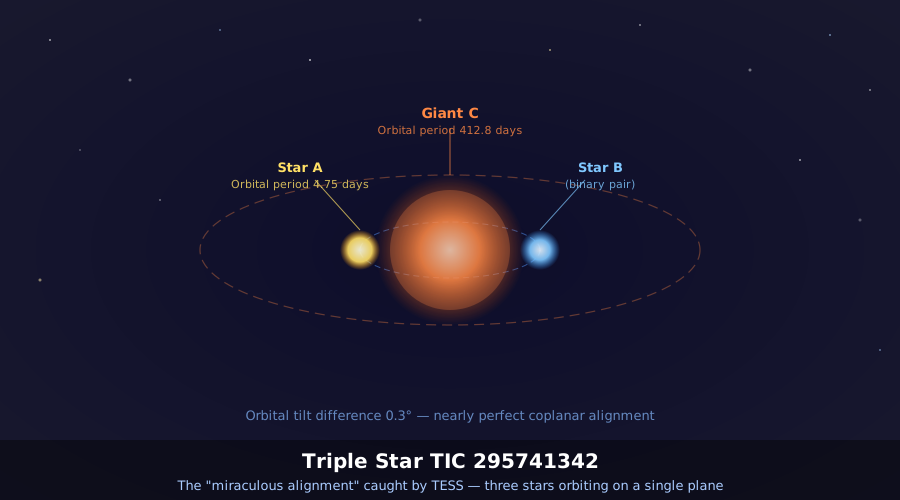
In May 2026, a NASA planet-hunting satellite called TESS flagged a system generating a lot of buzz: TIC 295741342. The alphanumeric label is forgettable, but the object itself is anything but. Three stars are orbiting on what is essentially a single flat plane — a degree of alignment so precise it borders on uncanny.
What Is a Triple Star System?
Start with the basics. Roughly half of all stars in the universe exist in binary systems — two stars gravitationally bound together, circling each other in an endless waltz. Single stars like our Sun are actually the exception, not the rule.
Go one step further and you get triple star systems: an inner binary pair with a third star orbiting both of them from a wider distance. They’re less common than binaries, but they show up across the galaxy.
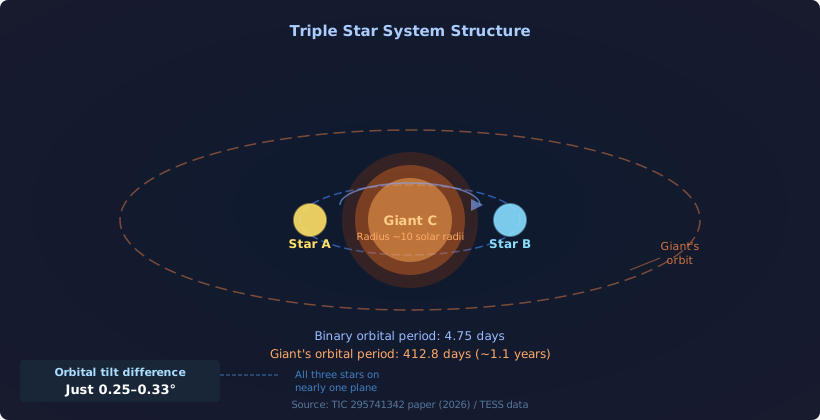
TIC 295741342 is one of those triples. The inner pair completes one orbit every 4.75 days, while the outer giant star takes 412.8 days — just over a year — to loop around the binary. That part isn’t unusual. What makes this system exceptional is that the orbital planes of all three stars are tilted by almost exactly the same angle.
Three Stars on One Flat Plane
When any object follows an orbit, that orbit traces a plane through space. Earth’s orbit around the Sun is a plane; the Moon’s orbit is close to the same plane. When multiple bodies are involved, those planes usually drift into slightly different orientations. In our own solar system, the planets all share “roughly” the same plane, but even Jupiter and Saturn deviate by a few degrees.
TIC 295741342 is different. The tilt difference between the inner binary’s orbital plane and the outer star’s orbital plane is just 0.25 to 0.33 degrees. Among all known triple-star systems, none come close to that level of alignment. It’s essentially the record holder.
That extreme coplanarity has a visible consequence. Because everything is so perfectly lined up when viewed from Earth, the inner binary can pass directly behind the outer giant — creating eclipses that no randomly oriented triple would produce.
The “Head and Shoulders” Light Curve
In astronomy, when one star crosses in front of another, the total light reaching us drops slightly. That’s called an eclipse, and stars that dim in this regular pattern are called eclipsing variables.
In TIC 295741342, the triple alignment generates three overlapping layers of eclipses. The inner binary stars already eclipse each other every 4.75 days. But every 412.8 days, the whole binary pair disappears behind the larger outer giant — a third eclipse on top of those.
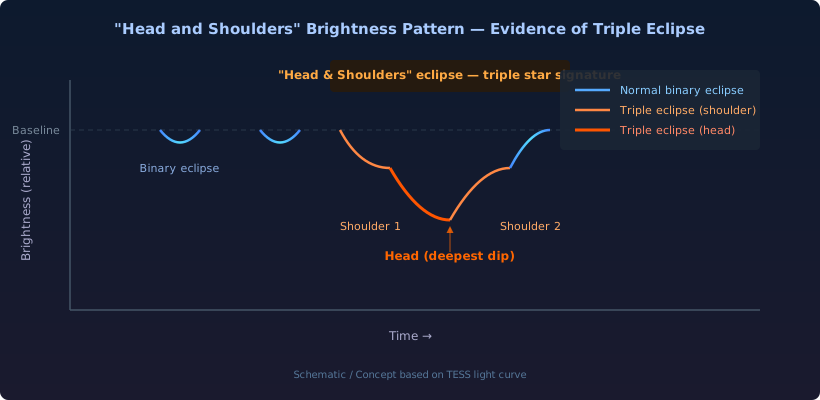
The shape of that combined event is striking enough that the research team named it: “head and shoulders.” Look at the light curve and the nickname makes immediate sense. First, Star B slides behind the giant and the total brightness dips — one shoulder. Then Star A follows, pushing the brightness to its lowest point — the head. As both stars emerge in reverse order, the curve rises through another shoulder and back to baseline. It’s not a clean, symmetric dip; it’s a structured silhouette in data.
That shape carries real information. Because the two inner stars differ in size and luminosity, and they enter and exit at different times, the light curve encodes the relative sizes and brightnesses of all three stars. Astronomers can read all of that from a single graph — like inferring the shape of furniture in a room by watching shadows move across a wall.
Triple eclipsing systems with this level of detail are extraordinarily rare. You won’t find many of them.
Why Wasn’t It Found Sooner?
Catching a system like this requires long, precise, continuous monitoring. The binary eclipses repeat every 4.75 days — that’s frequent enough to spot. But the triple eclipse, the big event involving the outer giant, only comes around once every 412.8 days. Miss that window and you have nothing unusual.
TESS watches hundreds of thousands of stars from space, continuously, without the interruptions that plague ground-based telescopes — bad weather, daylight, seasonal gaps. That kind of persistent all-sky survey is the only way to reliably catch events that happen less than once a year.
On top of the light curves, the research team collected 48 spectra to measure the radial velocities of the stars — how fast each one is moving toward or away from us, tracked via the Doppler shift. That independent dataset confirmed the masses and sizes derived from the eclipse geometry, cross-validating the whole picture.
What Happens to the Giant Next?
The largest star in the system, the outer giant (Star C), appears to be mid-way through its evolution toward becoming a red giant. Stars heavier than the Sun eventually swell to enormous sizes as they exhaust their core hydrogen.
The question is: what happens to the inner binary when Giant C finishes expanding? As the star bloats outward, it will eventually reach a boundary called the Roche lobe — the point where its own outer layers are no longer held in place by gravity and begin to spill toward the inner pair.
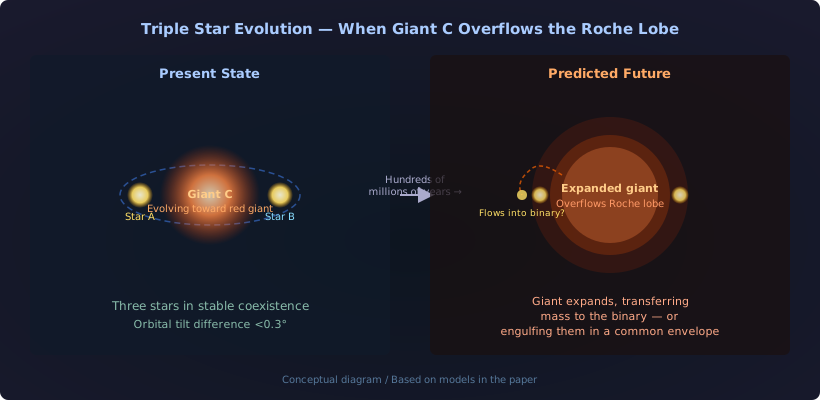
The researchers lay out two scenarios. In the first, Giant C transfers mass gradually and stably to the binary — a long, slow exchange. In the second, the giant engulfs the binary in a “common envelope,” a short, violent phase where all three stars are briefly wrapped in shared stellar gas. The two paths lead to very different endpoints: a white dwarf in a wide orbit, or a dramatically tightened binary system.
The current data doesn’t yet distinguish between these futures. Even the present evolutionary state of Giant C is uncertain — the team notes that the star could plausibly sit at either the red giant branch or the horizontal branch, and both interpretations remain on the table.
A Window TESS Opened
One of the more tantalizing implications of TIC 295741342 is that it’s probably not alone. Systems with this geometry — close enough to coplanar that all three eclipses line up — must exist elsewhere in the galaxy. TESS is still operating, scanning the sky and building up a long baseline of observations. The Vera Rubin Observatory, scheduled to begin science operations after 2027, will push the census even further with its unprecedented combination of depth and sky coverage.
Triply eclipsing systems are only visible when the geometry points exactly toward Earth. We have to be sitting in just the right direction. TIC 295741342 happened to open one of those windows for us.
A tilt difference of 0.3 degrees. Keep that number in mind the next time you look up at a sky full of points. Behind some of them, three stars are quietly crossing each other’s paths in near-perfect alignment — waiting for someone to notice.
Sources: