Step outside on a clear evening and look west. Around June 9, you’ll notice two unusually bright points of light sitting remarkably close together in the sky.
One is Venus, the other Jupiter. Unlike the fixed stars around them, both planets hold their light steady — no twinkling. They emerge sooner after sunset than any other object in the sky, and on the evening of June 9, 2026, they’ll be as close as they’ve been in years.
This kind of event has a name: a planetary conjunction.
Two Lights in the Evening Sky
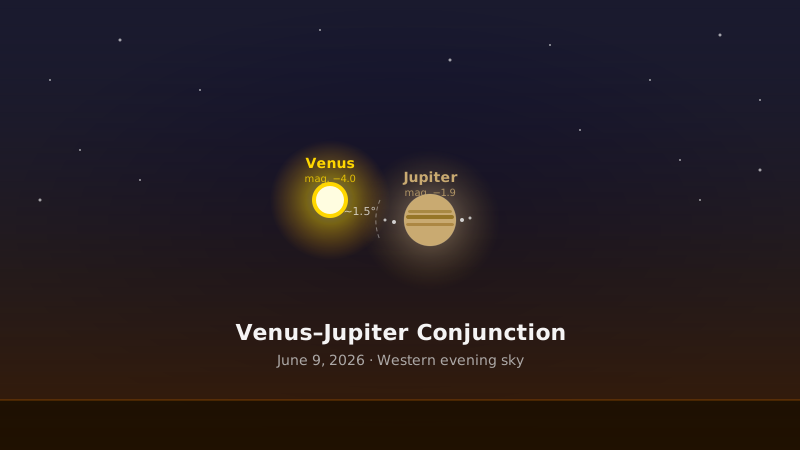
In early June, if you face west-northwest after dusk, two bright objects will catch your eye. They won’t be high — just 10 to 15 degrees above the horizon, roughly the width of your fist held at arm’s length.
The closest approach happens around June 9, when the two planets narrow to about 1.5 degrees apart. One degree is roughly twice the apparent diameter of a full Moon, or a little wider than a fingernail at arm’s length. Seeing two planets share the same narrow slice of sky is a genuinely striking sight.
If you have binoculars, point them at Jupiter and you’ll make out the banding across the disk and four tiny points of light — the Galilean moons, the same ones Galileo spotted through his telescope in 1610. Venus, by contrast, will appear as a brilliant white disk with no visible surface detail.
No special equipment is required. A reasonably dark sky and your eyes are all you need.
What a Conjunction Actually Is
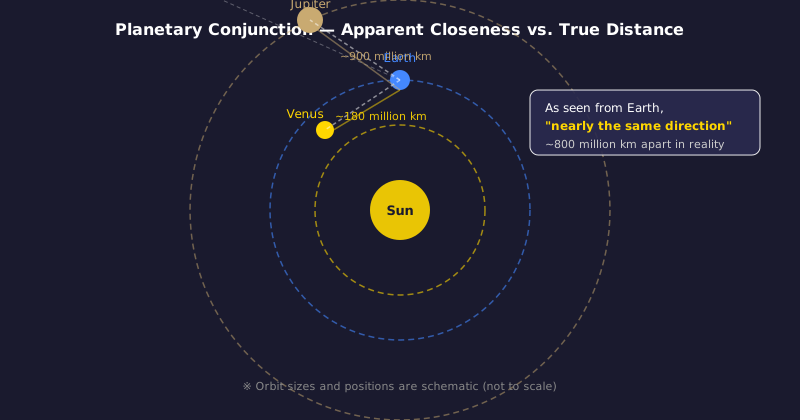
Here’s the thing worth understanding: Venus and Jupiter are not actually close to each other.
On June 9, Earth and Venus will be separated by about 180 million kilometers. Earth and Jupiter, meanwhile, are about 950 million kilometers apart. The difference between those two distances is nearly 800 million kilometers. In a real sense, they’re heading in almost opposite directions from us.
They appear to “meet” in the sky because Earth happens to lie along a viewing angle where the two planets line up in nearly the same direction. Venus sits in the foreground; Jupiter is vastly farther away. From our vantage point on Earth, their directions temporarily coincide — and that’s a conjunction.
In astronomy, when two celestial objects draw close on the sky’s surface, the event is called an “appulse” or more loosely a “conjunction.” The underlying reality is simply that their angular positions, as seen from Earth, have converged.
Why Venus Is So Much Brighter
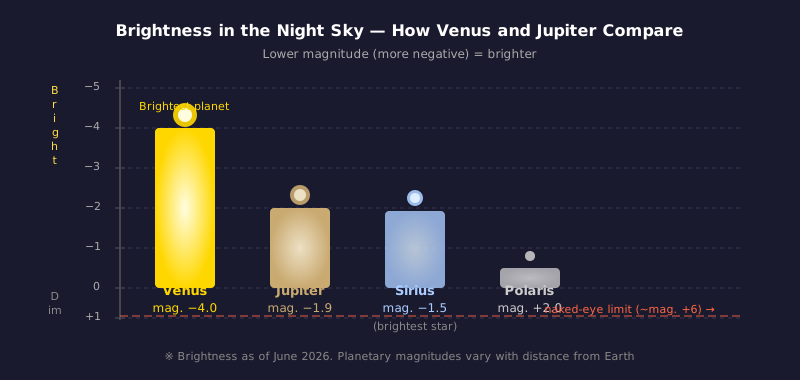
When Venus and Jupiter appear side by side, the difference in brightness is obvious. At closest approach, Venus shines at magnitude −4.0, while Jupiter comes in at −1.9.
In the magnitude system, smaller numbers mean brighter objects. The gap of just over two magnitudes translates to a brightness ratio of roughly 6 to 7 times — quite a gap for two planets in the same patch of sky.
Two factors explain it.
First, distance. Venus is an inner planet, meaning it orbits the Sun inside Earth’s orbit. That makes it dramatically closer to us than Jupiter at times like this — about 180 million kilometers versus 950 million. Distance alone accounts for a fivefold difference in brightness.
Second, reflectivity. Venus is wrapped in a thick layer of sulfuric acid clouds that bounces back around 70 percent of incoming sunlight. Jupiter has clouds too, but its albedo is considerably lower. Combine the distance advantage with that high reflectivity, and Venus becomes the brightest object in the night sky after the Moon.
For reference, Sirius — the brightest star in the sky — shines at magnitude −1.46, comparable to Jupiter tonight. It’s a winter constellation and not visible now, but the comparison gives you a sense of how dramatically Venus outshines everything else on this occasion.
Why Conjunctions Keep Happening
Planets “meeting” in the sky isn’t a coincidence. It’s a predictable consequence of the fact that Earth, Venus, and Jupiter each orbit the Sun at different speeds.
Earth takes about 365 days to complete one lap. Venus takes roughly 225 days. Jupiter takes about 12 years. With three objects orbiting at independent rates, the geometry occasionally aligns so that Venus and Jupiter appear in nearly the same direction from Earth — and conjunctions repeat on a regular, if somewhat irregular, schedule.
Venus and Jupiter conjunctions happen roughly once or twice a year on average, though the closest angular separation varies widely. Sometimes they get within a degree of each other; other times they merely pass within a few degrees. The 1.5-degree approach on June 9 is a reasonably close one.
Not every conjunction is visible. If the alignment happens when both planets are near the Sun in the sky, they’ll be lost in the daytime glare. This one falls in the western evening sky — an excellent position for northern hemisphere observers. Conjunctions that occur at dawn or in the daytime are much harder, or impossible, to see.
Conjunctions that combine a close approach with good observing geometry happen every few years. This one clears both bars.
How to Actually See It
This conjunction is favorably placed for observers across Japan — and, indeed, most of the Northern Hemisphere. A few practical tips:
Choosing your spot. You need a clear view of the western horizon. Tall buildings or mountains to the west will cut off your window. Riverbanks, parks, and open coastal areas are ideal, but a west-facing window works perfectly well.
Timing. On June 9, the sweet spot is roughly 7:30 to 9:00 p.m. local time. Right after sunset, the sky is still bright enough that only Venus is visible. Give it 20 to 30 minutes and Jupiter will emerge. By 9:00 p.m. the pair will be sinking toward the horizon, where atmospheric haze starts to interfere.
Binoculars. Bring them if you have them. At 10× magnification you’ll see Jupiter’s equatorial bands and all four Galilean moons. Venus shows as a featureless bright disk. A telescope reveals more, but it isn’t necessary for an enjoyable view.
Smartphone photography. This is well within the capability of a modern phone camera. A tripod eliminates camera shake and lets you use night mode or a longer exposure. Keep ISO in the 400–800 range; pushing it higher introduces noise. The combination of two bright planets and the last traces of twilight color makes for a compelling image.
Memorable Conjunctions from the Past
Planets appearing close together in the sky has captured human attention for as long as people have watched the night sky.
The “Great Conjunction” of December 21, 2020 is the most famous recent example. Jupiter and Saturn drew to within just 0.1 degrees of each other — almost indistinguishable as separate objects to the naked eye. Astronomers noted it was the closest approach between those two planets since Galileo was alive to use his telescope.
In June 2015, Venus and Jupiter closed to 0.3 degrees, close enough that many casual observers couldn’t separate them without optical aid.
Tonight’s 1.5-degree approach isn’t quite in that category of drama, but the pairing of Venus’s overwhelming brightness with Jupiter’s imposing bulk — and the visual puzzle of figuring out which is which — makes it worth the effort of stepping outside.
What’s Coming Next
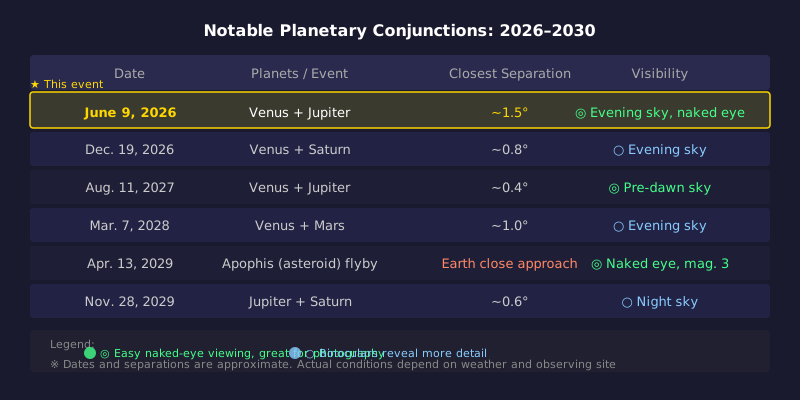
Planetary pairings happen on a regular cadence. Looking ahead, the next standout event is August 11, 2027, when Venus and Jupiter will meet again — this time closing to just 0.4 degrees, tighter than tonight. The catch: it happens in the pre-dawn eastern sky, so early risers get the reward.
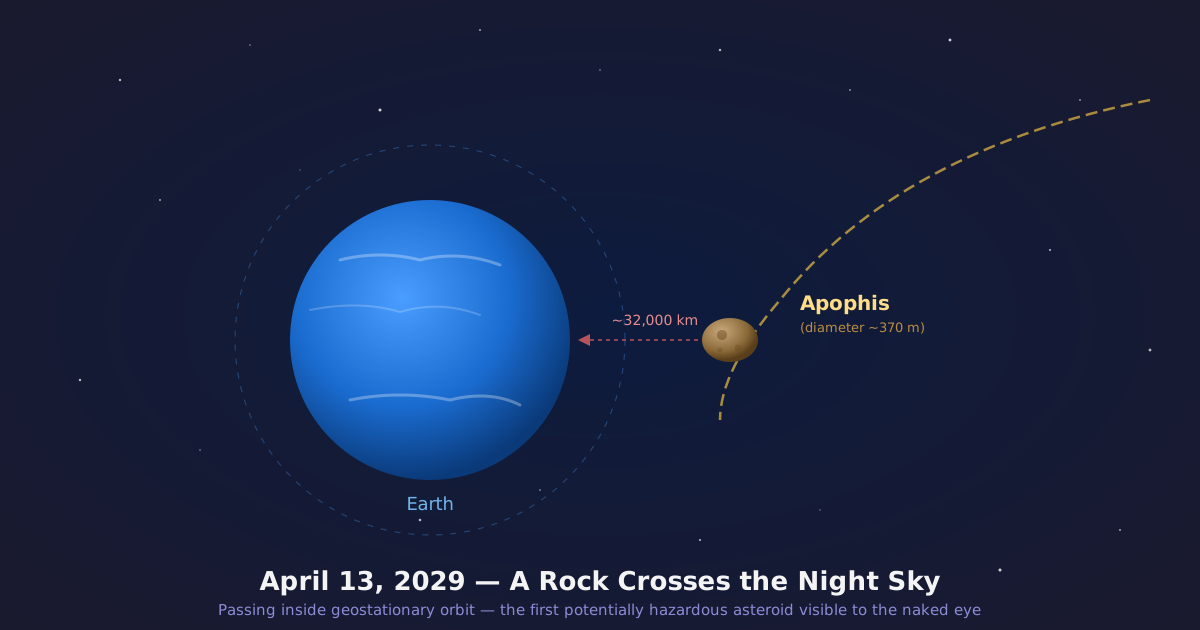
On April 13, 2029, the asteroid Apophis will make a close flyby of Earth. It’s a different kind of event — not a conjunction — but it’s expected to brighten to magnitude 3, visible to the naked eye as a slowly moving point of light. It’s a genuinely rare opportunity.
Once you start paying attention to where the planets are, the night sky stops being a static backdrop. Jupiter shifts a little east week by week. Venus swings in and out of the evening and morning sky over the course of months. Taking a photo tonight and comparing it to next week’s view is the simplest way to experience that motion directly.
The Joy of Watching Things Move
The word “planet” comes from the Greek for “wanderer.” Ancient observers gave these objects a special status precisely because, unlike the fixed stars, they moved. Night to night, week to week, the planets drift against the stellar background.
Getting into the habit of noticing where the planets are transforms the night sky into something that changes rather than just exists. Track Jupiter’s position over a month against a background constellation and you’ll actually see it shift. Venus goes through phases, swings from the evening to the morning sky, and grows dramatically in apparent size as it approaches Earth.
June 9 is a good place to start. Note where the two planets are, photograph them if you can, and then check back in a week. By then they’ll have visibly separated. The conjunction is a beginning, not an end — the planets keep moving long after the closest approach.
A telescope and a motorized mount are not required. A smartphone and a little curiosity are enough.
Observational data: EarthSky, NASA JPL Horizons