Honestly, when I first heard the number, I thought someone had made an arithmetic error.
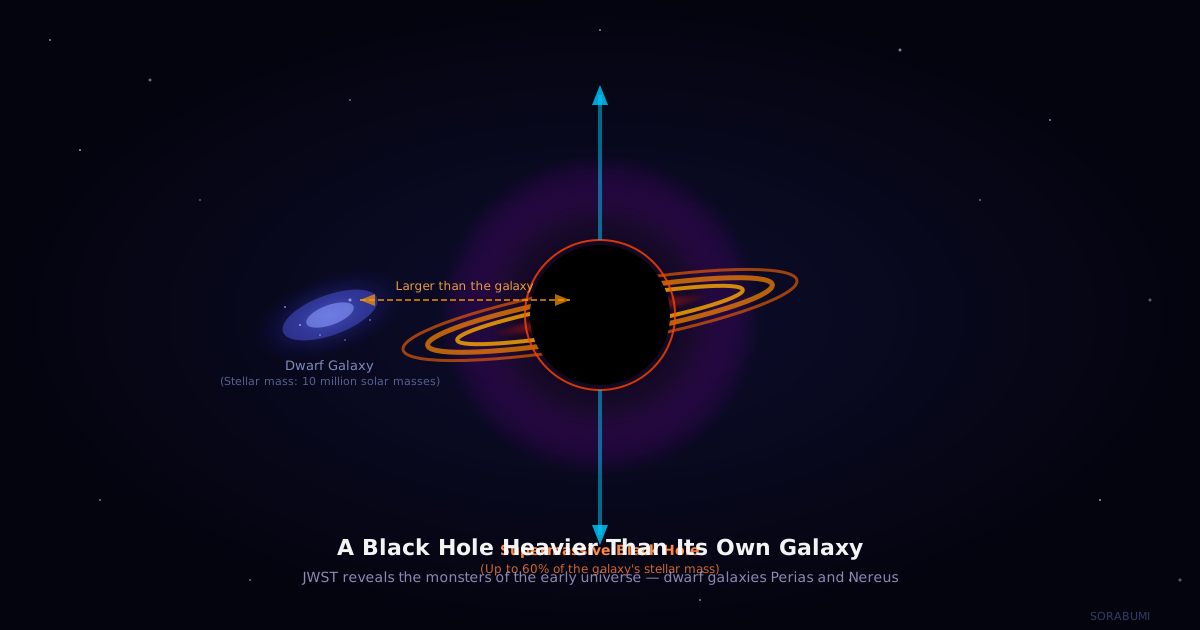
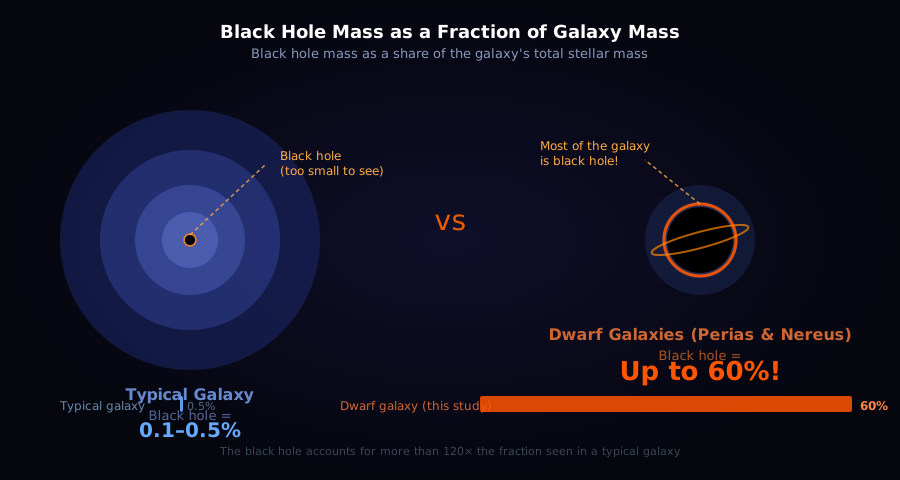
The mass of a black hole at the center of a galaxy is typically around 0.1 to 0.5% of the galaxy’s total stellar mass. But a study published in March 2026 reported that the central black holes of two dwarf galaxies account for up to 60% of those galaxies’ stellar mass.
Sixty percent. The galaxy isn’t really a galaxy anymore — it’s mostly black hole. And this isn’t only happening in the deep, ancient past. These objects were spotted in a universe that was already about 7 billion years old — relatively “recent” on cosmic timescales. So what’s going on here?
Two Very Strange Galaxies: Perias and Nereus
The discovery centers on two dwarf galaxies named Perias and Nereus, located at redshifts of roughly 0.71 and 0.75, respectively. Redshift is the stretching of light wavelengths caused by the universe’s expansion — a proxy for distance and look-back time. At these redshifts, we’re seeing these galaxies as they appeared about 7 to 7.5 billion years ago.
Dwarf galaxies are, as the name suggests, tiny. The Milky Way contains somewhere between 200 and 400 billion stars. Perias and Nereus have a stellar mass of only about 10 million solar masses — less than one ten-thousandth of our galaxy’s scale.
And yet, hiding at the center of these small systems was something monstrously out of place. A research team led by Eduardo Iani of the Institute of Science and Technology Austria analyzed JWST data and revealed what had been lurking there.
Why “Out of Place” Matters
There’s a strangely consistent ratio between galaxies and their central black holes.
Survey large galaxies across the cosmos, and you’ll find that the supermassive black hole at the center is typically around 0.1 to 0.5% of the surrounding stars’ combined mass. Nobody fully understands why this ratio holds so well. But because it shows up in galaxy after galaxy, scientists have long concluded that galaxies and black holes must grow together somehow — a process called co-evolution.
That expected ratio is 0.5%. These galaxies came in at 60%.
That’s more than 120 times the normal proportion. Think of it this way: in a typical house, the entryway takes up maybe 0.5% of the floor plan. In this house, the entryway swallows 60% of the space. There’s almost no room left to live in.
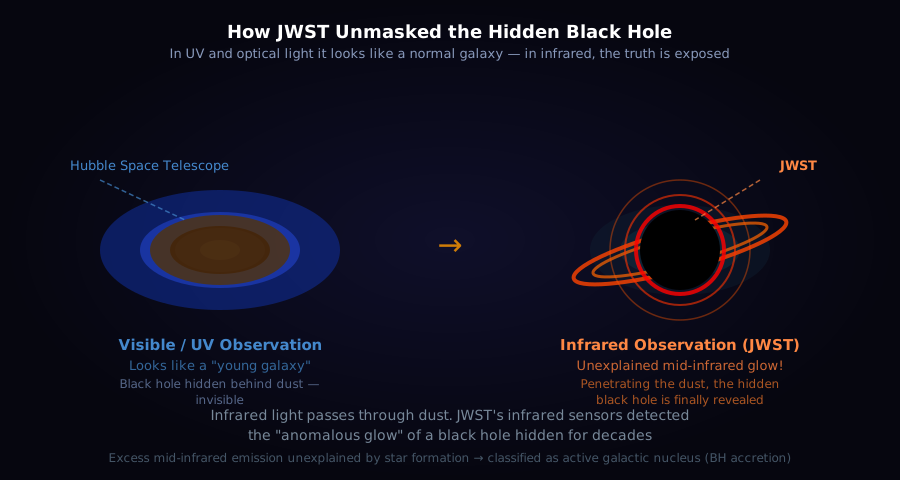
What makes this even more striking is that these dwarf galaxies don’t look unusual at first glance. Researchers describe them as actively forming stars — vibrant, young-looking systems. In visible and ultraviolet light, they appear to be nothing more than energetic star-forming galaxies. The black holes are almost undetectable.
The Monster Behind the Dust
The secret revealed itself when JWST observed in infrared.
Dust — cosmic dust — blocks visible light but is largely transparent to infrared radiation. The James Webb Space Telescope is purpose-built for infrared astronomy, and its defining advantage over Hubble is exactly this: it can see through the dust to what lies behind.
When JWST turned its instruments on Perias and Nereus, it detected an anomalous excess of mid-infrared emission — radiation that couldn’t be explained by star formation alone. In the researchers’ own words, it was “strong infrared emission that stars cannot account for.”
The likely explanation is an accretion disk — the swirling structure that forms as a black hole draws in surrounding gas. As that gas spirals inward, friction heats it to extreme temperatures and it blazes with radiation. Visible light gets absorbed by the surrounding dust and never escapes, but longer-wavelength infrared radiation punches through. JWST caught that hidden glow.
By analyzing the magnitude of the mid-infrared excess, the team calculated that the black holes’ masses reach up to 60% of the galaxies’ stellar mass.
Galaxy First, or Black Hole First?
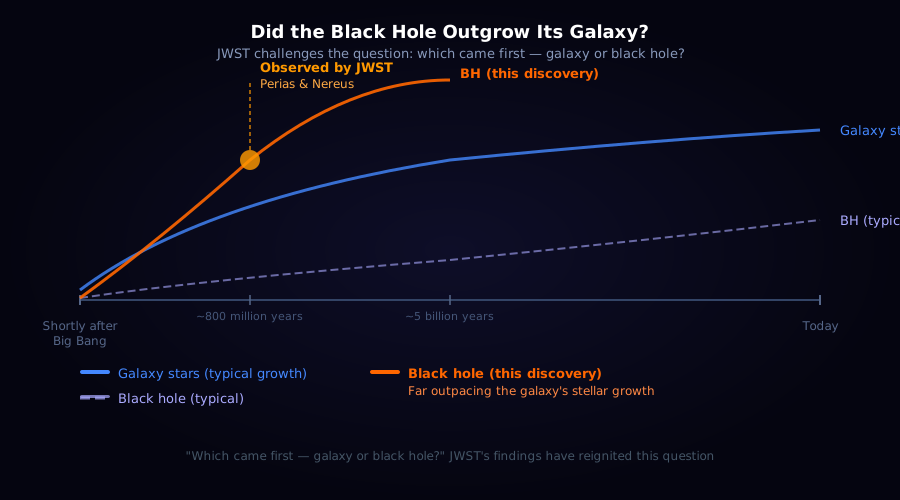
This discovery presses on a fundamental question in cosmology.
For a long time, astronomers have puzzled over why galaxy growth and black hole growth track each other so closely. The near-constant ratio suggests some kind of feedback mechanism. When a black hole grows too large, it releases enormous energy that blows gas outward, suppressing star formation. When star formation runs hot, it consumes gas that might otherwise feed the black hole. The two regulate each other, and a balance is maintained — or so the theory goes.
Perias and Nereus broke that balance. Their black holes outgrew the galaxies by a wide margin.
One possible explanation is super-Eddington accretion. Normally, there’s an upper limit — the Eddington limit — on how fast a black hole can consume surrounding material. But in the early universe, gas was far more abundant, and some black holes may have grown at rates exceeding that limit. The black hole essentially gorged itself, ballooning in mass before the galaxy’s star formation could keep pace.
Another possibility is that the black hole came first. There’s a longstanding hypothesis that in the very earliest moments of cosmic history — before galaxies had fully assembled — “seed black holes” already existed. Much of what JWST has observed in the early universe supports this “seed black hole” scenario, and the discovery of Perias and Nereus fits neatly into that picture.
Overmassive Black Holes May Be Everywhere
Since JWST came online, reports of black holes that are “too large” for their host galaxies have been piling up.
In May 2026, two galaxies observed just 800 million years after the Big Bang were found to harbor black holes growing faster than the galaxies themselves — at redshifts of 7 to 8, placing them in the very remote past. Perias and Nereus, at redshift 0.7, show that the same thing was happening in a much more recent universe.
In other words, overmassive black holes aren’t just a quirk of the early cosmos. They appear to persist further into cosmic history than anyone expected.
What does that imply? The conventional picture held that as the universe aged toward the present, galaxies and black holes would settle into their familiar proportions. But it now looks like dwarf galaxies in particular may be prone to breaking that balance. Their low total mass makes it hard for them to hold onto gas — and once a black hole in a small system starts running away, there may not be enough inertia to stop it.
Researchers suspect this is the tip of the iceberg. JWST observations are still in their early days. Surveys that relied on visible light alone were almost certainly missing these dust-shrouded, runaway black holes hiding in small galaxies.
Which One Is the Host?
Astronomy has long used the word “co-evolution” to describe the relationship between galaxies and their central black holes — the idea that the two grow together, at roughly the same pace, shaping each other over cosmic time.
This discovery challenges that framing. At least in some dwarf galaxies, the black hole didn’t evolve alongside the galaxy — it sprinted ahead. Or perhaps it was there from the start, and the galaxy formed around it.
That raises a quietly unsettling question: when we say “a black hole inside a galaxy,” is the phrasing even accurate? For objects like Perias and Nereus, “a galaxy surrounding a black hole” might be the more honest description.
JWST will keep drilling into the universe’s past. Over the next few years, the data on this topic will only accumulate. The story of how galaxies and black holes became what they are today is still being rewritten.
Reference: E. Iani et al., “JWST Reveals Two Overmassive Black Hole Candidates in Dwarf Galaxies at z≈0.7”, submitted to Astronomy and Astrophysics (2026)