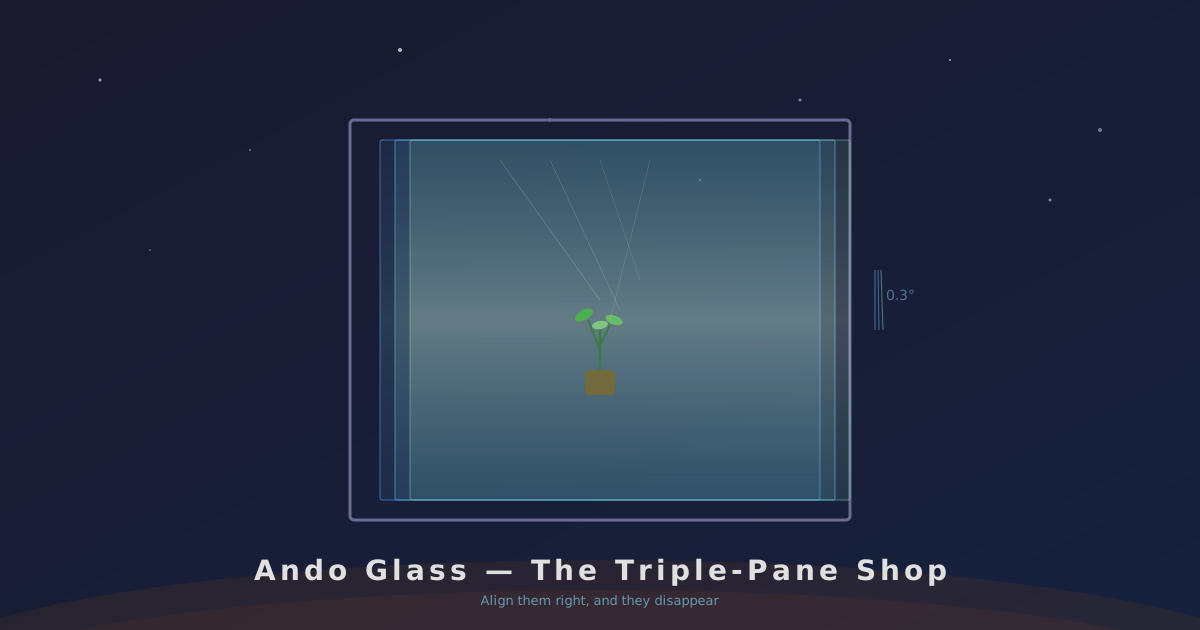
Ando Glass has been doing almost no business in the Clayton District of Mars for three years running.
Ando is the owner — a window glazier who spent his working life on Earth before crossing to Mars in his sixties to start the same trade all over again. Mars building codes require a minimum of two panes for any window, and you get fined if the insulation and airtight seal don’t pass inspection. So every glazier in the district sells double-pane windows. Ando sold those too. But there was something else he wanted to sell.
Triple-pane windows.
“You’d think three panes would make it cloudier, right?” he says to pretty much anyone who’ll listen — customers, delivery drivers, the occasional passerby who wanders in to ask directions. “But if you stack all three with the angles perfectly matched, zero drift, it goes the other way. Clearer than two panes. Much clearer.”
Apparently this is true. The display unit at the back of the shop genuinely lets you read the water stain on the wall behind it. But customers tend to have the same reaction: “Two panes is fine,” and out they go. Ando himself can’t explain the physics of it, to be honest. Line them up right and they go clear. That’s all he knows.
For what it’s worth, the installation fee for triple-pane is double that of double-pane, though the materials cost about the same. The difference is almost entirely labor — because if you can’t get all three aligned to within 0.3 degrees, you end up with nothing but a frosted mess. Ando had staked sixty years of his craft on that precision. Three years without a single taker made for a rather sad story.
That afternoon, a man named Nakata came in.
Nakata was in his forties, living in the apartment block two doors down. He had a gentle face, though he looked tired in a vague, hard-to-place way.
“I’d like to replace my west-facing window,” he said.
“Double-pane?”
“No — triple.”
Ando asked him to repeat that. Twice.
The story was this: Nakata’s west window looked out onto the wall of the next building. Most days, all he could see through the double-pane glass was a dull blur of gray. But lately he’d noticed a small crack in that wall. Through the gap, the tip of a plant leaf poked out — something his neighbor had sitting on a windowsill.
“I want to see that green properly.”
So that was the kind of reason that could get someone to order triple-pane. Ando nodded without a word and set out the next morning for his first triple-pane installation in three years.
The job took a full day. Three panes of glass, a spirit level, custom jigs, endless fine adjustments until all three sat within 0.3 degrees of each other. When he tightened the last bolt at dusk, the window had gone almost impossibly clear. The crack in the neighbor’s wall was right there. The leaf tip poking through the crack was right there. He could see the veins.
Nakata stood in front of the window looking satisfied. Ando packed his tools and quietly let himself out.
The next day, Nakata came back to the shop. His expression was a shade tighter than the day before.
“Ando-san — it’s too clear.”
“Yes.”
“The leaves are fine. They look beautiful. But — the crack in the wall is big enough that I can see inside the neighbor’s apartment. A laundry basket. A pair of socks on the floor.” He paused, like he was weighing how to say the next part. “When I was standing at the window, the person over there was looking back at me.”
Ando made it a habit to just listen at moments like this.
“So — I think I’d like to go back to two panes after all—”
Nakata was mid-sentence when the shop door opened.
“Excuse me, is this Ando Glass? I’m Murase, from the building next door.”
A woman, somewhere in her forties, with an expression that hovered between apologetic and hopeful.
“I heard the neighbor across the way — Mr. Nakata — got an incredibly clear window installed. I was wondering if I could order the same for my east-facing window — oh. Mr. Nakata.”
Nakata stood there with his mouth open. Murase gave a small smile.
“I tidied up the laundry basket.”
Ando turned to the second sheet of his order pad for the first time in three years. There was no waitlist in the shop — nothing so organized as that. He took the back of a receipt, wrote “2” in ballpoint pen, and stuck it on the wall.
When celestial bodies align along the same plane, they can block each other’s light — and in doing so, reveal information that would otherwise stay hidden.