Does a planet dozens of light-years away have air?
Nobody can travel there, and no telescope can magnify it into anything more than a point of light. Yet astronomers will tell you, matter-of-factly, “that planet has an atmosphere.” For a long time, I couldn’t figure out how they knew.
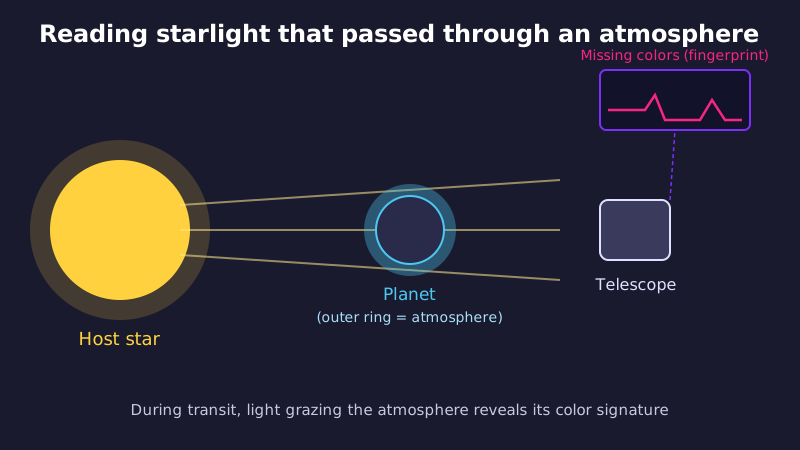
Here’s the trick: they’re not actually looking at the planet at all. They’re reading the color of starlight that grazed past it. That’s the story I want to tell today.
We Never Actually See the Planet
Let’s start with an uncomfortable fact. Almost nobody has ever directly seen an exoplanet — a planet orbiting a star other than the Sun.
More than 6,000 exoplanets have been confirmed since the first one turned up in 1995. That’s roughly 30 years to reach today’s tally. But the vast majority were never “photographed.” A tiny planet sitting right next to a blazing star simply drowns in the glare.
Picture trying to spot a nightlight hovering right beside a full moon, from a great distance. The nightlight loses that contest before it even starts.
So researchers changed their approach. Instead of trying to see the planet itself, they decided to read what the planet does to the starlight passing by.
So what exactly do you look for in that light?
The Few Hours When a Planet Crosses Its Star
The clue begins the moment a planet passes in front of its host star, as seen from Earth.
When a planet lines up directly between us and its star, it blocks a sliver of starlight, and the star’s brightness dips ever so slightly. Astronomers call this a “transit.”
The size of the dip depends on how big the planet and star are, but it typically runs from about 0.01% to 1%. An Earth-sized planet crossing a Sun-sized star, for instance, dims the star by roughly 0.008% — a mere 84 parts per million. It’s an almost absurdly small number.
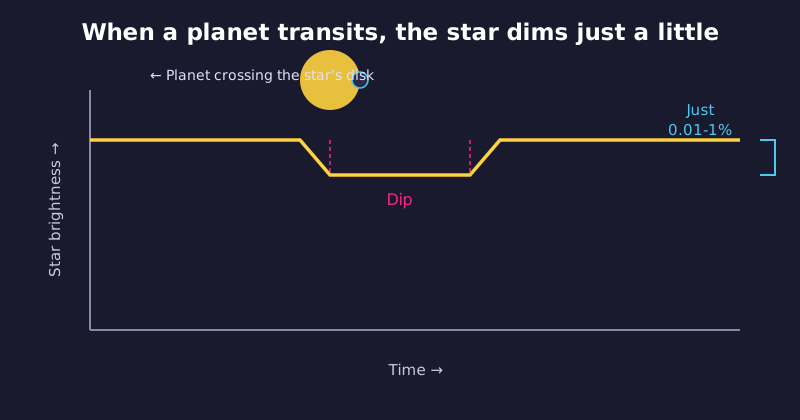
The good news: this transit repeats like clockwork, once per orbit. Astronomers observe the same transit over and over, patiently stacking the faint signal until it rises out of the noise. A single pass would get lost; repetition is what pulls the clue into view.
This is a change so small it escaped not just the naked eye, but earlier generations of telescopes too. Just measuring it at all is already a remarkable feat. But the story goes one step further.
If the planet has an atmosphere, something interesting happens during that transit.
Air Leaves a Fingerprint in Light
For the few hours a planet sits in front of its star, a sliver of starlight skims past the edge of the planet, threading through its atmosphere before continuing on to Earth. This “atmosphere-filtered light” is the real star of the show.
I’ll admit it: for a long time, I assumed astronomers were somehow peering directly at the planet. That’s not remotely what’s happening. What they’re reading is starlight that has already passed through one filter — the planet’s atmosphere.
Slip a sheet of colored cellophane in front of a light source, and the color coming through changes. The same thing happens on a planetary scale, with the atmosphere acting as an enormous filter.
Here’s the physics behind it: pass sunlight through a prism, and it splits into a rainbow. Gases have a habit of absorbing specific colors within that rainbow — and no two gases absorb quite the same way. Water vapor, carbon dioxide, methane: each one leaves its own signature gap.
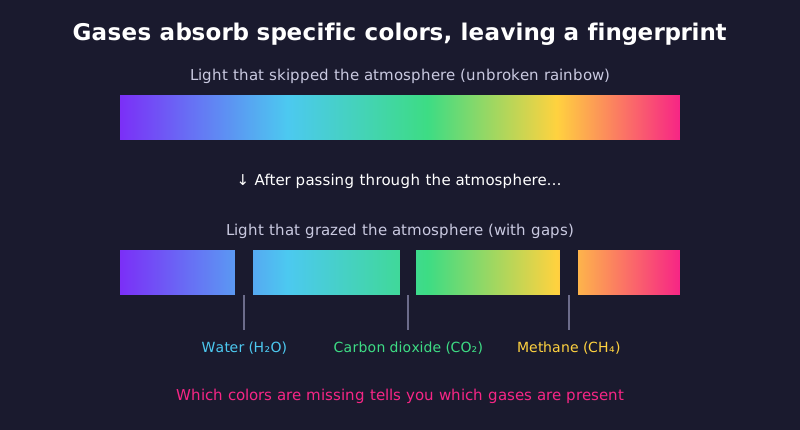
So when you carefully examine light that has passed through an atmosphere, you find the rainbow missing chunks here and there. Figure out which colors are gone, and you can work out which gases are present. Just as no two people share a fingerprint, no two gases leave quite the same gaps behind.
Compare the light during a transit with the light when nothing is transiting, and the difference between the two is, essentially, the planet’s atmosphere. This technique — breaking starlight apart and studying it — is called transit spectroscopy.
But that difference is a tiny sliver of color change buried inside a transit that’s already faint to begin with. Teasing it out is the hardest part of the whole method. It sounds almost too easy on paper — until the target turns out to be a rocky planet, and things get a lot harder.
On Rocky Worlds, the Clue Shrinks to an Apple Peel
Why is a rocky planet so much harder? The answer comes down to two things: how thick the atmosphere is, and how small the planet is.
A gas giant like Jupiter is both enormous and wrapped in an atmosphere that’s thick all the way through. That means a huge cross-section of atmosphere for starlight to skim across, and a clear, bold fingerprint left behind. These are, relatively speaking, easy targets.
A rocky planet like Earth is a different story. It’s small to begin with, and its atmosphere is astonishingly thin. Almost all of Earth’s air sits within a layer just a dozen or so kilometers thick. Against a planet with a radius of 6,371 kilometers, that’s barely more than a faint haze on the surface.
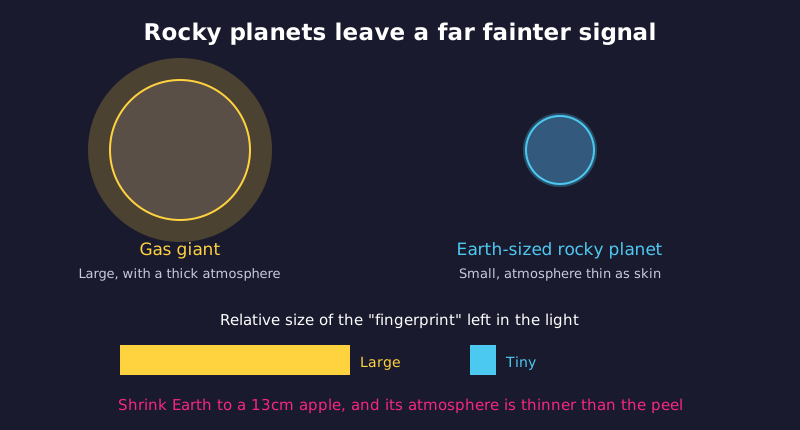
It helps to shrink things down to something tangible. Scale Earth down to a 13-centimeter apple, and the atmosphere doesn’t even amount to the thickness of the peel.
And astronomers are trying to read the tiny gap that light leaves behind after skimming that peel — from dozens of light-years away. When I first learned how thin that margin really is, I was half-amazed anyone manages to catch it at all. The signal is orders of magnitude smaller than what a gas giant offers.
That’s why the study of exoplanet atmospheres started with the easy targets — the gas giants. Rocky planets stayed out of reach for a long time. Only recently have researchers begun catching glimpses of that paper-thin fingerprint. So what changed?
JWST: An Almost Unfair Advantage
The turning point was the James Webb Space Telescope (JWST), launched in 2021.
JWST carries a mirror more than 6 meters across and reads infrared light — wavelengths invisible to the human eye — with remarkable precision. It just so happens that infrared is exactly where the fingerprints of gases like water and carbon dioxide show up most clearly. In other words, it’s about as ideal a tool as you could ask for when chasing the thin atmospheres of rocky worlds.
Right now, researchers are focused intently on a family of Earth-sized planets orbiting a star roughly 40 light-years from Earth — the TRAPPIST-1 system. A few of those planets sit at a distance where liquid water could plausibly survive.
Forty light-years is a distance that takes light itself 40 years to cross. The light the telescope is collecting right now left that atmosphere back when we didn’t even have a name for the planet yet.
Try picturing it: if you were standing on the night side of one of those rocky planets, watching its star sink below the horizon, part of that very light is, at this moment, skimming past the atmosphere above your head and heading out into space, on its way to a telescope dozens of light-years away.
And starting in 2026, reports have begun trickling in describing hints of an atmosphere on a rocky planet orbiting within its star’s potentially habitable zone. Here I want to choose my words carefully. What the observing team actually confirmed is narrower than it sounds: the light showed a gap consistent with an atmosphere. That is not the same as confirming “air like Earth’s.”
The observed fact and the interpretation researchers draw from it need to be kept separate. Skip that distinction, and the story slides quickly into exaggeration.
So once an atmosphere is confirmed, is that the end of the story?
Finding Air Is Not the Same as Finding an Answer
Honestly, discovering an atmosphere is closer to a starting line than a finish line.
Even when a gas turns up, the light’s gaps alone can’t tell you whether it came from living organisms or from volcanic activity and rock chemistry. Multiple processes can leave behind the same fingerprint. That’s why researchers cross-reference combinations and ratios of several gases at once, building their interpretation carefully, one layer at a time.
Even so, the method itself stays remarkably grounded. Nobody has gotten anywhere near these planets. Researchers are simply, patiently, reading the color of light that once passed through an atmosphere.
Somewhere in tonight’s sky, a rocky planet is crossing in front of its star this very moment. Light that threaded through its atmosphere dozens of light-years ago is landing on a telescope mirror somewhere tonight, turning into a small dip on a graph. The answer to whether that world has air is already written into that light — we just have to read it.