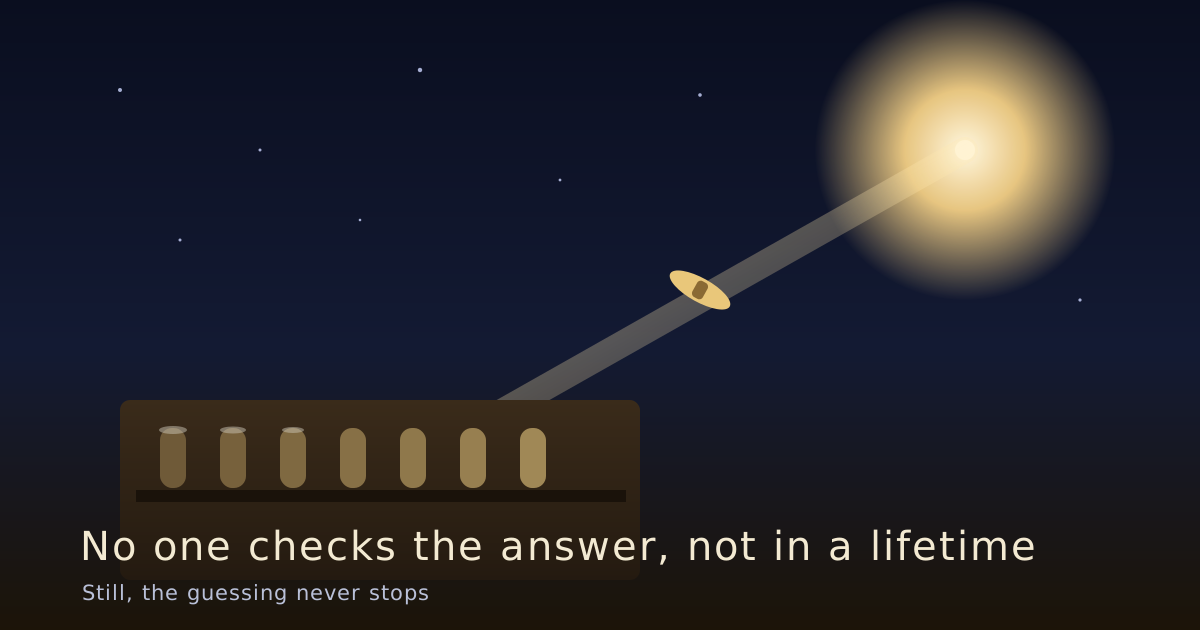
“Seriously, why won’t you open it?”
This must be the tenth time Maki has picked this fight. Seven unopened tubes sit on the cupboard shelf, dust thickening on the oldest ones. They’re voice-tubes from Nobu, her uncle, who moved to a distant star decades ago — messages that are only now, after all this time, starting to arrive.
In this town, people send their voices to family far away by tube-mail. You speak into a tube, and it rides a slow boat of light across the gap. The trip one way costs a person’s entire lifetime. A reply almost never makes it back to the one who sent the original message. By the time anything arrives, the sender is usually long gone.
So nobody in town asks their distant family for “the answer.” Instead, they play a guessing game. What is she doing right now? What does his face look like when he laughs? You guess, speak it into a tube, and send it off. Of course, whether you guessed right is something you’ll never find out — not in this lifetime. Maybe that’s exactly why everyone takes it so seriously. The addressing conventions for tube-mail, incidentally, have changed three times over the years, simply because delivery takes so absurdly long.
None of this sits right with Maki.
“It’s already here, though. If you open it, you’ll know whether you guessed right. That’s the whole point — checking the answer.”
“Open it, and it’s over.”
Grandma Hatsu doesn’t stop stirring the rice-bran pickling bed.
“Over? What’s over?”
“The guessing.”
Made no sense to her. A guessing game where you never learn if you guessed right — what was even the point? That night, after Grandma had gone to bed, Maki crept to the cupboard and slid out the newest tube. Just one. Nobody would notice. She twisted the cap, and old light spilled out softly as Nobu’s voice rose into the room.
She’d assumed it would be his reply to her own guess. It wasn’t.
“Mom’s probably still at that pickling bed every single morning. Sniffing her fingers, making that face — the salty one.”
It wasn’t a reply. Nobu, too, had sent nothing but a guess — a guess about the two of them, sealed in a tube and launched across the stars. And then Maki glanced back toward the kitchen. The crock of pickling bran. Grandma’s face, the one that always seemed to say salty. He’d nailed it. A voice decades old, and somehow, he’d nailed it exactly.
Neither of them ever sent the answer. Knowing full well it would never arrive in time, they only ever exchanged guesses, never confirmations. Which meant the reckoning would never come — not now, not ever. And without it, the two of them would go on reading each other, forever, from opposite ends of the dark.
Maki quietly closed the cap she’d opened. Slid the tube back into its place on the shelf. Then she took an empty tube and spoke her own voice into it. Grandma’s probably noticed I opened one, and she’s smirking about it right now. That was her guess. She set the tube on the outgoing shelf.
The next morning, Hatsu saw that the row had grown by one tube and said nothing. She just lifted a finger from the pickling bed and made a face — the salty one.