By 2026, gravitational-wave detectors had picked up 390 tremors in spacetime. Colliding black holes, merging neutron stars — the universe kept “ringing,” and scientists kept listening.
Yet there’s one kind of black hole researchers have been hunting for decades and have never once caught in the net.
A black hole that didn’t form from a dying star, but may have been born in the first instant of the universe itself.
A black hole no star could ever produce
Mention “black hole,” and most people picture the same thing: the wreckage of a massive star, collapsing under its own weight at the end of its life.
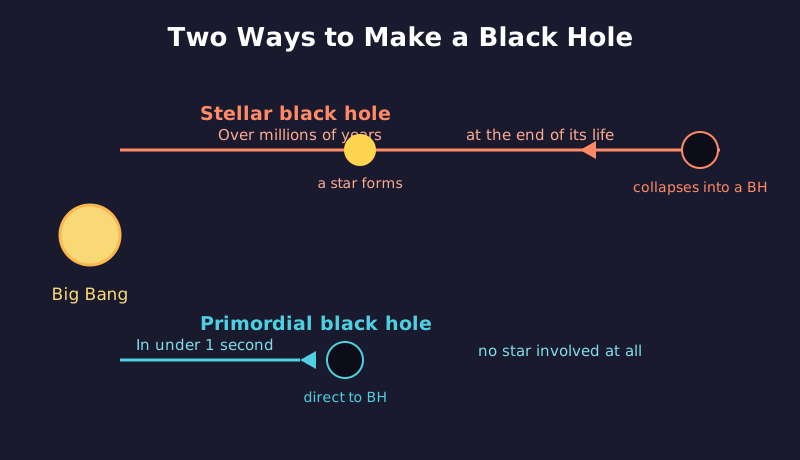
A star dozens of times heavier than the Sun burns through its fuel, loses the pressure holding it up, and its core caves in on itself. That’s a stellar black hole — the textbook version.
But theoretical physicists have spent more than fifty years chasing a completely different origin story. One where no star is involved at all. A black hole that forms directly, in the instant the universe itself came into being. Physicists call it a primordial black hole — a relic of the very early universe.
No dying star required.
Which means these would be black holes from an era when not a single star yet existed. It’s a strange thought: black holes floating in the dark before there was ever a star to light it up.
But if there were no stars around, how would you even make a black hole?
Something that happened in under a second
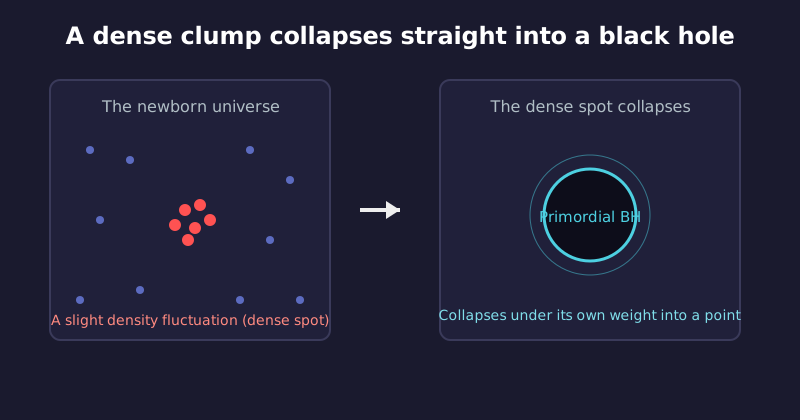
Right after the universe was born, space was unimaginably hot and dense. And that density, physicists believe, wasn’t perfectly uniform — it had tiny lumps and dips.
A patch that happened to be slightly denser than its surroundings would pull itself together a little more strongly. If that patch was dense enough, it could simply collapse in on itself and become a black hole. That’s the basic pitch behind primordial black holes.
No need to grow over millions of years like a star. This is thought to have happened in less than one second after the universe began.
If you could somehow witness it, you wouldn’t see anything — no stars, no galaxies, not even light that could travel in a straight line through matter that dense. Those faint ripples in density became the seeds for every structure the universe would eventually build.
It’s hard to picture just how dense things were. Imagine compressing a mountain’s worth of rock into a point the size of an atomic nucleus, and it still wouldn’t be enough. That’s the kind of crushing density we’re talking about — dense enough that a slight excess could collapse on the spot, without needing to gather any extra material. What takes a star eons to accomplish, the newborn universe could pull off in an instant.
There’s one crucial difference worth pausing on.
Black holes born from stars have a hard floor they can’t go below. Collapse requires material, and unless the stellar core is heavy enough to begin with, it never becomes a black hole at all.
Primordial black holes have no such limit. Depending on how dense that early clump was, you could in principle end up with anything from mountain-scale masses to several times the Sun’s mass. That single fact — that they can form on the light end of the scale — turns out to be the key to finding them.
So how exactly do you go looking for a black hole you can’t see?
Searching for something invisible, in the record of a tremor
Black holes don’t emit light. Point a telescope at one, and there’s nothing to see.
Primordial black holes are thought to be even smaller — the tiniest ones might be no bigger than a proton. So how would anyone ever detect something like that?
This is where gravitational waves come in. They’re ripples in spacetime itself, produced when massive objects move violently — and nothing produces them more dramatically than two black holes colliding and merging.
Even a black hole that emits no light at all becomes detectable the moment it merges with another, showing up as a “shudder” passing through our instruments. Since humans first detected this kind of wave in 2015, mergers all across the universe have been logged one after another.
Here’s where it gets genuinely interesting — this is the part I find most fascinating.
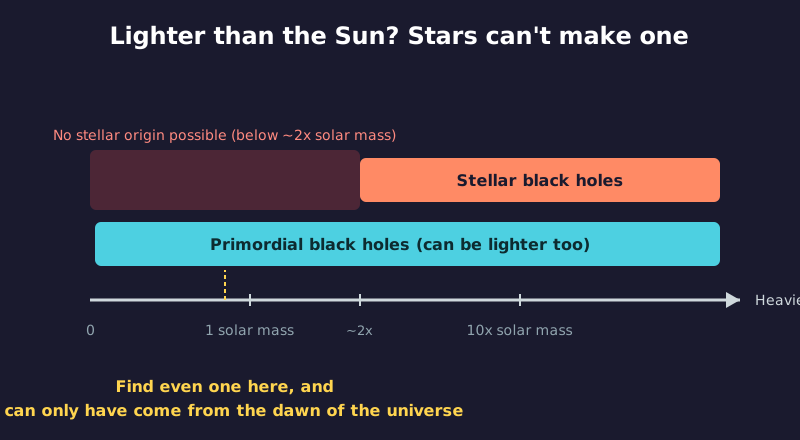
Analyze the shape of a gravitational-wave signal, and you can work out the mass of each object that merged. If astronomers ever caught two black holes merging that were each clearly lighter than the Sun, it would be a massive discovery.
Because there’s no way for a star’s death to produce a black hole that light.
Stellar collapse has hard boundaries. A white dwarf that exceeds about 1.4 solar masses — the Chandrasekhar limit — can’t hold itself up. Neutron stars max out at roughly twice the Sun’s mass.
In other words, nothing in today’s universe can build a black hole lighter than the Sun by starting with a star. If one turned out to exist, there’s only one place it could have come from: the birth of the universe itself. Researchers see this as potentially the smoking gun.
So has that proof turned up yet?
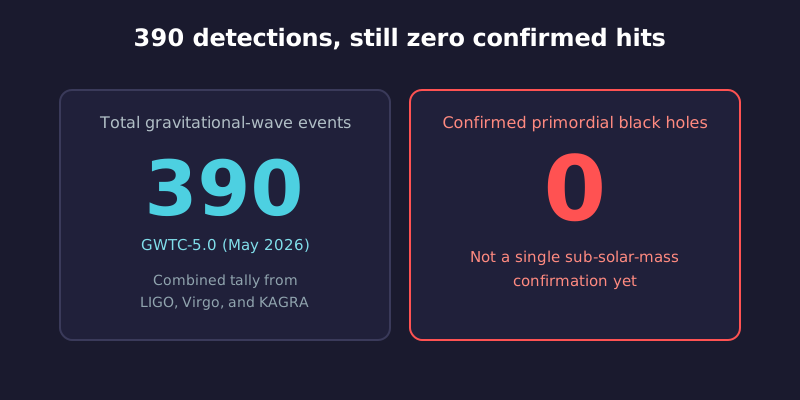
Still absent from 390 detections
Not yet.
Gravitational-wave observations reached a running total of 390 events by the time the latest catalog, GWTC-5.0, was released in May 2026 — a tally built jointly by LIGO in the United States, Virgo in Europe, and KAGRA in Japan.
And still, the decisive case — a sub-solar-mass black hole that could only be primordial — isn’t among them.
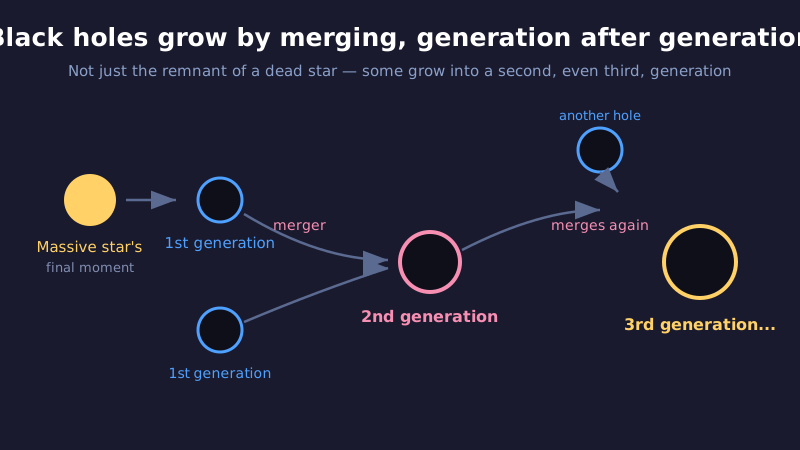
The catalog does report hints of other unusual black holes. Some appear to be “second generation” objects: black holes formed from an earlier merger that went on to merge again.
But that’s a different story entirely — still part of the stellar lineage, just several generations removed. It’s easy to conflate the two, but a single black hole born directly at the dawn of the universe still hasn’t been found.
Even a null result carries meaning.
I’ll admit, the idea that “not finding something” tells you something useful didn’t click for me right away. But every search that comes up empty tightens the ceiling: if primordial black holes exist at all in this mass range, there can’t be very many of them. The absence of a clue becomes a clue in itself.
Is this invisible object really worth all the effort?
Finding one could crack open the mystery of dark matter
There’s a bigger reason primordial black holes get so much attention.
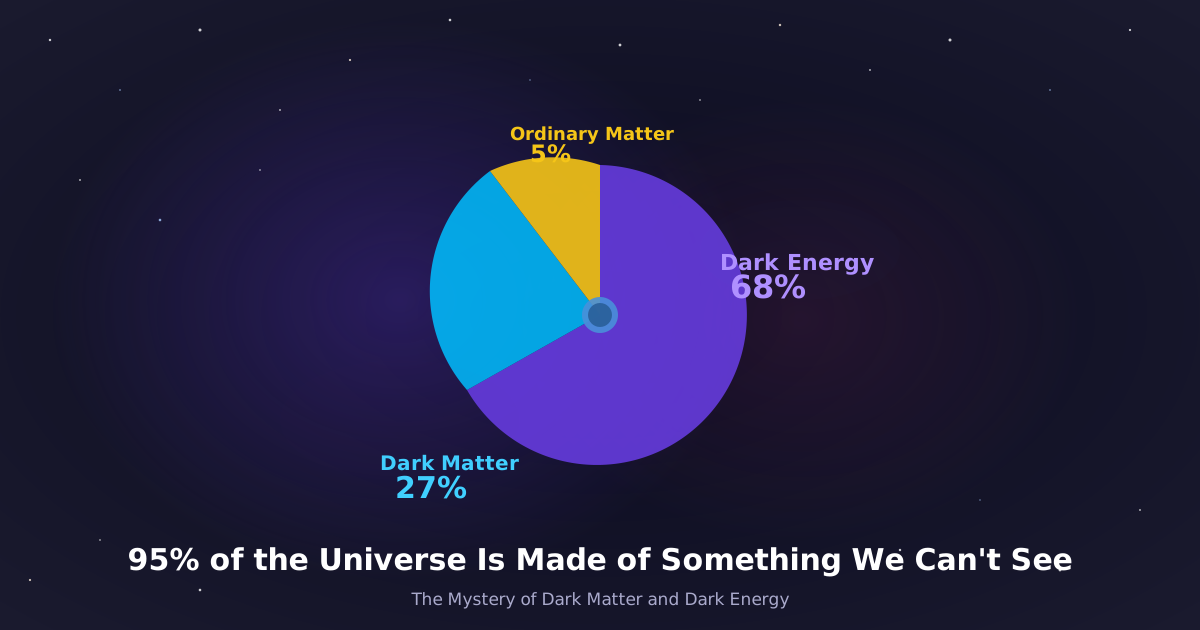
The universe is thought to be filled with vast amounts of dark matter — stuff that emits no light and whose true nature remains unknown. One persistent idea holds that some, or even most, of that dark matter could actually be primordial black holes.
If that turned out to be true, one of the biggest open questions in physics could be answered by black holes that never needed a star at all — a decades-old mystery cracked open through a completely unexpected back door.
For years, the leading approach to dark matter has been hunting for some undiscovered particle. Experiment after experiment has failed to find it. That’s part of why the old idea — that dark matter isn’t a particle at all, but a population of ancient black holes — keeps coming back into fashion. Catch even a single lightweight black hole in a gravitational-wave signal, and this whole debate could tip overnight.
There’s one more strange twist tied to the smallest primordial black holes.
Theory predicts that black holes leak a tiny trickle of energy over unimaginably long timescales and eventually evaporate — a process called Hawking radiation. The lighter the black hole, the faster it evaporates.
Some researchers calculate that a primordial black hole small enough to pack mountain-scale mass into something the size of a proton would be finishing its evaporation right about now, 13.8 billion years into the universe’s history. Honestly, that timing gives me chills. It would mean the moment of birth and the moment of vanishing sit at opposite ends of cosmic history, facing each other across the entire span of time.
Waiting for the one that hasn’t shown up yet
It’s been barely a decade since gravitational waves gave us this new sense in 2015.
Detectors keep getting more sensitive every year, and in 2026, construction began on a fifth facility, in India. The net is undeniably getting finer.
Someday, a waveform might show two objects lighter than the Sun spiraling together and merging. The instant that happens, humanity will finally hold proof of something that formed before the universe was even a second old.
Will it be detection number 391, or the several-thousandth? Somewhere out there, researchers are still waiting for the day two unusually small peaks quietly line up on a detector’s screen.