Launch a spacecraft without knowing where it’s going. That plan is real, and it’s already underway.
The European Space Agency’s Comet Interceptor will head into space before its target comet has even been found. Launch is scheduled for late 2028 or early 2029, and even then, the destination will remain officially “undecided.”
Normally, a spacecraft picks a destination first, then flies. So how does a mission with no destination make any sense at all?
Spacecraft Have Always Picked a Target First
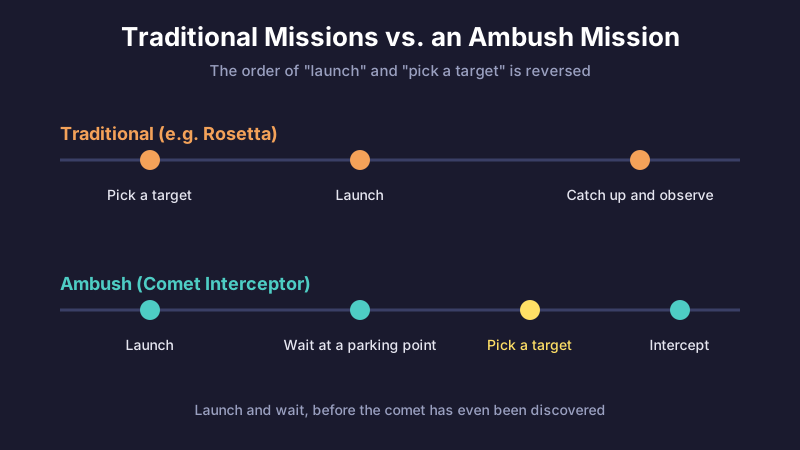
Mention sending a probe to a comet, and most people think of Rosetta. ESA launched that spacecraft with a specific destination already locked in: comet 67P/Churyumov-Gerasimenko. After a long journey, it caught up with the comet and even dropped a lander onto its surface.
That’s the crucial detail: the destination was known in advance. Engineers could calculate a precise trajectory and spend years fine-tuning a rendezvous.
Designing a spacecraft, at its core, is about working out where you’re sending something and how you’ll get it there. Without a known target, you can’t decide how much fuel to carry or when to fire the engines.
Comet Interceptor throws out that basic assumption. Launching without a chosen target sounds almost contradictory. So what’s really going on?
The Comets Worth Chasing Arrive Without Warning
The answer lies in the “personality” of the comet this mission is actually after.
The solar system is full of comets that have swung past the sun many times before. These are the periodic ones, looping around every few years to a little over a century — Halley’s Comet is the classic example. Because their orbits are well understood, astronomers can predict exactly when and where they’ll show up.
But every one of those close passes scorches their surface, boiling off gas and ice. In effect, they’re worn-out, well-used objects.
Comet Interceptor isn’t really after those. It wants something falling toward the sun for the very first time, arriving from the far reaches of the solar system.
Astronomers believe these comets originate in the Oort Cloud, a vast shell far beyond the planets — thousands to tens of thousands of times farther from the sun than Earth is. Out there, ice and dust have sat undisturbed since the solar system’s birth, never once warmed enough to melt.

In other words, this is 4.6-billion-year-old raw material, preserved in a deep freeze. ESA describes it as matter essentially unchanged since the dawn of the solar system.
The catch is that nobody knows when one of these comets will show up. They approach the sun so rarely — once every few thousand or tens of thousands of years — that most of them have never been seen since humans started keeping records. Telescopes usually spot them only shortly before they swing close to the sun. Start designing and building a spacecraft after that, and you’d never make it in time.

So the Mission Launches First and Waits
The solution flips the usual logic on its head. Waiting to start building until the target appears is too slow. Instead, launch first and lie in wait.
Think of it like parking an ambulance on a street corner where an accident seems likely, rather than keeping it in a hospital garage. You get there faster if you’re already nearby when the call comes in. Comet Interceptor works the same way: it takes up a position in space in advance, ready to move the instant a promising comet turns up.
After launch, the spacecraft will simply sit at its parking spot, built to hold that vigil for years if necessary. Once a suitable target is identified, mission planners will choose a trajectory and send the spacecraft in to intercept.
Pause on that for a moment. At launch, the destination, the departure date, and the length of the journey are all still blank.
A typical mission decides when it will arrive before anything else. This one decided, first, that it would wait indefinitely for a target that might show up at any time. The usual order is completely reversed.
Catching a One-Shot Opportunity from Three Directions
There’s another reason for the ambush strategy. A comet making its first pass by the sun is, by definition, making its first pass — period. There’s no retake. The encounter lasts moments, and any data missed during that window is gone for good.
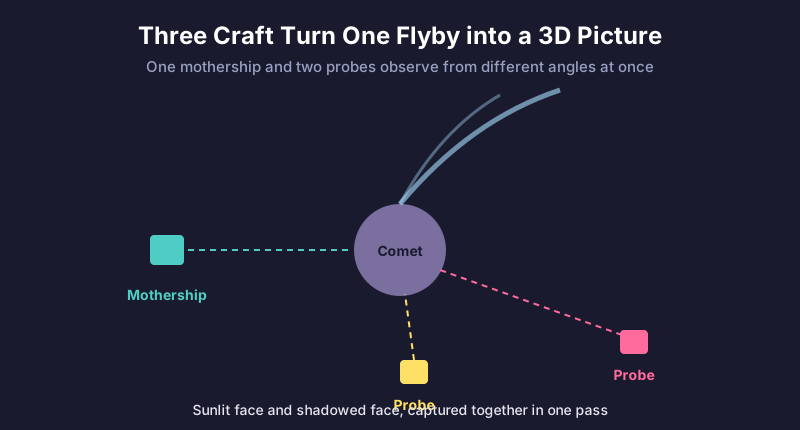
That’s why Comet Interceptor isn’t one spacecraft but three: a mothership plus two smaller probes that separate from it, carrying ten scientific instruments between them.
Those ten instruments split the work — sampling dust grains shed by the comet, analyzing the gas cloud around it, and mapping the environment near its nucleus. Rather than cramming every measurement onto a single spacecraft, the mission spreads the job across three, minimizing what gets missed during that fleeting pass. Building a three-dimensional picture of the comet is only possible because multiple viewpoints gather data simultaneously, from different distances.
Why split into three at all? Because once the spacecraft nears the comet, the mothership and its two probes fan out in different directions, observing the same moment from multiple angles simultaneously.
A single camera shooting from one side can’t tell you what’s happening on the comet’s far side. But three spacecraft firing their shutters at once — from three different positions — can capture both the sunlit face and the shadowed one, together, in a single pass.
One fleeting encounter, turned three-dimensional by three sets of eyes. It’s a design built to capture the unspoiled “true face” of a comet in a single first meeting.
The Real Prize Might Be a Rock from Beyond the Solar System
Here’s where it gets even more interesting. The ambush isn’t limited to comets born in our own solar system.
In 2017, astronomers spotted an elongated object hurtling through the solar system at extraordinary speed. Named ‘Oumuamua, it wasn’t bound by the gravity of any star; researchers concluded it had arrived from another star system entirely, and was simply passing through on its way back out. In 2019, a second interstellar visitor, comet Borisov, turned up.
In both cases, astronomers tracked the objects from a distance as they raced through the solar system and vanished again within a matter of months. By the time anyone spotted them, there was no time left to design and launch a mission to study them up close. Humanity could only watch these outsiders go.
That’s exactly why lying in wait matters. Material from other star systems occasionally passes through ours. Having watched these visitors slip away empty-handed before, the mission wants to be ready to intercept the next one.
Interstellar objects are explicitly part of Comet Interceptor’s target list. If a suitable one turns up while the spacecraft is waiting, it could give humanity its first close-up look at material from another star system.
Of course, that part comes down to luck. There’s no guarantee a suitable object will show up on the right trajectory at the right time. I’ll admit — that’s the part of this mission I find most compelling: the nerve it takes to make “something that might never arrive” your primary target.
Ready to Come Up Empty, and Launching Anyway
Since Comet Interceptor commits to launch before choosing a target, the possibility of coming up empty never really goes away. If no ideal comet appears during the wait, the mission may end up settling for a less perfect one.
The mission chose to wait regardless. Waiting until the ideal comet shows up to even begin preparations would guarantee arriving too late, every time. Rather than reacting once the target appears, the plan is to claim a spot in advance and be ready.
The mission is led by ESA, with Japan’s JAXA also participating as an international partner. ESA selected it as a candidate mission back in 2019 and later gave it formal approval. Hardware is now being built in earnest. In a few years, a spacecraft will lift off from the launch site in French Guiana without anyone able to say exactly where it’s headed.
Long before we notice a new comet in the night sky and it makes headlines, a spacecraft will already be out there somewhere, holding a seat for a guest it hasn’t met yet.