Stories of Space Exploration

Apollo, Hayabusa, Voyager—humanity's long reach into space.

28 articles

Articles

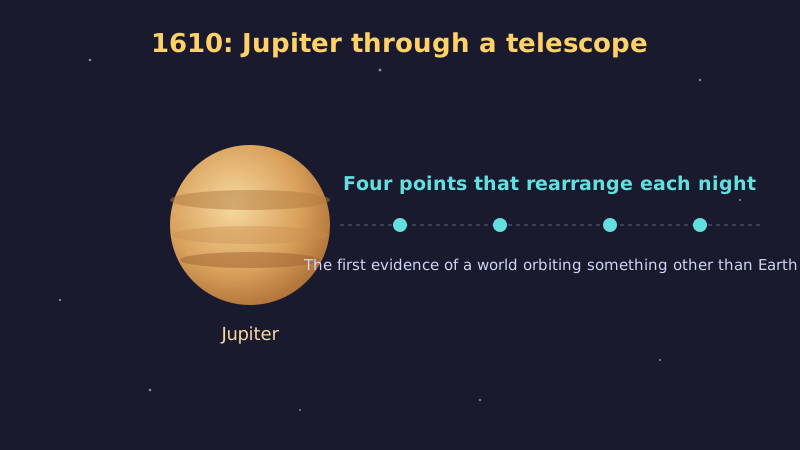
Four Lights by Jupiter Kept Rearranging Every Night — and Ended an Earth-Centered Universe

In the winter of 1610, Galileo spotted four tiny points of light next to Jupiter, and their arrangement kept shifting from one night to the next. It was the first evidence that something other than Earth could have objects orbiting it, and a few weeks of notes toppled a 2,000-year-old assumption about the shape of the universe. You can still see those same four points next to Jupiter through a pair of binoculars.
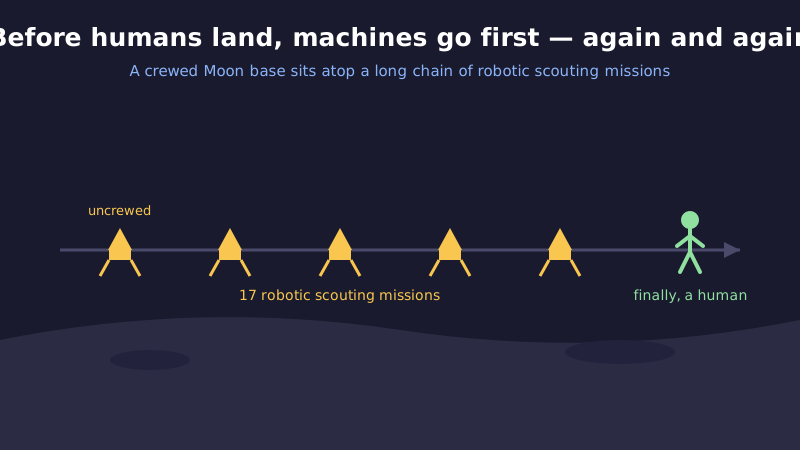
17 Robotic Missions Before a Single Astronaut: The Long Scouting Run to a Moon Base

Before humans return to the Moon, NASA is sending 17 uncrewed landers carrying more than 60 instruments — a roughly $2.6 billion reconnaissance effort. Why send machines dozens of times before people go even once? SORABUMI unpacks the long robotic run-up to a lunar base, from hunting for ice to proving landing accuracy to wiring up power and communications.

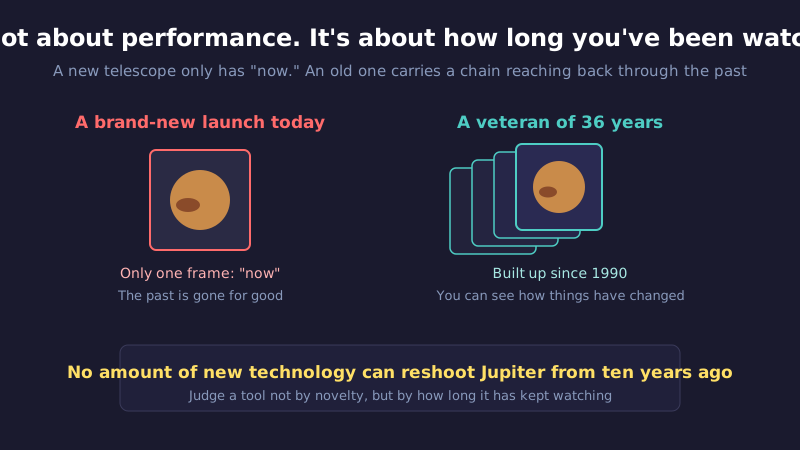
No Brand-New Telescope Can Reshoot Jupiter's Storms From Ten Years Ago

Launch the best telescope in the world today, and you still can't photograph Jupiter as it looked a decade ago. Hubble, working since 1990, caught something no new instrument ever could: the outer winds of the Great Red Spot speeding up by as much as 8% between 2009 and 2020. SORABUMI explains why a telescope's worth isn't measured by how new it is, but by how long it has been watching.

Why Artemis III, NASA's Next Moon Mission, Won't Actually Land on the Moon

On June 9, 2026, NASA announced the four astronauts of Artemis III. None of them will set foot on the lunar surface. Instead, they'll spend about two weeks circling Earth, testing dockings with landers from Blue Origin and SpaceX. The actual landing has been pushed to Artemis IV in 2028. Here's a look at the unglamorous reality behind spaceflight: sometimes you need a dress rehearsal before the real thing.

Hitchhiking on Planetary Gravity — Why the Slingshot Effect Changed Space Exploration

How can a spacecraft speed up without burning a drop of fuel? Gravity assist — the trick that took Voyager to the edge of the solar system and is now sending NASA's Psyche spacecraft toward a metal asteroid — is one of the cleverest moves in the history of spaceflight. Here's how it actually works.