A Mars probe takes about half a year to get where it’s going. So it seems strange that a spacecraft headed for Mercury — a planet much closer to Earth — is only now, after eight years, about to arrive.
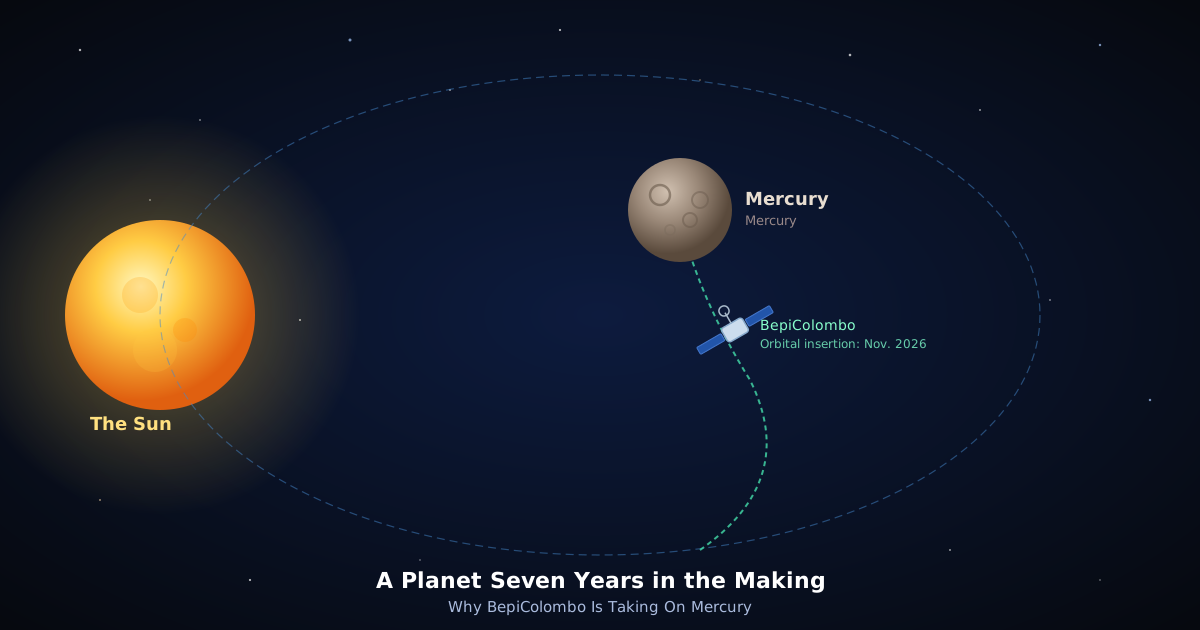
That spacecraft is BepiColombo, a joint mission between ESA (the European Space Agency) and JAXA (the Japan Aerospace Exploration Agency). It launched in October 2018, and in November 2026 it will finally settle into orbit around Mercury.
Close, but slow to arrive. It sounds like a contradiction. But there’s a very real, very space-specific reason behind it.
If Mercury Is So Close, Why Does It Take Eight Years?
Let’s start with a sense of scale. The distance from the Sun to Earth is about 150 million kilometers — a distance astronomers call one astronomical unit. Mercury sits closer in, the innermost planet of the solar system. From Earth’s perspective, it’s roughly as close as Mars. Not exactly next door, but not far either.
And yet the trip takes eight years. A baby born the day BepiColombo launched would be starting third grade by the time it arrives.
When I first saw that number, I assumed it was a typo. Going by distance alone, a spacecraft flying in a straight line should get there in a matter of months. In fact, simply carrying a probe out to the vicinity of Mercury doesn’t take long at all.
The hard part isn’t getting there. It’s getting caught.
Falling Toward the Sun Makes You Go Faster
This is the most interesting part of the whole story.
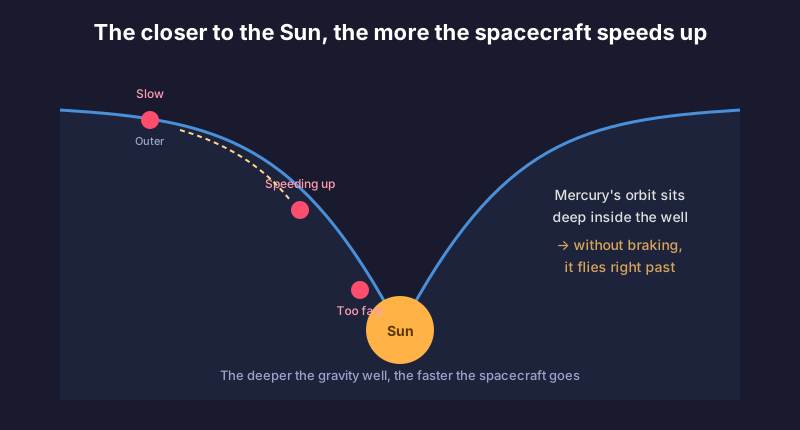
Traveling from Earth to Mercury means moving closer to the Sun. And the Sun is enormously massive. As a spacecraft falls inward under that gravity, it keeps picking up speed.
Picture a ball rolling down a hill — the farther it rolls, the faster it goes, with no effort at all. The Sun’s gravity works the same way. The deeper a spacecraft falls into that gravitational “valley,” the faster it moves. Mercury’s orbit sits quite far down that slope. By the time a probe gets there, it’s moving at a ferocious clip.
So what happens if you’re going too fast? Mercury’s gravity is far too weak to arrest that momentum. Even after traveling all the way there, a probe would simply sail past and get pulled back toward the Sun.
In other words, the hard part of a Mercury mission isn’t moving forward — it’s stopping. Arrival means slowing yourself down to precisely the speed at which Mercury’s gravity can finally take hold.
No Brakes in Space, So You Use Planets as Walls
So how do you slow down?
Space has no brakes. There’s no air, so parachutes are useless. The only way to shed speed is to fire engines in the opposite direction of travel — but carrying enough fuel to do that from scratch would make the spacecraft impossibly heavy.
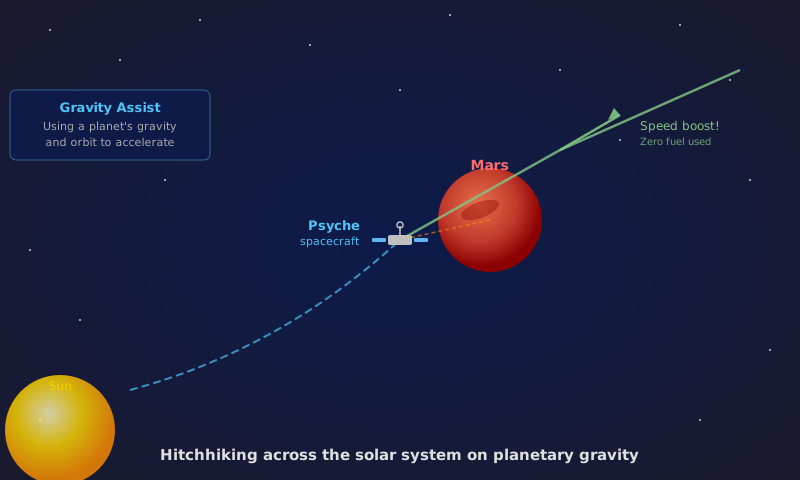
That’s where BepiColombo turns to flybys: skimming close past a planet and letting its gravity bend your path and adjust your speed.
Here’s the clever part. Approach a planet at just the right angle, and its gravity tugs on you just enough to steal some of your velocity. Think of it as handing off a little kinetic energy to the planet while you slow down. By carefully choosing the angle and direction of approach, engineers can use the same trick to speed up or slow down. It’s one of the great sleights of hand in spaceflight — changing a trajectory using almost no fuel at all. This technique, known as a gravity assist, has been a staple for deep-space missions like Voyager and Hayabusa for decades. Usually, though, it’s used to gain speed for a long journey outward. Using it over and over just to slow down is something Mercury missions in particular demand.
One flyby alone isn’t nearly enough. Each pass shaves off only a small amount of speed, so canceling out everything gained by falling toward the Sun takes repeated attempts — again and again. Miss the intended angle by even a little, and years of planning downstream get thrown off. That’s why engineers fine-tune the trajectory after every single flyby.
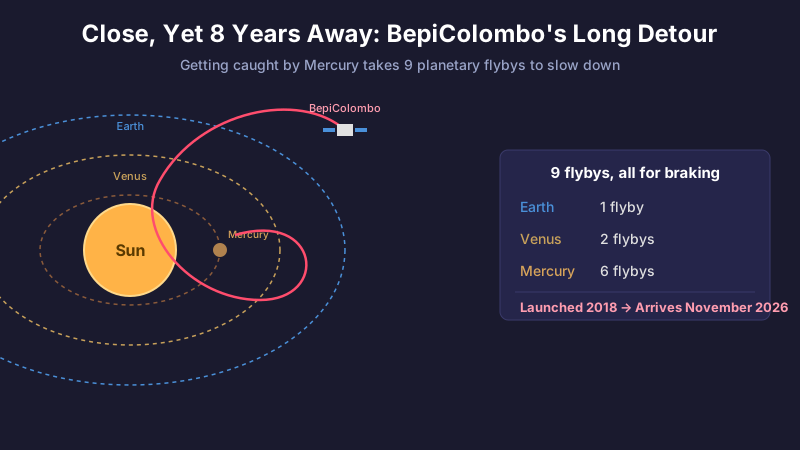
Over its eight-year journey, BepiColombo performs nine flybys in total: one past Earth, two past Venus, and six past Mercury itself, the destination. The first Mercury flyby happened in October 2021; the sixth and final one came in January 2025. The spacecraft has been skimming past the very same planet, spaced years apart, again and again. It’s a strangely patient journey — passing Mercury six times without ever landing, tapping the brakes a little more each time, until the seventh encounter finally lets the planet catch it.
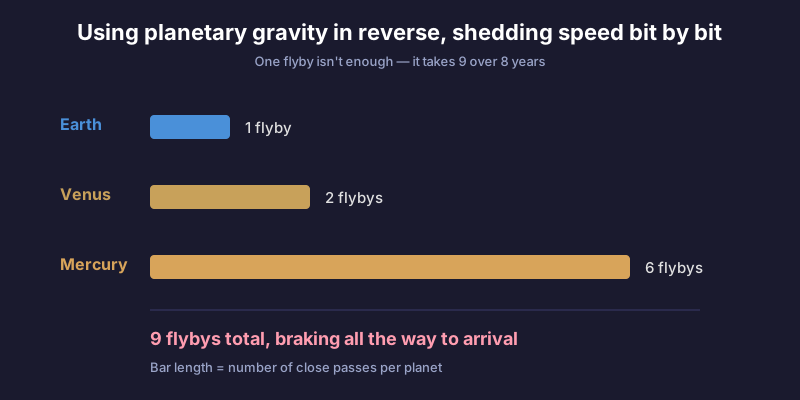
Six close passes by Mercury, and not once able to stay. So close, yet still so far. It’s a reminder that in space, proximity and difficulty are two entirely different things.
Two Spacecraft, Riding One Train
The way BepiColombo travels isn’t the only unusual thing about it.
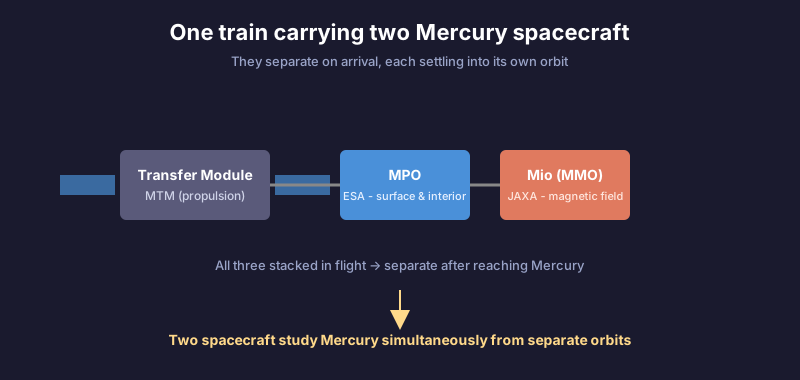
This mission is actually two orbiters fused together for the ride. There’s the MPO (Mercury Planetary Orbiter), built by ESA, and Mio (the Mercury Magnetospheric Orbiter, or MMO), built by JAXA. Add the Mercury Transfer Module (MTM), which handles propulsion during the cruise, and you get three sections stacked end to end for the entire trip. The whole assembly weighed about 4,100 kilograms at launch — roughly the mass of three compact cars, launched into space together.
Think of it as a single train made of several linked cars. They support each other through the long voyage, then uncouple once they reach Mercury.
Why two spacecraft? Because they have different jobs. MPO flies in a low orbit close to Mercury, examining the surface terrain and interior in detail. Mio, meanwhile, orbits farther out, studying Mercury’s magnetic field and the environment surrounding it.
Even for the same planet, it makes sense to watch the ground and watch the magnetic field from two different vantage points. Some things only become clear when you observe from both orbits at once. That’s why the mission carries both spacecraft together and lets them scatter to their respective posts after arrival. In a sense, the whole eight-year journey exists to deliver these two perspectives at the same time.
November 2026: Caught by Mercury, at Last
Then comes November 2026. After its ninth and final flyby, BepiColombo will finally be captured by Mercury’s gravity and settle into orbit. Full science operations are expected to begin sometime in early 2027.
Mercury remains one of the solar system’s most mysterious planets. Scorched by the Sun’s proximity, it’s nonetheless thought to harbor ice inside permanently shadowed craters near its poles. Ice on a blazing-hot world sounds like a contradiction, but it’s exactly the kind of question BepiColombo is designed to answer.
There’s more. Why does such a small planet have a magnetic field at all? What are the strange, shallow depressions scattered across its surface? These questions remain unanswered, in part because so few missions have ever visited a planet this close to the Sun and this hard to observe. That scarcity is exactly why researchers are so eager for the data these two long-term orbiters are about to deliver.
Try to imagine it: if you’d been aboard BepiColombo, you would have spent eight dizzying years skimming past Venus and Mercury nine separate times. Every single one of those passes existed for one purpose — to arrive at exactly the right speed, just once, to finally be caught by Mercury.
A Place Where Near and Far Get Tangled
On a map, Mercury looks like it’s right next to Earth. But for a spacecraft, it becomes one of the hardest planets in the solar system to reach — a destination you can only arrive at by fighting the Sun’s gravity every step of the way, slowing down again and again.
Close doesn’t mean easy. In space, distance and difficulty can pull apart from each other completely. BepiColombo’s eight years were spent entirely inside that gap.
In November 2026, low in the night sky, near a small point of light chasing the Sun, a train that spent eight years braking will finally uncouple its last two cars.