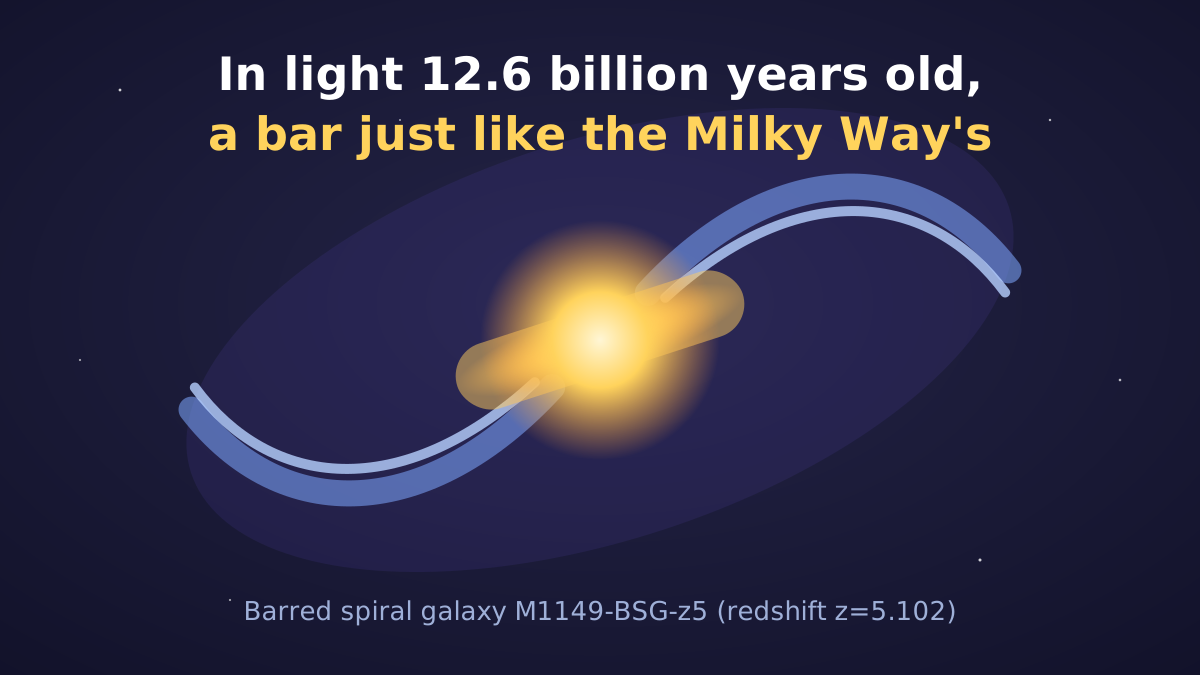
If you could look straight down on the Milky Way from above, you’d see a bar of light cutting through its center, with spiral arms unwinding from either end. For a long time, astronomers assumed a galaxy needed to be well into adulthood before it could build a shape like that.
Then JWST (the James Webb Space Telescope) found that exact bar in light from a time when the universe was only about 1.2 billion years old.
A galaxy from roughly 12.6 billion years ago was already spinning with a shape strikingly similar to our own.
A Spiral From When the Universe Was 1.2 Billion Years Old
The galaxy goes by the rather unglamorous name M1149-BSG-z5. According to the observing team, its redshift — a measure of how much the expansion of the universe has stretched its light — comes in at z=5.102. That places it at a time when the universe was barely 1.2 billion years old.
The team is calling it the most distant candidate barred galaxy found to date.
The higher the redshift, the farther — and older — the light. Looking far away is, in effect, looking back in time. The light from z=5.102 traveled for 12.6 billion years before it finally reached JWST’s sensors. What we’re seeing isn’t this galaxy as it is now, but as it was in the deep past.
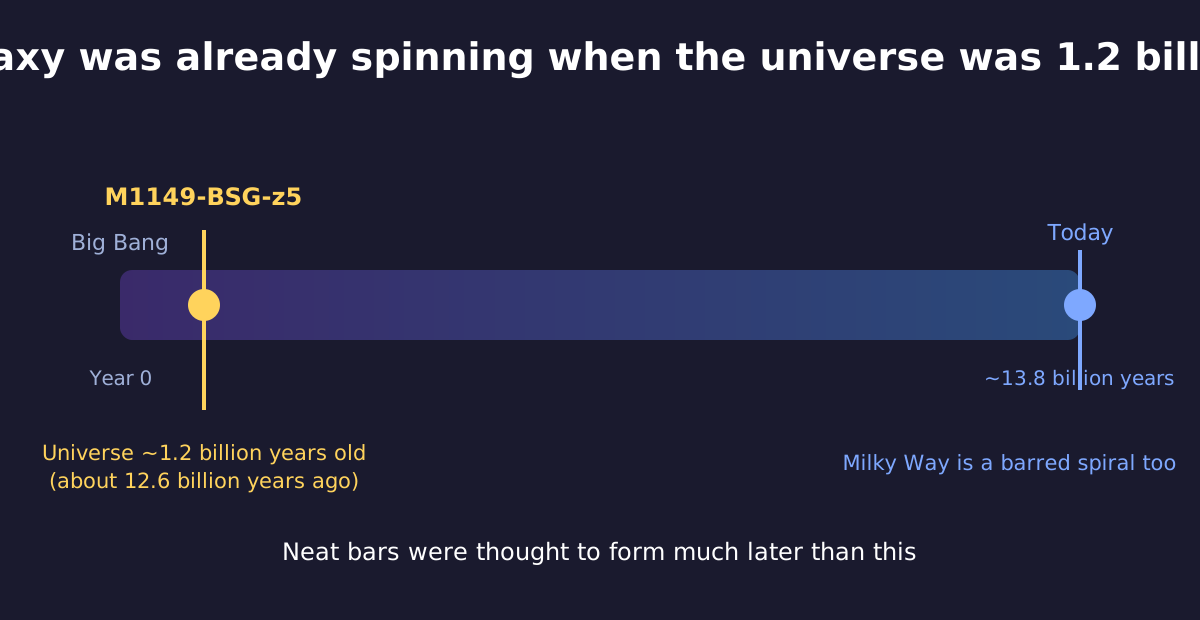
That number looked like a typo the first time I saw it. The universe is about 13.8 billion years old. Scale the universe’s entire life down to a single day, and this galaxy had already finished building a grown-up shape by around 2 a.m.
So why does having a bar count as such a big deal? That’s where the story really starts.
Why a Bar Is a Sign of a “Grown-Up” Galaxy
The “bar” in a barred spiral galaxy is a straight, densely packed lane of stars running through the galaxy’s core. The Milky Way falls into this category too.
Here’s the catch: a bar is a surprisingly fussy structure to build. Astronomers believe it takes stars in a disk rotating in neat alignment, settled into a stable orbit, over a long stretch of time. In other words, a bar is basically a disk’s way of announcing it has grown up.
I’ll admit I had this backward for years. I assumed bars formed because a galaxy was young and unruly. It’s actually the opposite — the rowdier the disk, the harder it is for a bar to survive.
Galaxies in the early universe are thought to have gone through something like a turbulent adolescence, with gas swirling and colliding violently. Stellar motions were chaotic, and the disk itself wasn’t stable. A bar can’t hold together in that kind of environment. So the conventional wisdom held that barred galaxies should be rare in the ancient universe.
And a bar isn’t just decoration. It works like a conveyor belt, funneling gas from the disk toward the center, where it’s thought to fuel star formation and feed the growth of a central black hole. A bar means a galaxy has entered a phase of reorganizing itself from the inside out.
M1149-BSG-z5 just threw a wrench into that conventional wisdom.
Nearly the Same Length as the Milky Way’s Bar
Here’s where it gets interesting. This galaxy’s bar wasn’t just present — it was already a serious structure.
The observing team’s structural analysis puts the bar’s length at roughly 4.5 kiloparsecs (kpc). Since 1 kpc equals about 3,260 light-years, that works out to roughly 15,000 light-years. The spiral arms stretched even farther, out to a radius of about 5.5 kpc — around 18,000 light-years.

Sit with that for a second. A 4.5-kpc bar is, roughly, the same scale as the bar sitting at the center of our own Milky Way.
A galaxy from 12.6 billion years ago — from when the universe was still an infant — had already put together a bar on nearly the same scale as the one we’re living inside right now.
If you could somehow stand on this galaxy’s disk, you might look up and see a river of light not unlike the Milky Way overhead. The surrounding universe was young, and galaxies sat closer together than they do today. The sky would have been busy, maybe even a little loud.
Its stellar mass wasn’t light either. The team estimates the galaxy’s stellar mass at around 28 billion times that of the sun, and it was churning out new stars at a rate exceeding 140 solar masses per year. Young, but already built with an adult’s frame and an adult’s appetite.
So how did we manage to make out the shape of a galaxy this distant and this small?
A Combination of Gravitational Lensing and JWST
A galaxy 12.6 billion years away is, by rights, far too faint to reveal any fine detail. Making it visible took a two-part trick.
The first part was a gift from nature. This galaxy turned up in the field of view near MACS J1149, a massive foreground galaxy cluster. The cluster’s gravity is strong enough to bend the path of light passing behind it. Einstein predicted this effect — gravitational lensing — and it works like a natural magnifying glass, brightening and enlarging distant objects that would otherwise stay hidden.
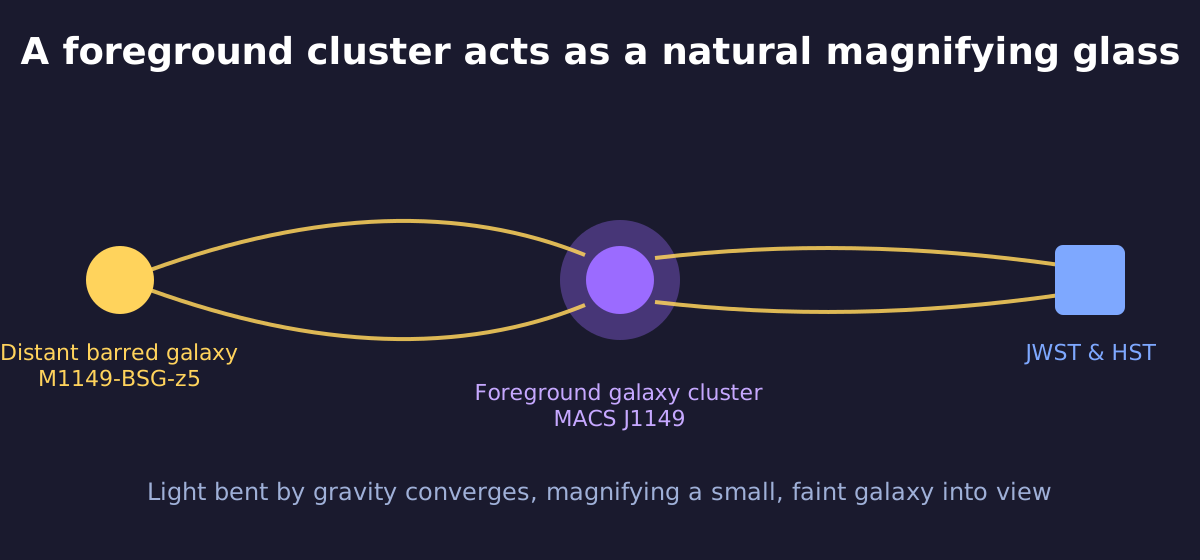
The second part was the telescope itself. The team combined observations from JWST and Hubble (HST), carefully tracing contours of brightness to pull the shape of the bar and spiral arms out of the data.
A natural magnifying glass, paired with the sharpest eyes humanity has ever built. Only with both together could anyone tell whether a galaxy from the universe’s infancy had a bar at all.
Without the assist from gravitational lensing, this galaxy would have shown up as nothing more than a fuzzy point of light — no way to tell if it had a bar or not. This single image only exists because a lens the universe happened to provide lined up with the technology we happened to build.
That’s a lot of coincidences stacked behind one picture.
Precocious — Because It Wasn’t Alone?
So why did this galaxy manage to grow up so fast? Here it’s worth separating what was actually observed from how the research team is interpreting it.
What the observations show: this galaxy sits in a denser-than-average patch of the universe, with a companion galaxy nearby. There are also signs of an active black hole (an active galactic nucleus) at its center, one that’s aggressively pulling in surrounding gas. The bar hauls gas toward the center, and that gas feeds the black hole — a picture of the bar and the black hole growing up together, side by side, all visible in this one galaxy.
Given that, the research team suggests that interaction with a nearby galaxy may have triggered the bar’s rapid assembly. Rather than aging quietly on its own, this galaxy may have been jostled by a neighbor into snapping into shape all at once.
It’s a strange thought — that being disturbed from outside might be what created order. But that’s still just one interpretation, not a settled conclusion.
What is clear is that this single discovery has put a crack in the assumption that galaxies in the early universe were still shapeless and unformed. Apparently, galaxies grow up faster than we thought.
Of course, one example alone can’t tell us whether this galaxy is a rare stroke of luck or something that was actually common back then. That’s exactly why the research team is now hunting for more old, well-ordered galaxies like it. One could be a fluke. Ten would rewrite what counts as “normal” for the early universe.
The Milky Way Overhead, and a Spiral From 12.6 Billion Years Ago
Just 1.2 billion years after the universe was born, a barred spiral almost indistinguishable from the Milky Way was already quietly spinning.
On a summer night, step away from the city lights and look up, and you’ll see a faint band of the Milky Way stretched across the sky. That’s the view of our own barred spiral galaxy, seen from inside its disk.
The same shape existed in the very early universe too. However many more of these “precocious bars” JWST turns up next will keep rewriting the story of how galaxies grow up.
The band overhead tonight and a single image from 12.6 billion years ago are connected by exactly the same shape: a bar.