You find a planet, then go back and check the old photos. It turns out it had been sitting there the whole time.
In July 2026, astronomers announced a third planet orbiting Beta Pictoris, a star 63 light-years away. The strange part: when researchers dug through observation data collected more than a decade earlier, the answer was already sitting in the corner of the frame.
ESO — the European Southern Observatory — has described this as an 11-year game of hide-and-seek. The telescope had captured the planet all along. Nobody had noticed, because it was simply too dim.
Finding the planet, then rewinding the tape
Beta Pictoris sits in the southern sky, a remarkably young star, only about 20 million years old. It’s surrounded by a sprawling disk of dust and debris — a system that looks a lot like our own solar system must have looked in its infancy. Astronomers have been fascinated by it for decades.
Two planets were already known here: a large one called b, discovered through direct imaging in 2008, and c, confirmed roughly a decade later. This new planet, d, is the third member of the family.
Beta Pictoris has also served for years as a testing ground for picking out faint objects near bright stars, which means researchers had a deep, decade-plus archive of observations to work with.
The team found d using an instrument called ERIS, mounted on ESO’s Very Large Telescope (VLT) in Chile. The technique involves suppressing the star’s overwhelming glare to directly image the faint objects sitting right beside it.
Up to that point, this was just another exoplanet discovery, one of many. Then things got interesting.
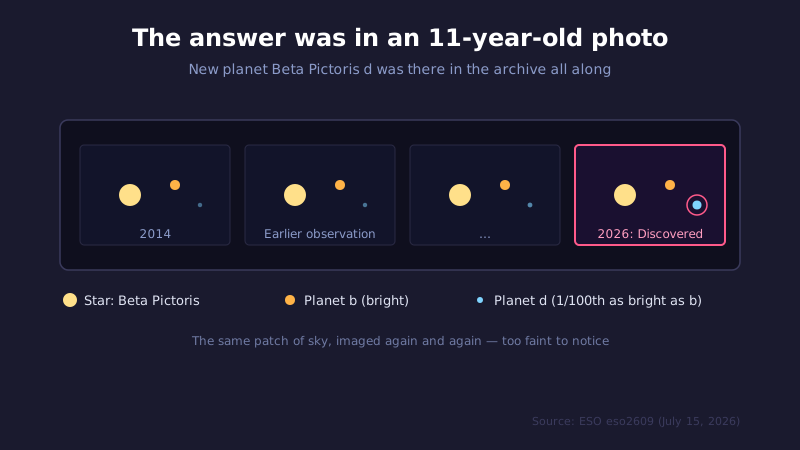
When the research team went back through the archives — the stored records of past observations — they found that d was already there, captured in images more than 11 years old. According to ESO, one image from a decade earlier showed d as a faint point of light sitting right next to its bright neighbor, b.
The answer had been waiting in the data the whole time.
Why direct imaging is so hard in the first place
Before going further, it’s worth stepping back. Astronomers have now found several thousand exoplanets. But most of those discoveries never actually involved seeing the planet itself.
The vast majority came from indirect methods: a star dimming slightly as a planet passes in front of it, or a star wobbling ever so slightly under a planet’s gravitational pull. Direct imaging — actually photographing the planet — accounts for only a small fraction of confirmed worlds.
The reason is simple. A star vastly outshines any planet orbiting it. Trying to pick out a faint, small object sitting right next to an overwhelming light source is far harder than it sounds.
In practice, astronomers use specialized instruments to block out the star’s glare, then painstakingly subtract whatever stray light remains through image processing. A faint point like d only emerges after that long process of subtraction, right at the very bottom of the pile.
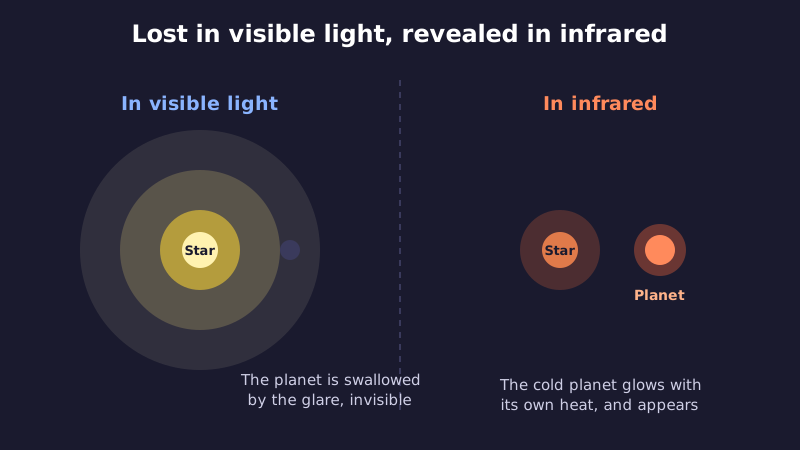
So why can astronomers directly image planets around Beta Pictoris at all? Because it’s young. A newly formed planet still retains much of the heat from its formation and glows faintly in infrared light on its own. That makes it far easier to spot than an older planet, which can only reflect its star’s light back.
Even so, d turned out to be unusually faint — even by the generous standards of this particular system.
Why did it take 10 years to notice?
So if it was there all along, why wasn’t it found sooner? This is the part worth pausing on.
The answer comes down to how dim d really is. According to ESO, the planet is only about a hundredth as bright as its neighbor b. That makes it one of the faintest and lowest-mass planets ever directly imaged from the ground.
“A hundredth as bright” doesn’t mean much on its own, so here’s a way to picture it. Imagine a single firefly glowing right next to a bright streetlight. A camera captures both. But the streetlight’s glare swallows the firefly completely, and a quick glance at the photo would never reveal it was there.
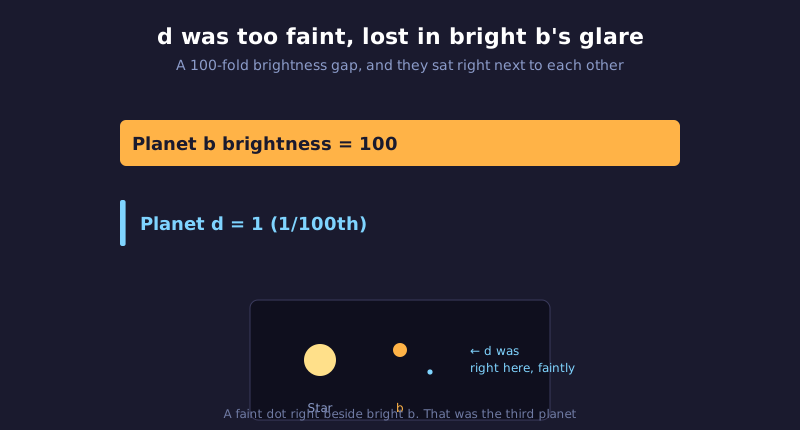
To make things worse, d happened to appear from nearly the same direction as bright planet b. It wasn’t just dim — it was also lost in the glare of its neighbor. Two strikes against ever spotting it.
That combination is exactly why the discovery took so long, the research team explains. But it also means something more encouraging: better observation techniques and sharper analysis let scientists pull the answer out of the same old data. The images hadn’t changed in over a decade. What changed was what researchers could read from them.
What kind of planet is d?
Bit by bit, a picture of this third planet is coming into focus.
Its mass comes in at roughly 2.4 times that of Jupiter — noticeably lighter than its two older siblings. Both b and c weigh in at roughly 10 Jupiter masses each, which makes d something like a quarter their size. Call it the small kid brother of the family.
Its orbit is the widest of the three. Various teams put its distance from the star at roughly 26 astronomical units. One astronomical unit is the distance between the Sun and Earth, about 150 million kilometers — so d’s orbit sits just inside where Neptune would be if this were our own solar system, at about 30 astronomical units.
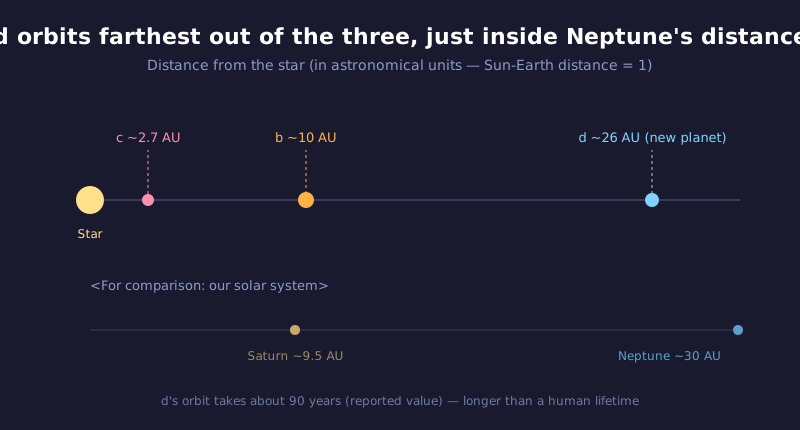
Orbiting that far out also means d runs colder, and ESO suspects this low temperature is part of why the planet is so extraordinarily dim. A wider orbit also means a longer year. Reports put d’s orbital period at roughly 90 years.
Put another way: in the time it takes this planet to complete a single lap around its star, Earth sees about 90 New Year’s Days pass by. A human being could be born, live a full life, and pass away before d finishes even one trip around Beta Pictoris. Seen in that light, 11 years of observation data covers only the tiniest sliver of the planet’s full year.
Honestly, this detail made us grin a little when we first read it. A planet that takes 90 years to complete one orbit, and astronomers are calling it “discovered” based on just 11 years of its footprints.
Why two teams, two telescopes, same answer
There’s one more thing that makes this discovery especially solid. d wasn’t found by a single team.
The group that worked through ERIS data on the VLT was led by Ben Sutlieff of the University of Edinburgh and Markus Bonse of ESO. Meanwhile, a completely separate team arrived at the very same planet using the James Webb Space Telescope (JWST), led by Aidan Gibbs of the University of California, Davis.
One team on the ground, one in space. Different instruments, different researchers, same result. Both teams published their findings on July 15, 2026, in the same journal, The Astrophysical Journal Letters.
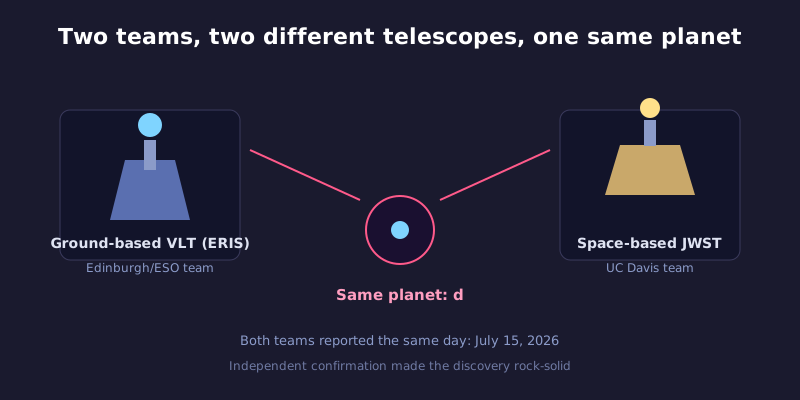
It’s a bit like two people arriving at the same destination by completely different roads. That kind of independent confirmation gives the discovery a lot of extra weight.
ESO notes that Beta Pictoris now joins HR 8799 as one of the only known systems where multiple planets have been directly imaged. Researchers also suspect that d, orbiting on the outer edge, may be helping shape the inner boundary of the debris disk. This young star system likely still has plenty of secrets left about how planetary systems come together.
The answer was hiding in data already collected
What stays with you most about this story might not be the planet itself, but how it was found.
You don’t always need to point a new telescope at some fresh patch of sky to make a discovery. Sometimes it’s enough to go back over data you already have, armed with better tools than you had before. Do that carefully enough, and answers you missed the first time start to surface. The next discovery isn’t always out there somewhere in the universe — sometimes it’s sitting in a file you already captured, waiting to be looked at again.
Think of an old folder of photos on your phone. At the time you took them, you barely noticed what was happening in the corner of the frame. Years later, you scroll back and suddenly spot something you’d never seen before. Beta Pictoris d pulled off exactly that trick, except with a telescope instead of a phone.
Sixty-three light-years away, a faint planet on a 90-year orbit sat quietly in the corner of a photograph taken a decade ago, tucked right beside its bright neighbor, waiting patiently to be noticed.