About 12 light-years from Earth — practically next door, by cosmic standards — orbits a planet more than seven times as massive as Jupiter. A true gas giant.
Here’s the strange part: despite sitting so close, almost no exoplanet (a planet orbiting a star other than the Sun) has ever been captured in a photograph. We know they’re out there. We just can’t see them.
This one, though, got its picture taken. And the trick that made it possible was that the planet is cold and dim.
Exoplanets normally don’t even show up as a dot
Astronomers have found thousands of exoplanets so far. Almost none of them have ever been photographed.
Twelve light-years, by the way, really is close in cosmic terms. Sunlight takes about eight minutes to reach Earth, but light from the next-nearest star takes roughly four years. On that scale, 12 light-years is like the next town over.
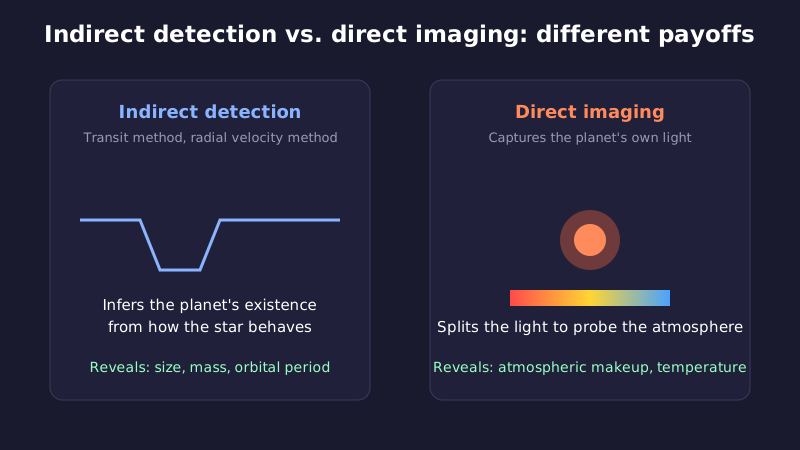
So how do we find these planets? Mostly indirectly. When a planet crosses in front of its star, the star’s light dims by a tiny fraction — that dip is what the transit method measures. Or a planet’s gravity tugs its star into a faint wobble, which the radial velocity method picks up.
Both techniques pin down a planet’s existence with impressive precision. But neither one actually captures the planet itself. They infer it exists by watching how the star behaves.
Only a small fraction of known exoplanets have ever been directly photographed, and most of those are young, still-hot giants glowing brightly on their own. Catching an older, cooler planet in the act is a much harder problem.
I’ll admit it: for years, whenever I heard “exoplanet discovery,” I pictured an actual photograph through a telescope. In reality, almost all of them were just a small dip or wobble on a graph.
So why don’t these planets show up in pictures, even the nearby ones?
The glare problem: the brightness gap between star and planet
The reason is simple. Stars are blindingly bright.
A star generates its own light. A planet, in most cases, only reflects it. In visible light, a star-planet pair like the Sun and Earth differs in brightness by roughly ten billion times.
Ten billion is hard to picture, so try this: at night, if someone stands directly in front of a car’s headlights, the camera just captures a blown-out white glare — their face vanishes into darkness. The same thing happens here, just on a wildly larger scale.
Imagine a single firefly glowing right next to a searchlight, and you’re trying to photograph it from several light-years away. The firefly’s glow gets swallowed whole by the searchlight’s bleed.
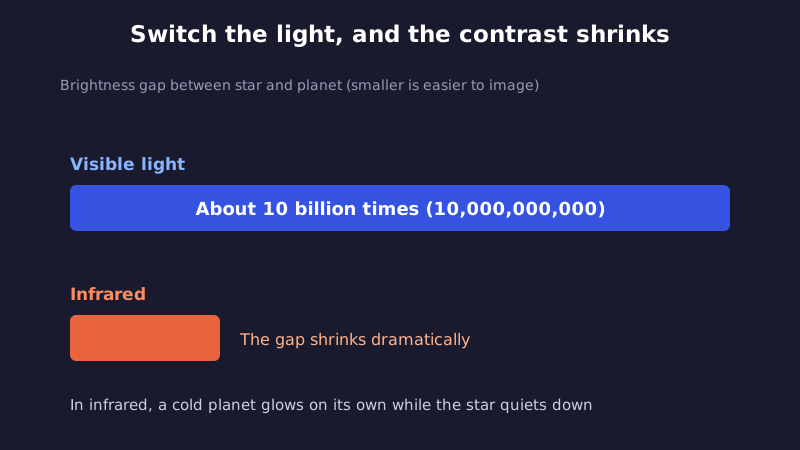
So the real obstacle isn’t distance — it’s the brightness gap with the host star. Which raises the question: how do you close that gap? This is where things get interesting.
Cold and dim becomes an advantage
The key is changing what kind of light you look at.
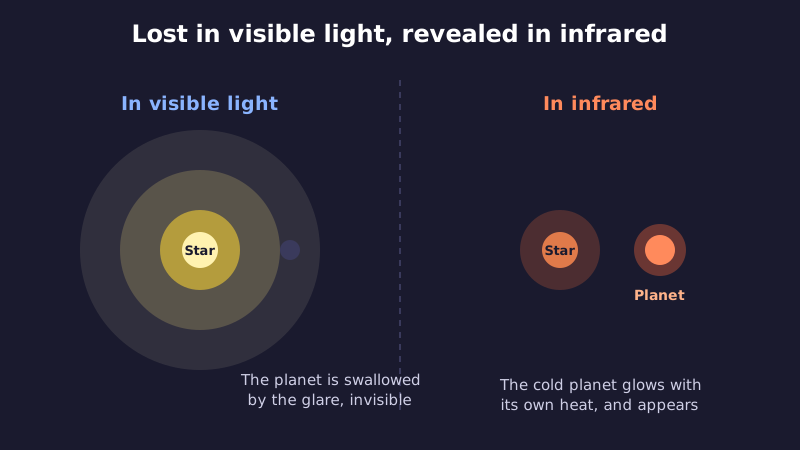
Give up on visible light — the kind our eyes see — and switch to infrared (light we sense as heat, invisible to the naked eye). The whole picture changes.
Every object, no matter how cold, radiates light according to its own temperature. It’s the same reason a person’s body shows up bright and white on an infrared camera. A cold gas giant doesn’t need starlight to be seen; it faintly glows in infrared purely from its own heat.
This is where “cold and dim” flips from a liability into an asset. In visible light, it’s just a planet that’s hard to spot. But move into infrared, and the brightness gap between star and planet shrinks dramatically — the planet lights up on its own while the star quiets down by comparison.
There’s an engineering trick, too. Telescopes use a device to artificially block the star’s glare, then pick up the faint light left glowing just beside it.
This particular planet — Epsilon Indi Ab, orbiting a star in the constellation Indus — was imaged by MIRI, the mid-infrared instrument aboard JWST (the James Webb Space Telescope). A team led by Elisabeth Matthews of the Max Planck Institute for Astronomy first captured it in 2024 and published a detailed analysis in April 2026.
The observations used two mid-infrared filters, at wavelengths of 11.3 and 10.6 micrometers — precisely the wavelengths where a cold planet like this one shines brightest.
So what exactly did all that effort reveal?
Meet the planet
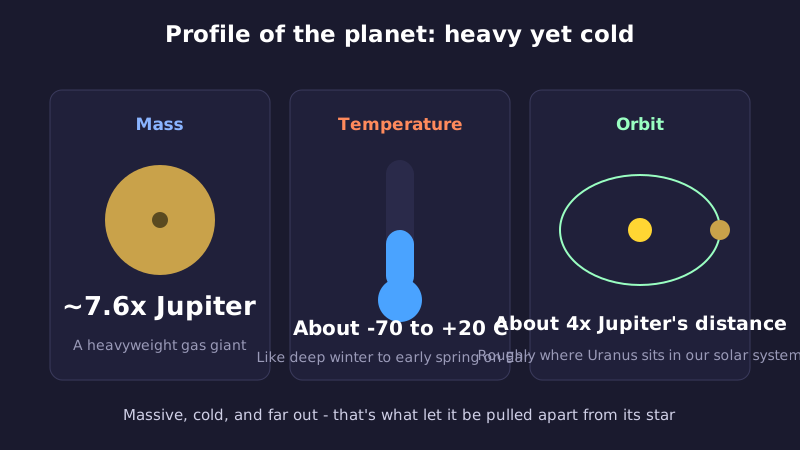
According to the research team, this planet weighs in at about 7.6 times the mass of Jupiter. Since Jupiter itself is more than 300 times Earth’s mass, that makes this an absolute heavyweight among gas giants.
The surprising part is its temperature. Near the surface, it’s estimated to sit somewhere between about 200 and 300 kelvin — roughly minus 70 to plus 20 degrees Celsius.
Those numbers might sound unremarkable at first, but think about it: this is a planet more than seven times the mass of Jupiter, sitting at temperatures you’d expect on Earth somewhere between deep winter and early spring. The research team describes it as unusually cold among directly imaged planets.
Its orbit is distant, too — about four times the distance between the Sun and Jupiter. Translate that to our own solar system, and you’d land somewhere out around Uranus’s orbit. That distance from its star is precisely what let telescopes resolve star and planet as two separate points of light.
Picture yourself hovering above this planet’s cloud tops. Its host star would hang in the sky as nothing more than a brilliant point of light — not a sun warming the world below, but something closer to a distant streetlamp. Everything around you would sit in a dim, frigid twilight.
And that very dimness is exactly what let a telescope back on Earth catch its picture. There’s something wonderfully ironic about that.
Why a picture matters, not just a data point
Given all that effort, what’s the actual payoff of capturing a planet’s image directly, rather than just detecting it?
Indirect methods can tell you a planet’s size, mass, and orbital period. But they never actually capture its light. Direct imaging does — you’re holding the planet’s own light in hand.
Once you have that light, you can split it apart by wavelength (a technique called spectroscopy) to find out what’s in the atmosphere and how hot or cold it really is. Instead of inferring everything secondhand from the star’s behavior, you’re hearing it straight from the planet itself.
Knowing the atmosphere’s composition starts to reveal a planet’s “face” — whether it has clouds, what gases wrap around it. A planet that was once just evidence of existence starts to become a world with a personality of its own.
The research team sees this as a stepping stone: refining the technique on cold, distant giants like this one now, so that eventually it can be pointed at much smaller planets. Imaging something as small as Earth directly is still far out of reach — but sharpening the tools on these easier, cold gas giants is how you get there.
Flip it around: what makes a planet photographable
Turn everything here on its head, and you get a recipe for which planets can actually be photographed: a small brightness gap with the host star, enough distance from that star to be resolved as a separate point of light, and a cold, massive body that radiates its own light in infrared.
In other words, planets that sit far enough from their star to stay cool are exactly the ones we can catch on camera. There’s a strange inversion at work in cosmic photography: the dim supporting character standing next to the bright star turns out to be the easier one to photograph.
Next time you’re walking under the glare of a streetlight at night, take a second to notice the shadows swallowed at your feet by that glow. About 12 light-years away, a cold, giant planet was standing in exactly that kind of shadow — and it was precisely that darkness that let it leave its first-ever mark on a human camera.