Some stars blaze across the night sky. But they’re rarely the ones holding up a galaxy’s weight.
Most of that mass belongs to faint, unremarkable stars too small for any telescope to resolve one by one. And here’s the catch: astronomers don’t actually count them. They estimate.
Which raises an uncomfortable possibility. We might only be getting galaxies half right.
You Can’t Put a Galaxy on a Scale
How do you weigh something tens of billions of light-years away? Obviously, you can’t drop it on a bathroom scale.
Astronomers rely on the light a galaxy sends our way. A brighter galaxy, the logic goes, is packed with more stars — and therefore weighs more.
Think of it like guessing a household’s lifestyle from its electric bill. You can’t see inside the house, but the power usage gives you a rough sense of what’s going on. With galaxies, you work backward from the light that arrives to estimate the total stellar mass.
The trouble is, distant galaxies are often so faint they show up as nothing more than a point of light. You can’t pick out individual stars — the whole galaxy blurs into a single smudge. Reconstructing what’s inside from that one smudge means stacking guess on top of guess.
And here’s where it gets tricky: brightness and star count aren’t proportional at all.
Only a Handful of Stars Actually Shine
Stars are born in a huge range of sizes. Some weigh in at dozens of times the Sun’s mass; others are barely a tenth of it.
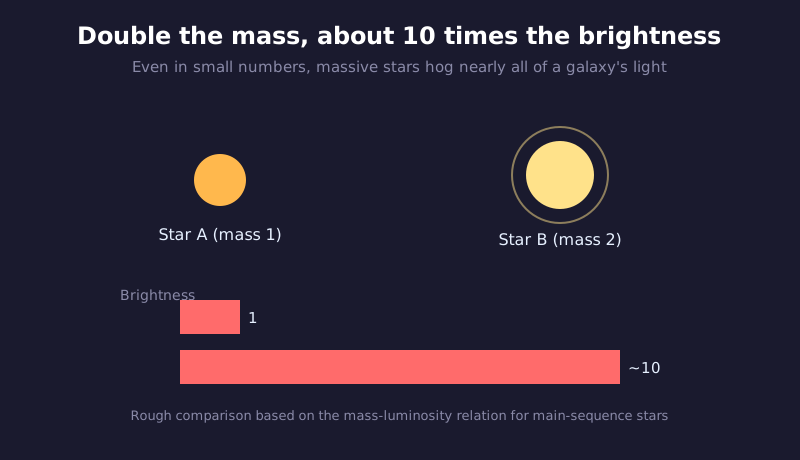
Here’s the catch: heavier stars are disproportionately brighter. Luminosity climbs steeply with mass — roughly speaking, double a star’s mass and you get about ten times the brightness.
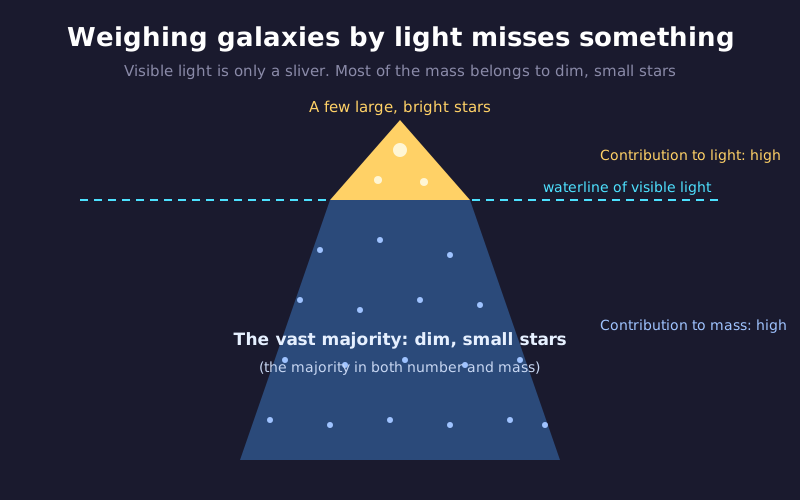
So a small number of massive stars end up hogging almost all of a galaxy’s light.
Meanwhile, the overwhelming majority of stars are small and dim. In the Milky Way, more than 70% of stars are believed to be cooler and smaller than the Sun — so-called red dwarfs. Some shine at less than a thousandth of the Sun’s brightness.
Picture a room lit by one bright bulb. That single bulb determines how bright the room looks. But count the light sources, and the tiny, dim ones — hidden in the corners — vastly outnumber it.
Galaxies work the same way. A small population of massive stars dominates the light; the vast majority of small stars carries the number and the mass. These are two entirely different things, yet we can only observe one of them directly.
Red dwarfs also live an extraordinarily long time. The Sun will burn out in a few billion years, but dimmer stars sip their fuel so slowly that many have likely never died since the universe began. They’re not flashy, but they quietly form the backbone of every galaxy.
The Star Count We Never Actually Made
Stop and think about this for a second. In a distant galaxy, you can’t pick out individual red dwarfs. All that reaches us is one blended color, mixing the light of countless stars together.
So how do astronomers know how many faint, small stars are hiding in there?
The honest answer: they assume. They guess at the proportion of stars born at each size, a ratio astronomers call the “stellar mass function.”
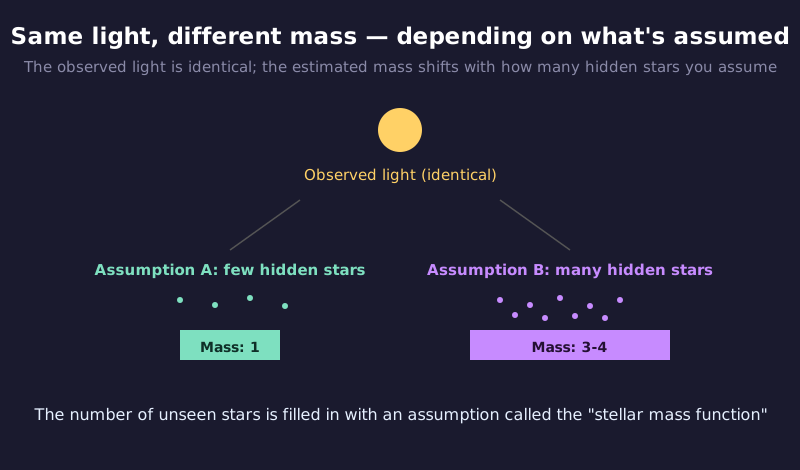
That ratio comes from counting stars nearby — then reusing the same numbers everywhere else. Whatever proportion holds true in the Milky Way’s neighborhood gets applied to galaxies billions of light-years away.
Why recycle the same numbers? Because there’s no alternative. Counting individual stars in a distant galaxy is far beyond what any telescope can do today. Astronomers have to borrow a ratio from the stars they can actually count nearby. It’s a reasonable approximation — but it’s easy to forget it’s a borrowed one.
I’ll admit I underestimated how much this mattered for a long time. But think about it: it’s a bit like a household survey that assumes every family across the country spends the same fraction of income on groceries as your own neighborhood does. That might hold up next door. Cross an ocean, and there’s no reason to expect it still applies.
The weight we assign to a galaxy rests on this single assumption. That’s the blind spot.
JWST Keeps Finding Galaxies That Are “Too Heavy”
This is where it gets interesting. Let’s rewind the clock — way back.
The farther away a galaxy is, the longer its light has traveled to reach us. Looking far away, in other words, means looking into the past. The infrared-sensitive James Webb Space Telescope (JWST) has been capturing galaxy after galaxy from this ancient era.
And it keeps turning up galaxies that don’t make sense. Galaxies from when the universe was still young, already crammed with stars, looking unexpectedly bright and heavy — as if they assembled far too fast.
Why is that a problem? In the standard picture, galaxies build up gradually, gathering gas and forming stars over billions of years. But if massive galaxies were already common early on, there simply wasn’t enough time for them to grow that big. It’s like walking into a brand-new store on opening day and finding it already packed with regulars.
How did galaxies get so big, so fast? Several explanations have been proposed. Some researchers argue, cautiously, that we may simply be misjudging these galaxies’ distances or ages. But one explanation in particular stands out — both for how thorny it is and for how interesting.
It circles back to that blind spot. What if early galaxies harbored far more faint, small stars than the local-universe ratio assumes? That would throw off both how much light they emit and the mass we calculate from it. Some research teams suspect that star formation itself may have worked differently in the early universe.
Some estimates suggest the true mass could be 3 to 4 times higher than currently assumed. That’s not a settled conclusion — it’s one leading candidate still under scrutiny.
Get the Weight Wrong, and You Rewrite Cosmic History
A factor of a few might sound like a rounding error. But a galaxy’s mass is tied directly to the timeline of the universe itself.
How fast galaxies grew, and when, is measured by how much stellar mass is packed into galaxies at each cosmic epoch. If those mass estimates are off by several times, the whole story of when the universe started filling up with stars needs revisiting.
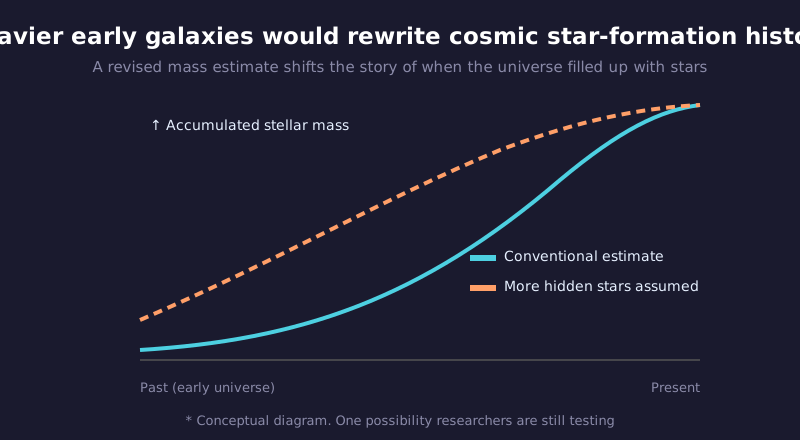
Researchers aren’t rushing to rewrite the numbers, and for good reason. Assuming more hidden stars than usual is a convenient way to smooth over inconvenient data — a trap researchers are well aware of. That’s why teams are cross-checking against other observations before drawing conclusions.
Honestly, either outcome is fascinating. If these galaxies really are as heavy as they appear, the universe assembled stars faster than we imagined. If the culprit is undercounted faint stars, we’ve uncovered a systematic bias — one that makes distant galaxies look lighter than they really are. Either way, someone has homework: theorists, if the first is true; our measuring methods, if it’s the second.
Did star formation really work differently back then? Or is some other explanation correct? Nobody knows yet.
What You See Is Just the Tip of the Iceberg
Imagine standing inside a galaxy from the early universe, able to count every star around you one by one. Your eye would catch a handful of dazzling giants first. But at your feet, spread quietly in every direction, would be many times more small, reddish, unremarkable stars.
Every galactic weight we’ve ever calculated came from working backward from that handful of bright stars. What we’ve been missing is the quiet majority.
Next time you look at a photo of a starfield, remember this: what you’re seeing is only a fraction of what’s actually there. A galaxy’s true weight is hiding in the darkness the camera never captured.