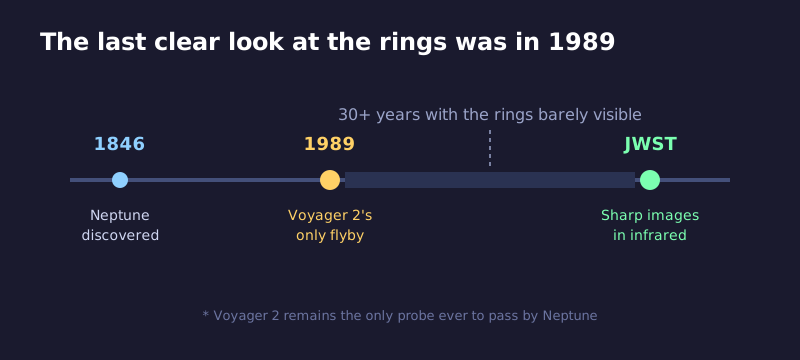
Only one spacecraft has ever flown close to Neptune. Voyager 2 did it in 1989, on its way out of the solar system, and the faint rings it photographed that day barely showed up again for more than three decades.
Then, out of nowhere, those rings came back into sharp focus. The instrument that did it wasn’t a spacecraft that traveled all the way out there. It was JWST — the James Webb Space Telescope — parked comfortably near Earth the whole time.
That’s the strange part. A single close pass should beat a photo taken from a much greater distance. Yet here, the far-away shot won. So what flipped the odds?
Nobody had seen the rings clearly since 1989
Neptune was discovered in 1846. It sits about 30 times farther from the Sun than Earth does — roughly 2.8 billion miles out, an ice giant so distant that ground-based telescopes see nothing more than a small blue dot.
Only one human spacecraft has ever gotten close: Voyager 2, which swung past Neptune in 1989 as its final stop before leaving the solar system, after touring Jupiter and Saturn on the way. That flyby gave us our first real look at the faint ring system encircling the planet.
Neptune belongs to a class called “ice giants” — worlds made more of icy compounds than gas, with no real surface to speak of. Even now, we still don’t fully understand what’s happening beneath that hazy blue atmosphere.
Here’s the catch: Voyager 2 didn’t stop. It kept flying and never came back. It’s still heading out of the solar system today. Once it passed, Neptune’s rings sank back into obscurity, and for a long stretch afterward, nobody got a good look at them again.
Why so hard to see? Saturn’s rings, after all, show up beautifully in almost any photo.
Too faint to survive the glare
Saturn’s rings are dominated by chunks of ice, which reflect sunlight efficiently. That’s why they glow so clearly even from a distance.
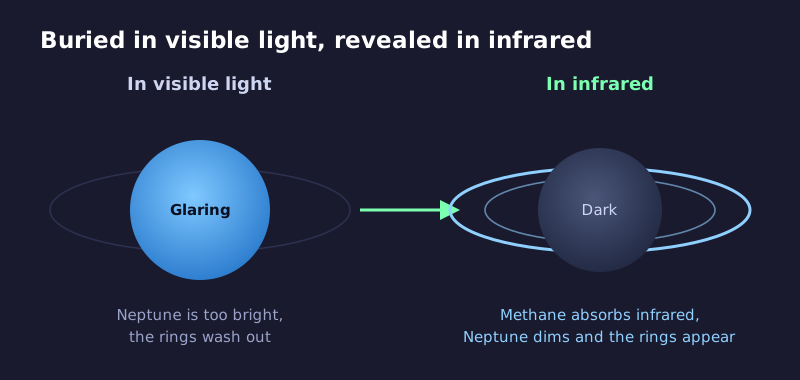
Neptune’s rings are different — thought to be made mostly of fine dust, which reflects far less light. They’re simply dim to begin with, and that dim ring sits right next to a planet that, in visible light, is anything but dim.
Add in the sheer distance: about 2.8 billion miles. Even the largest ground-based telescopes can barely resolve Neptune as more than a small, blurry point of light. Trying to pick out a faint, poorly defined ring right next to that point was, for decades, simply out of reach.
Picture photographing a bright light bulb in a dark room. The bulb blows out into a white blob, and anything small sitting near it disappears into the glare. Neptune has the same problem.
When the planet itself shines brightly, its glare swallows the faint rings whole. That washout is exactly what kept Neptune’s rings hidden for so long.
So how did JWST get around it? By changing the color of the light it looked at.
In infrared, Neptune goes dark
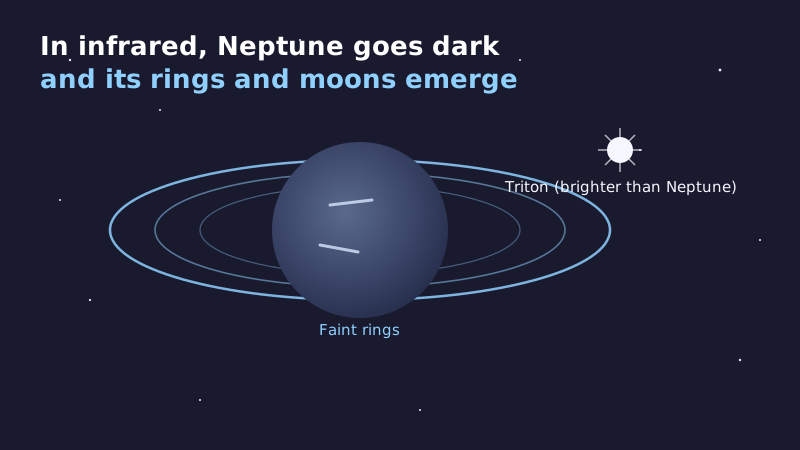
JWST used its NIRCam instrument — Near-Infrared Camera — to photograph Neptune not in visible light, but in infrared, a longer wavelength invisible to human eyes.
This is the key to the whole story. Neptune’s atmosphere contains methane, and methane absorbs infrared light remarkably well. So instead of the bright blue orb we see in visible light, Neptune in infrared looks pale and dim — almost washed out in the other direction.
Once the planet itself goes dark, the glare disappears. The faint rings that had been drowned out for decades finally stand out in relative contrast. What JWST captured is, by most accounts, the sharpest overall view of the ring system in more than 30 years — including faint dust bands in infrared that hadn’t been confirmed since Voyager 2’s flyby.
I’ll admit, this logic didn’t click for me right away. Nobody moved closer. Nobody zoomed in. The rings simply became visible because the color of light changed — and that felt almost too simple to be true.
Here’s a familiar comparison: when you photograph someone backlit on your phone and switch modes, the blown-out background suddenly calms down and a hidden face appears. JWST pulled off something similar, just by choosing a different color of light.
Getting closer wasn’t the answer. Making Neptune go dark was.
Seven moons came along for the ride
Once Neptune dims, it’s not just the rings that benefit. The same trick makes the planet’s moons easier to spot too.
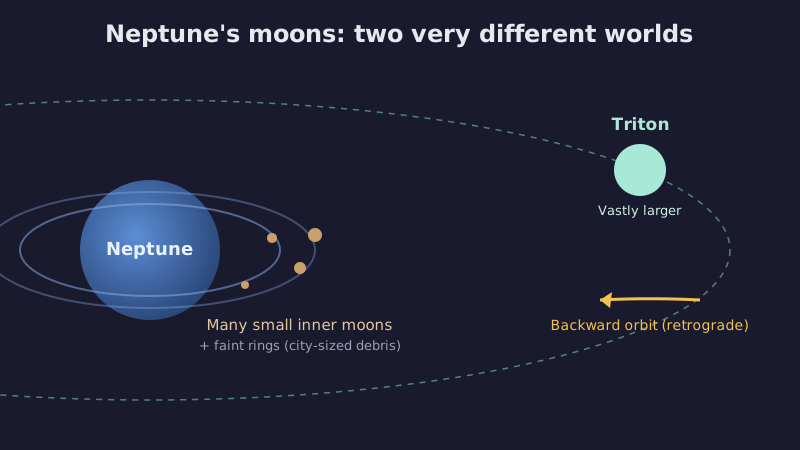
In this observation, JWST caught seven of Neptune’s 14 known moons at once: Galatea, Naiad, Thalassa, Despina, Proteus, Larissa, and Triton. All of them are small and dim, and all of them used to blend into Neptune’s glare — until now.
Triton is the real standout. In the image, it actually shines brighter than Neptune itself. The reason comes down to reflectivity: Triton’s surface is coated in frozen nitrogen, which bounces back roughly 70% of the sunlight that hits it. Next to a Neptune dimmed by infrared, Triton alone gets to glow.
Triton has another oddity worth noting. While nearly every other moon in the solar system orbits in the same direction its planet spins, Triton goes the opposite way — a retrograde orbit. That strange behavior is one reason researchers suspect Triton wasn’t born around Neptune at all, but formed farther out in the solar system and got captured later.
A retrograde orbit also means Neptune’s gravity is slowly braking Triton down. Some researchers think that, far in the future, Triton could drift close enough to break apart — becoming raw material for a brand-new ring. A captured wanderer, eventually recycled into a halo.
If you stood on Triton’s icy surface, the Sun would look far smaller and dimmer than it does from Earth — just a faint point of light. Even at “noon,” a dim sky would hang overhead, with a huge, pale-blue Neptune looming above. And the only sound would be the creak of frozen nitrogen under your feet, in a silence otherwise complete.
One close pass versus endless return visits
Let’s circle back to that opening puzzle. JWST, despite being far away, beat Voyager 2’s up-close photo — and the choice of infrared light explains a lot of that.
But it’s not the whole story. A spacecraft flyby is a one-shot deal — a brief pass, gone in a flash. For nearly 40 years now, Voyager 2 has remained the only probe that’s ever been anywhere near Neptune.
A telescope waiting near Earth works differently. It can turn back toward Neptune again and again, tracking how the rings and atmosphere change over time. Instead of a single snapshot, it offers ongoing, repeatable observation.
Researchers have long known that Neptune’s rings vary in density from place to place — dust seems to clump and disperse over time. That kind of slow change is invisible to a one-time flyby. You need an instrument that can return to the same target across different seasons, different years, before any motion becomes visible at all.
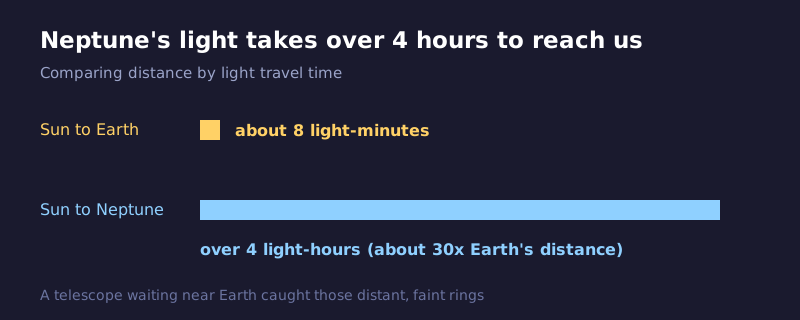
The distance itself hasn’t changed. Neptune’s light still takes over four hours to reach us — more than 30 times longer than the roughly eight minutes sunlight takes to reach Earth. Even so, a tool built to wait can see things a tool built for a single pass never could.
The farther and fainter something is, the more patience pays off
Neptune takes 164 years to complete one orbit around the Sun — long enough that no single human lifetime spans even one full year on that world. We have almost no way to get physically closer, and its light always arrives hours late.
Faced with something that distant and that faint, we didn’t reach for “get closer.” We reached for “look again, in a different color, as many times as it takes.” The rings that vanished after a single 1989 encounter have reappeared — this time in front of a telescope built for patience.
Whatever happens to these rings next won’t be tracked by a spacecraft rushing past. It’ll be a single telescope, sitting far away, quietly watching and waiting. Somewhere in the night sky is a dark point you’d never find with the naked eye — and beyond it, a faint ring is still turning, still shedding and gathering dust, in silence.