Deep in Neptune’s inner moon system orbits a body called Hippocamp — roughly 34 km across, about the size of a single city floating in space.
It didn’t form that way from the start. Scientists think it’s a chunk knocked loose in a collision, broken off from Proteus, a somewhat larger moon orbiting just outside it.
In other words, an older moon shattered, and its fragments drifted back together into a “rebuilt” moon. Around Neptune, it turns out a moon isn’t necessarily a once-and-done arrangement.
Same planet, two completely different neighborhoods
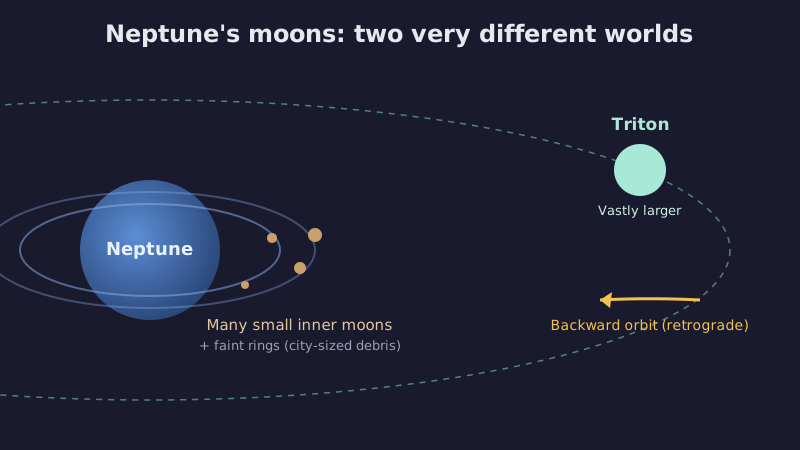
Neptune has exactly one moon that’s genuinely huge: Triton, roughly 2,700 km across. That’s less “moon” and more “small planet.”
Turn your attention inward, though, and the scene changes entirely. A crowd of small moons — tens to a few hundred kilometers across — is packed in close. Even the largest of them, Proteus, is only about 420 km wide. Hippocamp, the smallest, barely reaches 34 km.
Do the math and Triton turns out to be about 80 times wider than Hippocamp. That’s an absurd size gap for moons sharing the same planet.
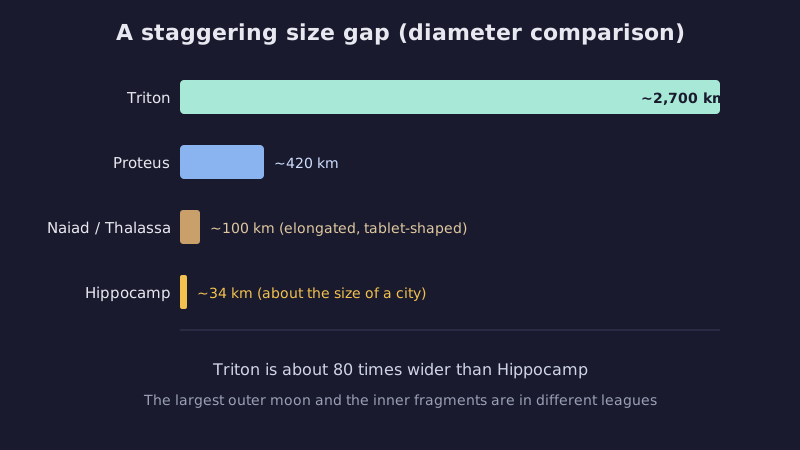
What’s more, the inner moons aren’t even round. Naiad and Thalassa, in particular, are shaped more like elongated candy tablets — lumpy, jagged slabs of rock about 100 km long.
Most of these inner moons were first spotted by Voyager 2 during its 1989 flyby of Neptune. Hippocamp, the smallest, wasn’t found until later, in Hubble Space Telescope images.
Compare that to Jupiter or Saturn, where moons line up in tidy order from small to large. Neptune’s inner system looks nothing like that. Why is it such a mess? It’s worth pausing on that question.
Naiad and Thalassa: the “dance of avoidance”
Nothing captures how crowded Neptune’s inner moons really are like the strange choreography of Naiad and Thalassa.
According to a NASA/JPL report, these two moons orbit as though they’re actively dodging each other. Naiad circles Neptune roughly every 7 hours, Thalassa every 7.5 — practically neighboring orbits.
At that distance, a collision should be almost unavoidable. But Naiad’s orbit is tilted just slightly, so every time it overtakes Thalassa, it slips past above or below it instead. Researchers have nicknamed this maneuver the “dance of avoidance.”
Even at their closest approach, the two moons stay about 3,540 km apart — a bit more than the distance across the length of Japan. They’ve been holding that precise gap for eons.
Picture two people in a narrow hallway who keep stepping the same direction to avoid each other, over and over. Now imagine that awkward shuffle playing out 4.5 billion km away, for billions of years.
A configuration this delicately balanced doesn’t just appear from nowhere. It looks like the aftermath of things smashing together, grinding down, and barely settling into place. And in fact, researchers think Neptune’s chaotic inner moons are exactly that: the cleanup crew after a single catastrophic event.
An intruder named Triton wrecked the original family
The star of that catastrophe is Triton, the outer giant.
Triton has a feature that’s rare among the solar system’s large moons: it orbits backward, against the direction of Neptune’s own spin. A moon that formed naturally alongside its planet should orbit the same way the planet rotates. Going the opposite way is strong evidence that a moon came from somewhere else and was captured later.
Which means Triton probably wasn’t Neptune’s moon to begin with. Researchers believe it was once a large icy body wandering the outer solar system, until Neptune’s gravity caught it and pulled it into orbit.
The trouble is what that capture unleashed. Dropping something this massive into an existing system doesn’t leave the original moons unscathed.
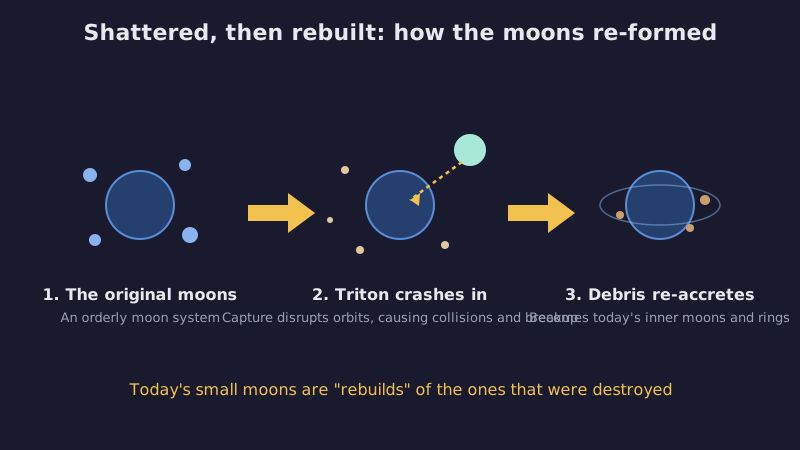
Triton’s gravity is thought to have thrown the original moons’ orbits into chaos, sending them crashing into each other and breaking apart. Whatever orderly system existed before was violently destroyed. Call that the end of “generation one.”
Triton itself, fresh off its capture, likely started out on a wildly stretched, elongated orbit. Over a long stretch of time, tidal forces — the mutual gravitational tug between orbiting bodies — gradually rounded that orbit into the near-circular path it follows today. The inner system would have taken an even worse beating during that slow settling process.
Rebuilt from the rubble
Here’s where things get interesting — honestly, this is my favorite part of the story. Getting smashed apart wasn’t the end.
The debris didn’t just scatter into space and vanish. Scientists think it kept orbiting Neptune, gradually clumping back together under its own gravity until it re-formed into small moons. Re-accretion from wreckage, essentially.
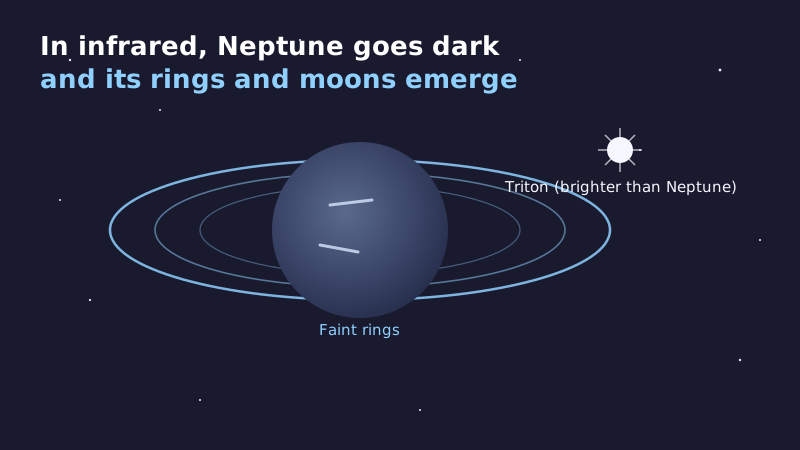
That’s how today’s inner moons were born: rebuilt from the leftover material of the ones that came before — a second generation, in effect. Even the faint rings are thought to be made of the same debris, just spread out as finer particles in a band.
According to NASA, the rebuilding didn’t stop there either. Hippocamp, the moon we started with, is believed to be a fragment of Proteus — itself already a second-generation moon — knocked loose in a later collision. That makes Hippocamp a third-generation object.
It’s a bit like tearing down a house and reusing the old beams and roof tiles to frame the next one. Something similar happened here, just on a planetary scale. Each rebuild recycled the wreckage of the last — except every time, the resulting moons got smaller, and more numerous.
It’s a coherent story. But nobody actually watched it happen. Is there any direct evidence, written into the moons themselves, that they really were broken and rebuilt?
What JWST saw: a dark, ice-poor surface
That’s where JWST — the James Webb Space Telescope — comes in, shining infrared light on the question.
A research team used JWST’s cameras to break down the reflected light from Neptune’s and Uranus’s inner moons and rings in fine detail. The goal: figure out what’s actually on their surfaces.
The key signal sits around a wavelength of 3 micrometers, where water ice leaves its mark. The more ice on a surface, the more strongly it absorbs light at that wavelength, producing a deep dip in the data.
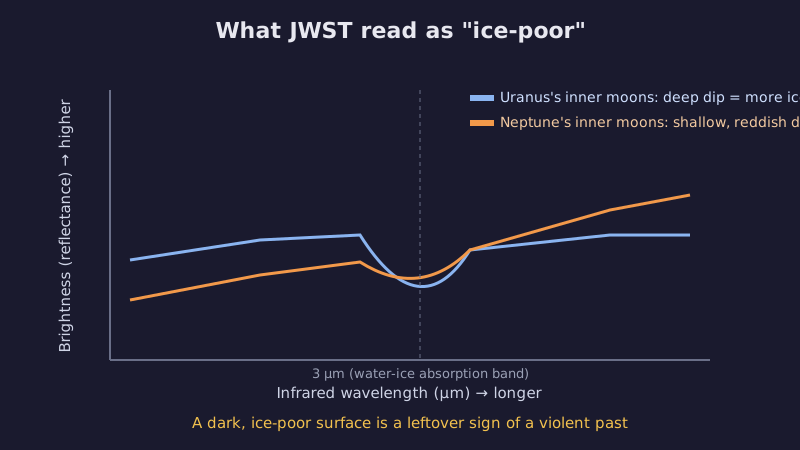
Compared side by side, Neptune’s inner moons showed a shallower dip than Uranus’s — and their surfaces skewed noticeably redder overall. The research team reported that Neptune’s inner moons carry a lower proportion of water ice.
That difference might sound minor, but it turns out to matter a lot. A dark, ice-poor surface lines up neatly with what you’d expect from a body that’s been through a rough history.
When objects collide violently, break apart, and reassemble while picking up dark contaminant material, they lose their pristine original ice and darken over time. If Neptune’s inner moons really do carry a history of being ground down and rebuilt, this ice deficit reads as a natural leftover of that process. Color and ice content alone can’t nail down an object’s history with certainty, though, and the research team is careful to weigh other explanations too.
A moon isn’t forever
If you could stand on Hippocamp’s surface, the rock under your feet would be a fragment of some other moon that no longer exists. Look up, and Neptune would fill most of the sky, with Triton — the culprit behind all of it — sliding backward across the view.
We tend to assume a moon is a fixed, unchanging companion that’s been with its planet from the start. That’s probably because our own Moon has shown us the same face, night after night, for as long as anyone’s looked up.
But Neptune’s inner system tells a different story: moons form, get destroyed, and get rebuilt. A single, intact giant and a scattering of shattered, reassembled fragments are living out completely different lives around the same planet.
Next time you glance up at a hazy moon overhead, remember that its round, familiar face is just “generation one, still intact for now.” Out around Neptune, moons that have been rebuilt two or even three times over are still crowding each other in that same delicate dance.