Beneath Titan’s icy shell, there’s supposed to be a hidden ocean. That’s been the working assumption for years. But late last year, a study suggested this “ocean” might not be an ocean at all.
Saturn’s largest moon is famous for its thick atmosphere and methane rain, and whether liquid water lies beneath its surface matters enormously — it ties directly into the question of whether life exists anywhere beyond Earth. That’s why this reassessment is such a big deal.
Where Did the Hidden-Ocean Idea Come From?
First, a quick primer on Titan. It’s about 5,150 km across — the second-largest moon in the solar system, and bigger than the planet Mercury (roughly 4,900 km). Titan feels less like a moon and more like a small planet in its own right.
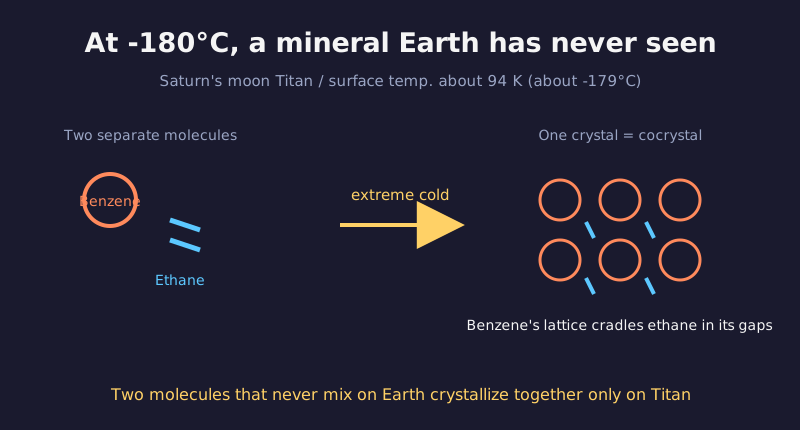
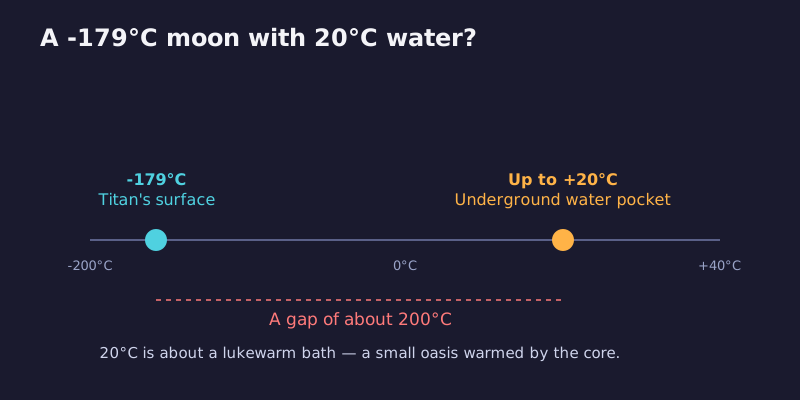
A thick nitrogen atmosphere blankets the surface, where methane lakes and rivers carve the landscape. Liquid methane falls as rain, flows through channels, and pools into lakes — essentially Earth’s water cycle, replayed with methane standing in for water. Surface temperatures hover around -179°C, hardly a place you’d expect liquid water to survive.
There’s also a curious puzzle tied to that atmospheric methane. Sunlight steadily breaks it apart, yet the atmosphere never seems to run dry. Something below the surface may be replenishing the supply. Whatever’s down there, in other words, is tangled up with this atmospheric mystery too.
In 2005, the Huygens probe — carried to Saturn’s system aboard Cassini — touched down on Titan’s surface, still the most distant landing any human-made craft has ever pulled off. The first images it beamed back showed a hazy, orange-tinted landscape unlike anything seen before.
Even so, the case for a hidden ocean rests on solid ground. From 2004 to 2017, Cassini orbited Saturn and repeatedly measured Titan’s gravity with remarkable precision.
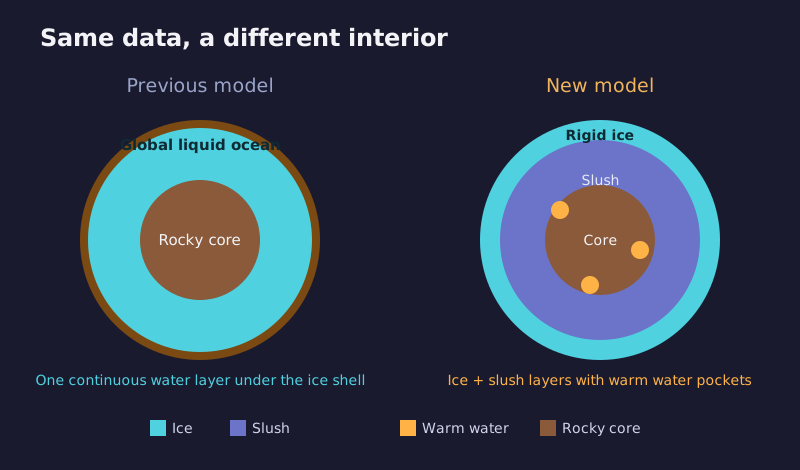
Those gravity measurements were read as evidence for a layer of liquid water beneath the ice — essentially a salty ocean wrapped entirely around Titan’s icy shell, like a single continuous shell of its own.
The model held up for years, and for good reason: other icy worlds, like Jupiter’s moon Europa and Saturn’s moon Enceladus, harbor subsurface oceans of their own. Assuming Titan followed the same pattern seemed like the obvious call.
So why did that ocean come under suspicion?
Same Data, a Different Answer
Here’s the interesting part. Nobody found a new ocean. No spacecraft flew a new mission. Researchers simply went back to Cassini’s existing data and reanalyzed it more carefully — and that alone flipped the conclusion.
The study was led by researchers at NASA’s Jet Propulsion Laboratory: postdoctoral researcher Flavio Petricca and senior research scientist Julie Castillo-Rogez. Their findings were published in the journal Nature on December 17, 2025.
The team worked with radio signals from ten of Cassini’s close flybys of Titan. As a spacecraft moves toward or away from Earth, the frequency of its radio signal shifts by a tiny amount — a shift picked up by NASA’s Deep Space Network of giant antennas. From those minute frequency changes, researchers could reconstruct Titan’s gravity field and measure the moon’s “tidal deformation”: how much it stretches and squeezes under Saturn’s gravitational pull.
Same observations, different conclusion. The key turned out to be exactly how that tidal deformation behaved.
Ice, Slush, and Pockets of Warm Water
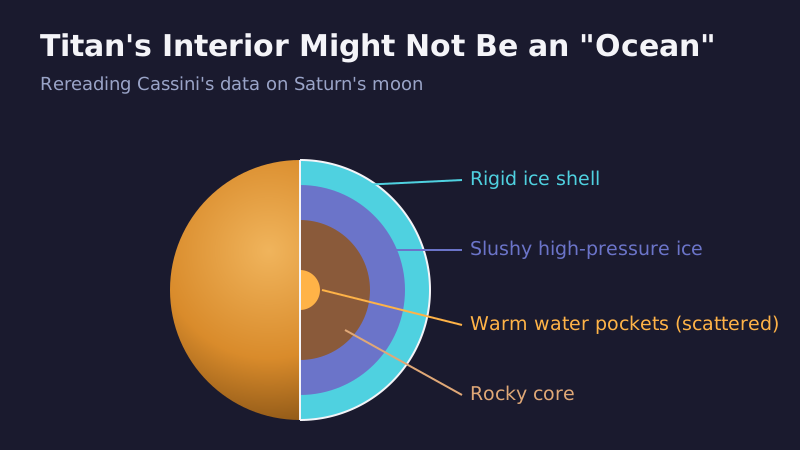
Here’s the picture the team arrived at. Titan’s interior starts with a rigid outer ice shell. Below that sits a thick layer of high-pressure ice with a slushy, semi-solid consistency. Liquid water, meanwhile, only shows up as small pockets scattered near the rocky core — not as a global ocean at all.
“High-pressure ice” might sound like a contradiction. Ordinary ice is light enough to float on water. But under intense pressure, water molecules pack into a denser form of ice that’s actually heavier than the liquid itself. Deep inside Titan, the team suggests, this kind of ice mixes into slushy layers stacked one atop another.
The layering isn’t even uniform. Hard ice and soft slush appear to alternate in bands at different depths — like a millefeuille pastry made of ice. That’s the interior structure this new analysis paints.
From “a global ocean” to “layers of ice and slush” — the same dataset, reinterpreted, tells a strikingly different story.
And those water pockets apparently aren’t just cold leftovers, either. According to the research team, water near the core could reach temperatures as high as 20°C — roughly the warmth of a lukewarm bath.
The surface sits at -179°C; some pockets underground may hit 20°C. That’s a gap of about 200°C. Buried inside this frozen moon, in other words, are faint pockets of genuine warmth.
Why a Lag in Titan’s Stretching Reveals What’s Inside
This next part gets a little technical, but skip it and the rest won’t quite click.
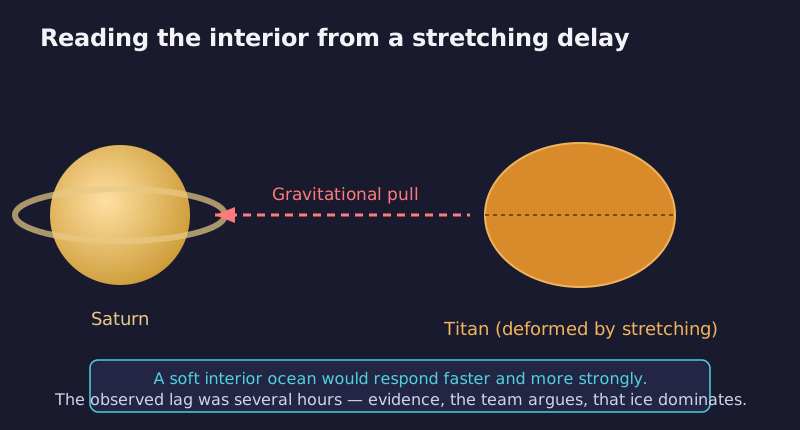
Earth’s oceans rise and fall because the Moon’s gravity tugs on them. Saturn does something similar to Titan, stretching and squeezing the whole moon just slightly — deforming it, ever so subtly, into something like a rugby-ball shape.
What matters here is how quickly that deformation keeps pace with the pull of gravity. If the interior is a soft, liquid ocean, the deformation is large and the response is nearly instant. If it’s mostly rigid ice, the response is sluggish and lags behind.
Picture squeezing a water balloon versus one filled with gelatin. Apply the same pressure to both, and they dent and rebound in completely different ways. Measure a moon’s stretching “personality,” and you can infer what’s hiding inside.
Cassini’s data revealed a lag of several hours. The research team argues that this sluggishness is itself evidence that Titan’s interior is dominated by ice — a global ocean, they reason, would respond far more nimbly.
What was actually observed were shifts in radio signals and a delay in deformation. Concluding “ice must dominate” from that is an interpretation, and it’s worth keeping the two apart. Still, it’s a reasonable way to read the evidence.
Does “No Ocean” Mean No Hope for Life?
Naturally, this raises the question of life. Subsurface oceans have long been treated as promising places to look for it. If that ocean vanishes, does the hope vanish too?
Apparently not — or not that simply. According to NASA, the absence of a global ocean doesn’t close the door on the possibility of life. If anything, the real key may be those warm water pockets.
Picture it this way. The rocky core holds materials that could serve as raw ingredients for life. Water warmed near that core could slowly percolate up through the slushy, high-pressure ice layer, carrying nutrients toward the outer shell. The research team believes a circulation like this is plausible.
Heat from the core, nutrients from the rock, water moving between them — the cast needed for life is, at least on paper, already assembled. Of course, having the right cast doesn’t mean the play has actually begun.
Life needs water, nutrients, and a moderate source of heat to take hold and persist. Rather than one vast ocean, a scattering of small, warm, nutrient-rich pockets of water might, under the right conditions, actually suit life better than a single uniform sea. That’s a rather different setting from the sprawling subsurface oceans imagined at Europa or Enceladus. It isn’t a flashy conclusion, but it does leave behind a quiet trace of hope.
Granted, this is only “a possibility that remains open.” There’s no evidence anywhere that life actually exists there. Even the thickness of the ice and the extent of the water pockets are still far from settled.
The Real Test Awaits a Flying Robot
In the end, this whole picture was built from gravity measurements and radio signals gathered from afar — a plausible model of Titan’s interior, nothing more. Confirming it will take data collected on the ground.
That job falls to Dragonfly, the rotorcraft NASA is preparing to send to Titan — essentially a large drone designed to fly across the moon’s surface and study it up close. Launch is currently planned for no earlier than 2028.
Dragonfly’s strength is mobility: rather than staying put, it can hop from site to site, sampling the ground’s composition at each stop. It won’t peer directly beneath the ice. But whatever seeps up to the surface acts as a mirror of what’s happening below.
What’s striking is where this new conclusion actually came from. The idea that Titan “might not have an ocean after all” emerged entirely from re-reading ten flybys’ worth of data that had been sitting in the archives for years. No new telescope was needed. No new mission had to fly. Years after Cassini’s mission at Saturn ended, the same old records are still yielding fresh answers.
Tonight, Saturn might appear as a faint point of light low in the southern sky. Somewhere deep inside that light, on a moon at -179°C, a 20°C pocket wrapped in slush may be quietly stirring nutrients into motion — maybe.