Shake a bottle of salad dressing all you want — leave it alone for a minute and the oil and vinegar separate right back into layers. Chemistry class teaches us that like dissolves like. But on the surface of Saturn’s moon Titan, that everyday rule quietly falls apart.
Molecules that would never team up on Earth join together there into a single crystal. And it’s not just any crystal — it’s a mineral you won’t find anywhere on our planet.
Where “like dissolves like” stops working
Let’s start with the temperature, because everything hinges on it. Titan’s surface sits at roughly 94 kelvin, or about -179°C. Earth’s coldest recorded temperature is around -89°C, so Titan is more than twice as cold.
At that kind of cold, matter behaves completely differently. Gases that drift through our atmosphere become liquids on Titan, pooling into lakes. The Cassini spacecraft confirmed exactly that: lakes and seas of liquid methane and ethane spread across the moon’s surface.
Now think back to chemistry class. Water and oil don’t mix because their molecules have different “chemical personalities.” Similar molecules dissolve into each other easily; different ones stay apart. Chemists sum this up with a simple phrase: like dissolves like.
Honestly, when I first learned about this Titan chemistry, I wanted to go back to that classroom and correct the teacher. Under the right conditions, it turns out, molecules with supposedly poor chemistry can bond tightly together after all.
Cocrystals: two kinds of molecules sharing one crystal
The key concept here is the “cocrystal.” Let’s unpack it.
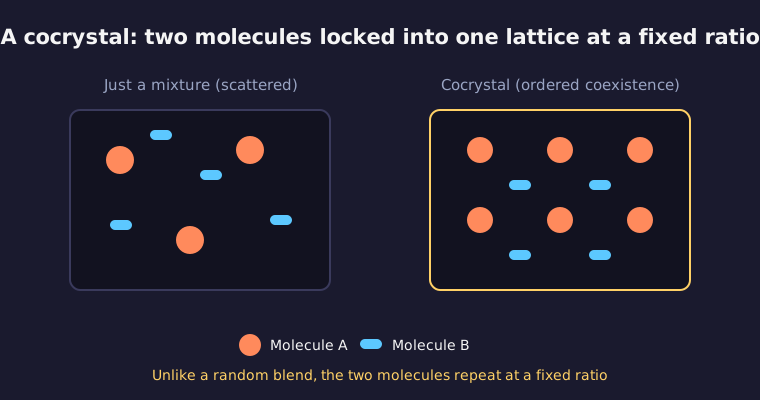
An ordinary crystal is built from just one kind of molecule or atom, stacked neatly in rows — salt is salt, sugar is sugar. A cocrystal is different: it’s a structure where two or more kinds of molecules settle into a single crystal lattice, always in the same fixed ratio.
That’s not the same as just mixing things together. Molecule A and molecule B pair up in a precise, repeating arrangement. That regularity — that orderliness — is what separates a true cocrystal from a random jumble.
Cocrystals aren’t some exotic space-only phenomenon, by the way — we make them here on Earth too. In pharmaceuticals, chemists sometimes pair a poorly soluble drug molecule with a second molecule to form a cocrystal, making the drug easier for the body to absorb. There’s a decent chance the pill in your medicine cabinet relies on this trick.
So cocrystals themselves aren’t rare. The real question on Titan is which molecules are pairing up.
Benzene and ethane, partners only below freezing
A research team at NASA’s Jet Propulsion Laboratory (JPL) recreated Titan’s surface temperature and pressure in the lab and tested combinations of molecules. One standout pairing they found: a cocrystal of benzene and ethane.
Here’s where it gets interesting. According to the team’s report, they grew the crystal at around 130 kelvin, cooled it to roughly 90 kelvin, then used synchrotron X-rays to map its structure. What they found was a lattice of benzene molecules with channels — gaps — running through it, and ethane molecules tucked neatly inside those gaps.
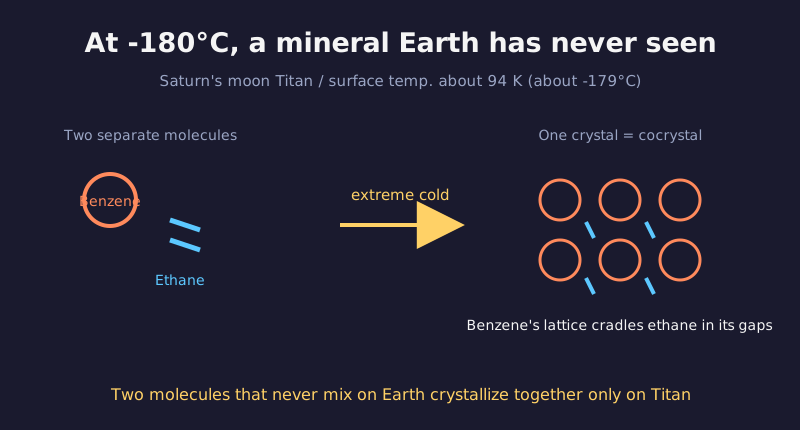
The team also estimated how fast this cocrystal could form under Titan-like conditions. According to the report, benzene precipitates out of liquid ethane and finishes crystallizing in roughly 18 hours. On a geological timescale, that’s practically instant.
Both benzene and ethane are known to form naturally in Titan’s atmosphere. They rain down from the sky, meet on the surface, and become a mineral Earth has never seen.
Why this mineral can’t form on Earth
So why don’t these same two molecules crystallize together here on Earth? The answer comes down to what physical state each molecule is in.
Ethane’s melting point is around -183°C (about 90 kelvin). Titan’s surface temperature is only a few degrees warmer than that — just enough for ethane to barely stay liquid. A typical room on Earth, by contrast, sits around 22°C. There, ethane is already a gas, and it drifts away before you can even try to catch it.
On Earth, ethane is a familiar gas found in natural gas, and it won’t stick around unless you trap it in a container. On Titan, though, that same substance flows across the ground as a liquid and fills entire lakes.
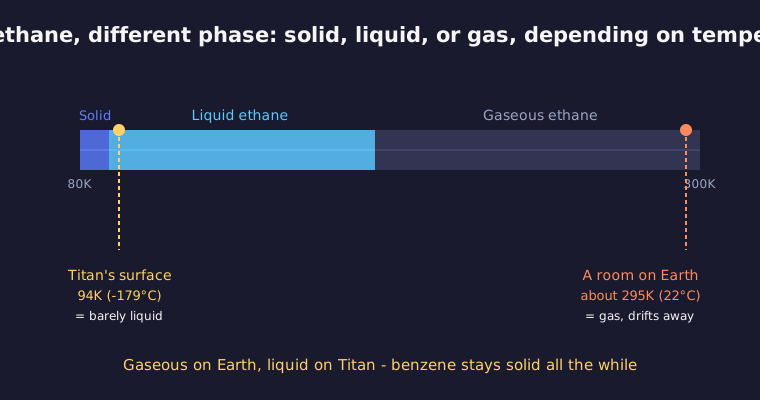
Now consider benzene. Its melting point is around 6°C. On Titan, it’s frozen rock-solid; in a room on Earth, it’s a free-flowing liquid.
Put it together and you get this: on Earth, ethane is a gas and benzene is a liquid, so solid and liquid never actually meet on the same stage. On Titan, solid benzene sits submerged in liquid ethane, slowly dissolving and settling out as a cocrystal. Simply changing the temperature completely swaps the roles each molecule plays.
There’s a second factor at work too: the cold itself. Molecules are always jittering from thermal energy, and the hotter it gets, the more violently they shake. The forces pulling benzene and ethane together are inherently weak, and at room temperature that constant jitter overwhelms them, preventing any orderly arrangement from forming. Titan’s extreme cold suppresses that jitter almost completely. Because even a weak bond can survive without being shaken apart, the cocrystal stays stable — but only in the cold.
Picture yourself standing at the edge of a Titan lake. The liquid at your feet would be a hydrocarbon that behaves something like gasoline, and along the shore, unfamiliar white crystals would cling like frost. Try to apply Earth logic and ask “what mineral is this?” — you won’t find the answer in any field guide.
What’s left behind at the edge of Titan’s lakes
This story doesn’t stay confined to the lab. It connects directly to Titan’s actual landscape.
Cassini spotted bright deposits ringing Titan’s lakes. Kraken Mare, a vast liquid sea near the north pole, is roughly the size of Japan’s entire landmass. Just as Earth’s dry salt lakes leave white salt crusts at their edges, Titan’s lakes appear to leave behind dissolved material as their liquid recedes. Scientists describe these deposits using a familiar Earth term: evaporites.
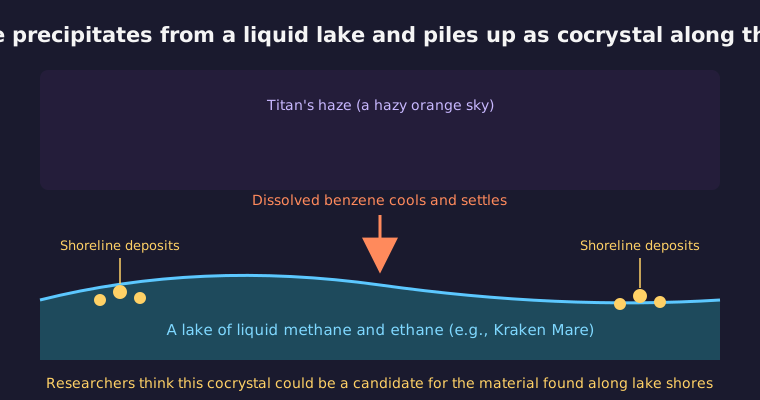
The research team believes materials like the benzene-ethane cocrystal are strong candidates for what makes up these shoreline deposits. Exactly what solid form organic molecules take after falling from the sky and settling on the ground — that’s a question researchers are only beginning to answer, one sub-zero lab experiment at a time.
Back in 2005, the Huygens probe touched down on Titan’s surface. It landed on damp, organic-rich ground, and researchers even reported methane seeping out from the heat of landing. What solid shapes do molecules take after they fall from the sky? Cocrystal research is gradually filling in the blanks of that picture.
I’ll admit it: when I first heard “minerals on Titan,” I assumed it was all ice and rock. In reality, there may be fields of crystals made of carbon and hydrogen out there — crystals that Earth’s geology hasn’t even gotten around to naming yet.
Minerals wear different faces depending on where they are
We tend to use the word “mineral” without thinking, as if it automatically means “something found somewhere on Earth.” Quartz, feldspar, calcite — the entries in any field guide are all crystals that happen to be stable at Earth’s temperatures and pressures.
Come to think of it, even water plays a different role on Titan. At around 94 kelvin, water ice behaves like granite — hard as rock, forming the very skeleton of the terrain. The same substance that flows from your kitchen faucet becomes the building material for mountains out there. And on top of that rock-hard ice, scientists picture organic cocrystals piling up like salt deposits.
Stand on Titan, and Earth’s field guides stop being useful. There, roughly 94 kelvin calls the shots, and a cocrystal that couldn’t survive a single instant on Earth lies scattered underfoot as an ordinary rock. What can become a mineral is ultimately decided by how cold a world happens to be.
Next time you watch oil and vinegar separate in a bottle of salad dressing, remember this: the very same two liquids, on a frozen moon more than a billion kilometers away, might be locked together wearing a completely different face.