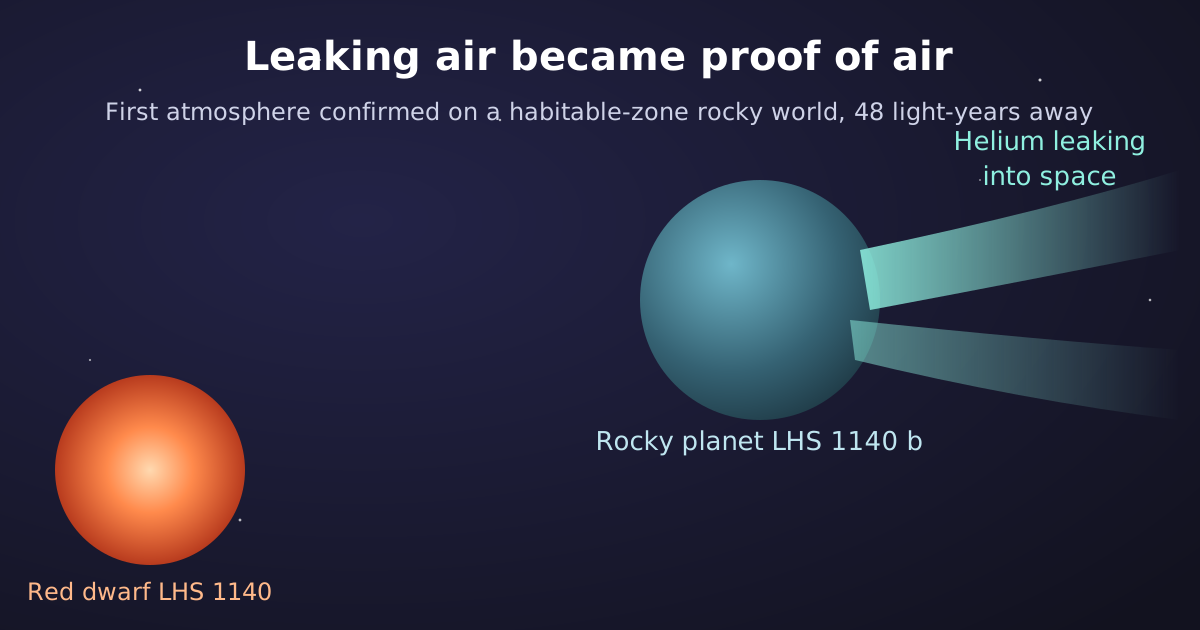
For the first time, astronomers have confirmed that a rocky planet 48 light-years away has an atmosphere. But here’s the twist: they didn’t see the air directly. They caught it in the act of leaking away, drifting off into space from the planet’s upper layers.
Something that’s escaping has to be there in the first place. It sounds like a strange way to prove a point, but that logic just delivered the first confirmed “yes, there’s an atmosphere” verdict for a rocky planet sitting in its star’s habitable zone — the distance band where liquid water can exist.
What made this a first
The planet is LHS 1140 b, discovered in 2017 orbiting a red dwarf (a star smaller and dimmer than the Sun) about 48 light-years from Earth. It’s a rocky world 1.73 times Earth’s diameter and roughly 5.6 times its mass — a classic “super-Earth,” a bit bulkier than home.
In July 2026, this planet set a record. It became the first rocky, habitable-zone world with a confirmed atmosphere, backed by solid evidence.
“An atmosphere is essential for life as we know it,” said Collin Cherubim, who led the observations. “This is the first time we’ve found one on a rocky planet in the habitable zone.” The team published its findings in the journal Science on July 16, 2026.
Let’s be clear about where the line sits: “an atmosphere exists” and “life exists” are two completely different claims. What this study confirmed is that the stage — the vessel that could someday hold an atmosphere hospitable to life — is there. So how did researchers actually see that vessel?
Escaping air is evidence of air
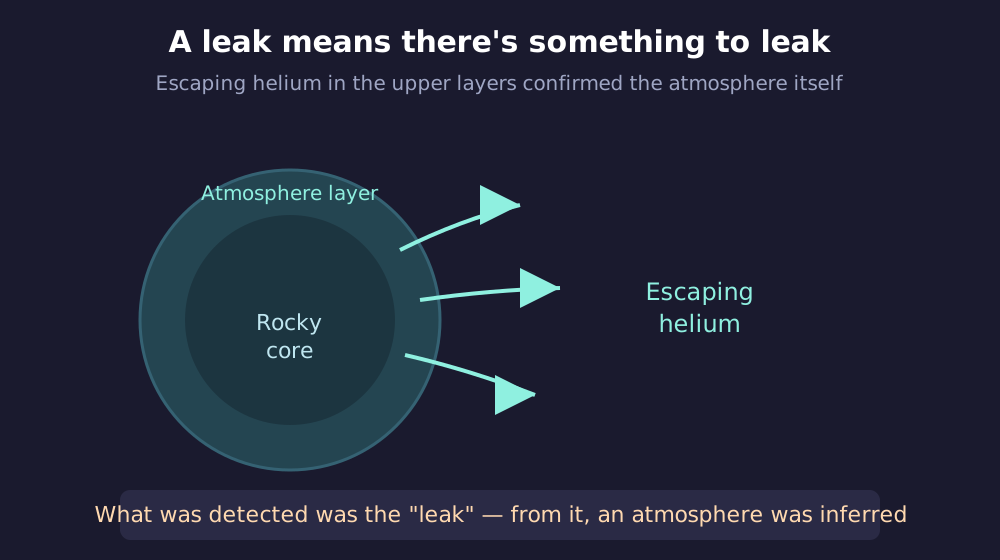
What the astronomers detected was helium — gas streaming from the planet’s upper atmosphere out into space.
When a planet sits close to a bright star, radiation heats the outermost layer of its atmosphere, and the lightest gases are the first to drift away. Helium, second only to hydrogen in lightness, tends to lead that exodus. That makes it a reliable marker for spotting an atmosphere in the act of leaking.
Something escaping implies a source it’s escaping from. If water drips from a bucket, you know there’s water inside without ever looking in. This detection worked much the same way. Researchers used spectroscopy — splitting light into its component colors to read chemical signatures — to trace the outward flow of helium, and from that, concluded the planet has an atmosphere.
Here’s the interesting part: astronomers spotted the atmosphere disappearing before they ever confirmed it was there. Every previous search on habitable-zone rocky planets had come back with the same result — no trace of air. After that long losing streak, this “leak” was the first real signal researchers had ever gotten back.
Two planets, one lucky transit
So how do you pick up a faint leak from a planet 48 light-years away?
The team used WINERED, an infrared spectrograph at the Magellan Telescopes in Chile. When a planet passes in front of its star — a transit — starlight grazes through the planet’s atmosphere on its way to us. Buried in that light are absorption fingerprints unique to helium. Only light that has passed through the atmosphere carries those chemical signatures home.
Luck played a role too. Two of the planets orbiting LHS 1140 happened to transit their star at almost the same moment — a rare alignment that gave the observation an extra boost. David Charbonneau, who co-led the research, said the detection was “statistically rock solid.”
It’s worth keeping the observation and the interpretation separate. What was actually measured is a helium-leak signal. Concluding that an atmosphere exists is one further step of inference. Keeping those two things distinct is the key to reading discoveries like this one correctly.
Being in the right spot isn’t enough
Let’s zoom out for a moment. Why did this “first” take so long to arrive?
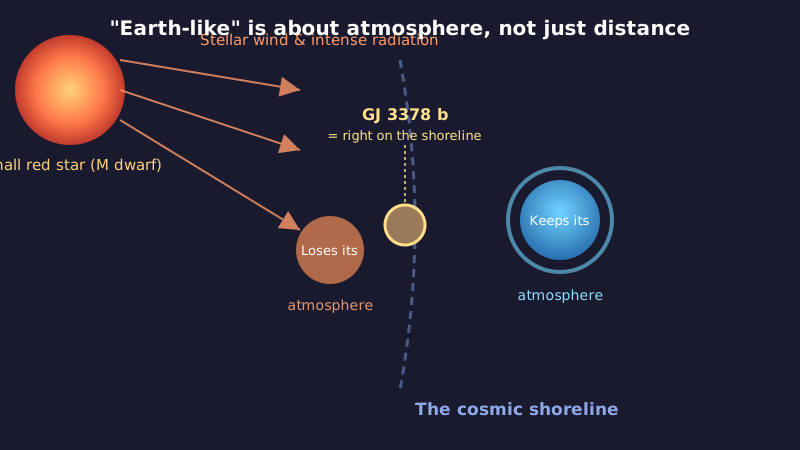
Sitting in the habitable zone doesn’t guarantee an atmosphere — the story is more complicated than that. Even at the right distance, plenty of forces can strip air away: stellar flares (explosive bursts of radiation), stellar winds that blow off upper layers, weak planetary gravity that can’t hold gas down, and whether or not a magnetic field is around to act as a shield.
Red dwarfs in particular tend to flare violently when young, and rocky planets orbiting close to one are especially vulnerable to losing their atmospheres. That’s why astronomers kept finding planets that were “at the right distance but stripped bare” — habitable-zone placement turned out to be just an entry ticket, not a guarantee.
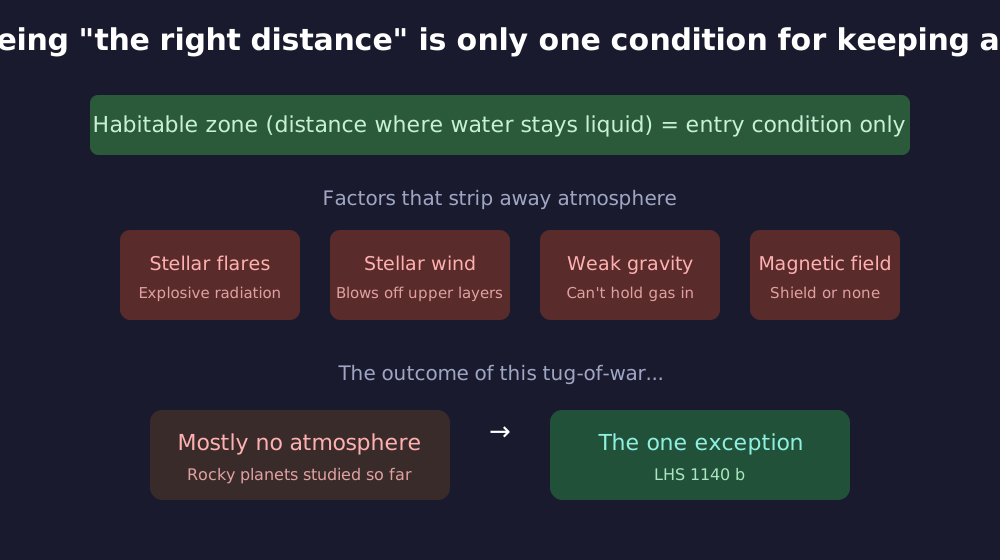
Let’s look at the numbers behind that tug-of-war.
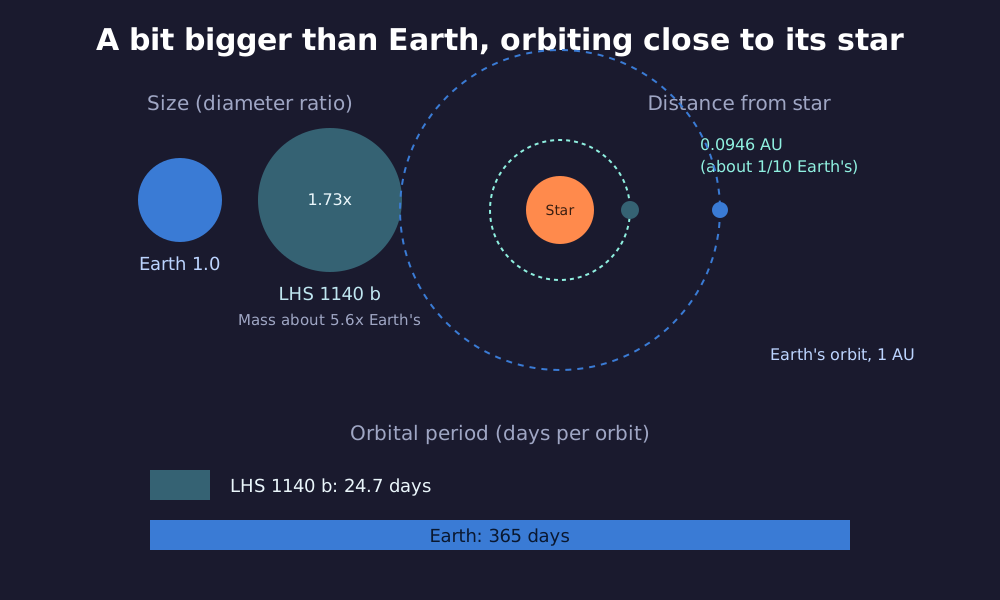
LHS 1140 b orbits its star at just 0.0946 astronomical units — roughly a tenth the distance between Earth and the Sun — completing a full orbit in only 24.7 days. Because red dwarfs are dim, a planet has to huddle in that close just to keep water liquid. Close and dim also means exposed: this world takes flares head-on. Against those odds, it still held onto its air.
Picture standing on this planet’s dayside. The star overhead would glow red and loom far larger in the sky than our Sun ever does — and every so often, it would erupt in flares directly above you. Under that kind of sky, this planet has managed to keep its atmosphere intact.
An atmosphere that may have lasted three billion years
The research team offered one more striking estimate: this atmosphere has likely persisted for more than three billion years.
Worth repeating the distinction here: what was actually observed is that helium is leaking right now. Working backward to conclude the atmosphere has endured for eons is the team’s interpretation, not a direct measurement. Still, if that inference holds up, it matters a great deal.
This isn’t a wisp of air that just formed and will soon vanish. It points to a rocky planet, orbiting dangerously close to a temperamental red dwarf, that has held onto its atmosphere across geological timescales — roughly as long as life has existed on Earth. The sheer duration carries real weight.
The long-standing question — “does distance alone decide whether a planet keeps its air?” — finally has a concrete counterexample: apparently, some worlds hang on anyway. It’s a single win buried in a long losing streak, but that one example changes where astronomers point their telescopes next.
Our own air is quietly leaking too
It’s tempting to jump straight to talk of life. But what this discovery actually confirmed is more modest: not life itself, but the possibility of a stage where life could someday stand. The next step is figuring out what’s actually in that atmosphere — a job for instruments like the James Webb Space Telescope (JWST).
One last thought closer to home. Earth, too, is constantly losing tiny amounts of hydrogen and helium to space. The air you’re breathing right now is leaking out of Earth’s bucket, just impossibly slowly.
Forty-eight light-years away, a rocky world had been leaking air the whole time. The moment humanity caught that leak, a distant planet’s atmosphere stopped being a theoretical possibility and became a real sky, sitting out there right now.