A telltale molecule turns up in an exoplanet’s atmosphere — the kind of molecule life might produce. Normally that’s headline news. Yet the astronomers who found it are often the first to say: “Let’s not get ahead of ourselves.”
Why hold back when the clue you’d hoped for finally appears? It isn’t coldness, and it isn’t false modesty. These researchers already know exactly which trap they’re most likely to fall into.
Let’s talk about that trap, and about why scientists are so stingy with the word “discovery.”
“Hint” and “Discovery” Are Not the Same Word
First, how do you even examine an exoplanet’s atmosphere? When a planet crosses in front of its host star, a sliver of starlight passes through the planet’s air on its way to us.
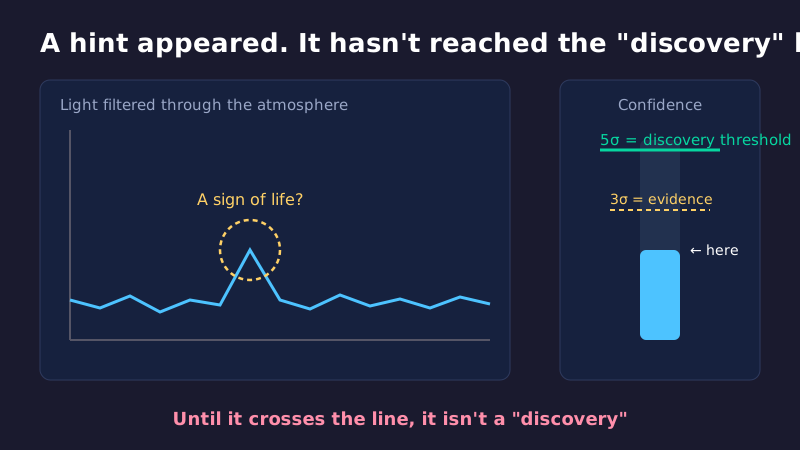
Molecules in that atmosphere absorb light at specific wavelengths — specific colors. So by measuring how much light arrives at each wavelength, scientists can infer which molecules are likely present. This is exactly the kind of observation JWST (the James Webb Space Telescope) excels at.
Now imagine a dip appears in the spectrum, right where a particular molecule should absorb light. If that molecule happens to be one linked to biological activity — a so-called biosignature, a substance that could indicate life — pulses start racing.
But is that dip really caused by the molecule? Instrument noise, or a random statistical wobble, can produce a shape that looks convincing without meaning anything at all.
That’s why scientists start by calling it a “hint,” not a “discovery.” Between those two words sits a sharp, deliberate line.
Sigma: The Yardstick for Confidence
That line is measured with sigma (σ), a statistical yardstick. Roughly speaking, it tells you how unlikely it would be for a result to appear purely by chance.
Picture flipping a coin and getting heads over and over. A few heads in a row? Probably just luck. But dozens in a row, and you start wondering if the coin is rigged.
Think of sigma as a number that captures exactly this feeling — “this streak has gone on too long to be luck.” The higher the number, the harder it is to explain away as coincidence.
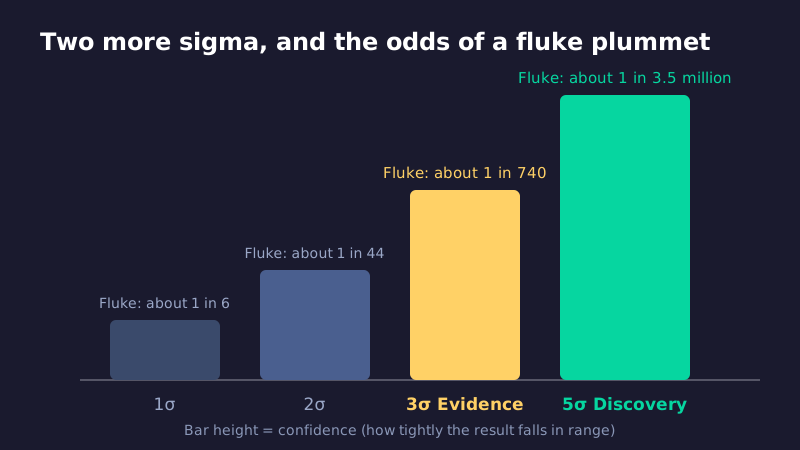
Let’s walk through the scale. At 1 sigma, the odds of a fluke are still fairly high — nothing conclusive yet. Two sigma isn’t enough either.
At 3 sigma, the odds of a fluke drop to roughly 1 in 740. That’s a real jump, and it’s usually the point where scientists start using the word “evidence.”
Then there’s 5 sigma. At that level, the odds of a fluke plunge to about 1 in 3.5 million.
The first time I saw that number, I assumed it was a typo. Climb just two more steps from 3 sigma’s 1-in-740, and suddenly you’re not in the thousands anymore — you’re past three million. Sigma doesn’t add up in a straight line; it accelerates like a slope that suddenly turns into a cliff.
The Discovery Threshold: Flip 22 Heads in a Row
A 1-in-3.5-million chance doesn’t mean much on its own, so let’s translate it into something tangible.
Think about flipping a coin repeatedly and getting heads every time. Ten heads in a row happens about once in a thousand tries — that’s roughly the territory of 3 sigma, at 1 in 740.
And 5 sigma? Roughly speaking, that’s the rarity of flipping a coin 22 times in a row and getting heads every single time.
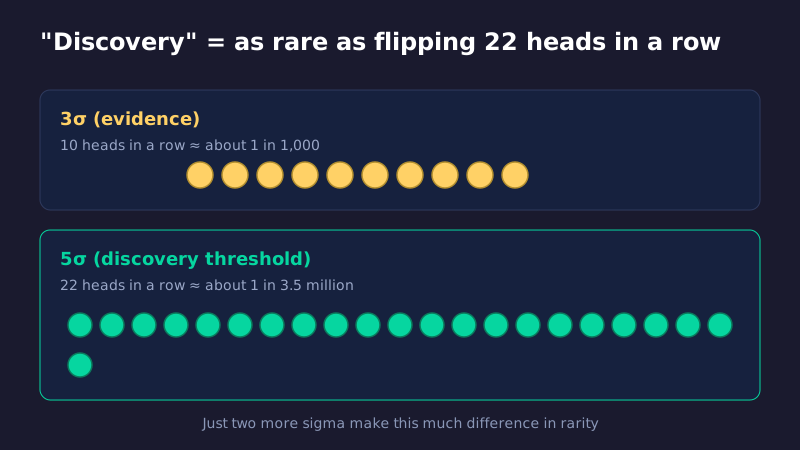
Picture it: you flip a coin in your hand 22 times, and it never comes up tails once. Somewhere around flip 15 or so, everyone watching starts thinking something’s off. That’s the confidence 5 sigma represents — a level of certainty so extreme that “this can’t be chance” becomes a statement you can stand behind.
In particle physics, 5 sigma is the traditional bar for using the word “discovery.” Anything up to 3 sigma stays labeled “evidence”; only at 5 sigma do researchers say they’ve “found” something. It sounds almost excessively strict — but there’s a good reason for it.
Why Set the Bar So High?
Even 3 sigma — a 1-in-740 shot — sounds pretty convincing. So why not call that a discovery? It’s not excessive caution. It’s the scar tissue from past mistakes.
The history of physics is full of “hints” that sat right around 3 sigma, only to fade away once more data came in. Every one of those near-misses that didn’t get announced too early — and the ones that did, and had to be walked back — pushed the bar higher over time.
Here’s where it gets even trickier for exoplanets. In a lab on Earth, you can rebuild your apparatus and rerun the experiment as many times as you like. But an exoplanet might sit tens or hundreds of light-years away.
The same planet might cross in front of its star only once every few days — or far less often than that. Gathering enough additional data to firm up a result can take years. Because you’re dealing with a target you can’t just walk back over to, every single judgment call has to be made carefully.
Get excited over a statistical fluke, announce to the world that life has been found, and then have to retract it — that kind of misstep damages the credibility of science itself. So the bar stays high, on purpose.
The Other Opponent: Your Own Wishful Thinking
If it were only about numbers, this would already be a fairly clean story. But the search for life has a trickier adversary: the mind of the person doing the looking.
People tend to see what they want to see. If you’re hoping there’s a biosignature molecule out there, a suggestive shape in the noise starts to look convincing whether it deserves to or not. This is confirmation bias — the tendency to notice and collect evidence that fits what you already expect.
I’ll admit something: for a long time, I assumed this trap only caught careless people. It doesn’t. The best researchers are often the ones who worry most seriously about falling into it themselves.
And there’s another wrinkle built into the molecules themselves. Many molecules associated with life can also form without any life at all, through ordinary chemistry — volcanic activity, for instance, or reactions driven by starlight.
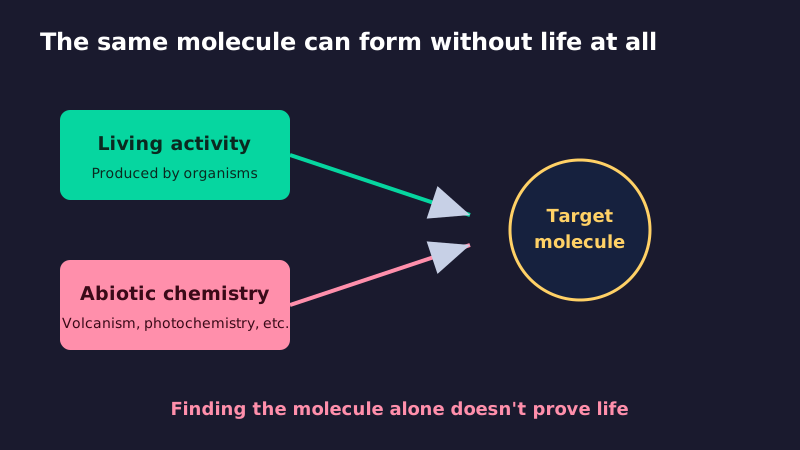
In other words, even confirming that the target molecule is genuinely present doesn’t settle the question of life. Researchers have to systematically rule out every non-biological way that molecule could have gotten there — a process known as eliminating false positives, cases where something looks like life but isn’t.
The statistical wall of sigma, and the psychological wall of confirmation bias: a hint of life has to clear both before it earns the word “discovery.”
Holding Back Isn’t Coldness — It’s Integrity
So how does a hint actually become a discovery? First, more observations, gathering enough data to shrink the odds of a fluke down toward nothing.
Then, a separate research team has to run the observation independently and get the same result. A pattern seen by just one team could still be that team’s own wishful thinking. Step by step, researchers close off every plausible non-biological explanation, and only once the confidence crosses the threshold does the word “discovery” get unlocked.
This caution resembles a routine you might recognize from a medical checkup. If a scan turns up a shadow, your doctor doesn’t announce a diagnosis on the spot — they order a follow-up scan, from a different angle, to rule out the possibility that the first image just caught something oddly. The search for life on other worlds runs on the same instinct: never settle anything based on a single result.
So when scientists don’t celebrate a hint of life right away, it’s not because they lack imagination. It’s the opposite. Precisely because they understand this could turn out to be the single greatest discovery in human history, they refuse to claim it on anything less than rock-solid confidence.
Doubt what you’re hoping for, first and hardest. Rule out flukes, rule out wishful thinking, rule out every chemistry pathway that doesn’t require life — one at a time. None of it is glamorous. But this unglamorous discipline is exactly what will make a real discovery, when it finally comes, believable.
Next time you see a headline asking “A sign of life?”, look for the line usually tucked just beneath it: “further observations are needed to confirm.” That sentence isn’t an overcautious disclaimer. It’s an honest progress report from partway up a slope that ends, eventually, at 1 in 3.5 million.