The universe was only about 670 million years old. And already, in that young cosmos, a black hole that had swallowed roughly 1.6 billion Suns’ worth of mass was blazing away.
We can actually see that light from Earth right now. It’s a beam that’s been traveling for more than 13 billion years to reach us.
And here’s where it gets strange. Was there really enough time, that early on, for a black hole this massive to form?
A monster in the universe’s infancy
Our subject has an unglamorous name: J0313-1806. It’s a quasar, and a quasar is simply the ferocious light released when a supermassive black hole gorges on the gas around it.
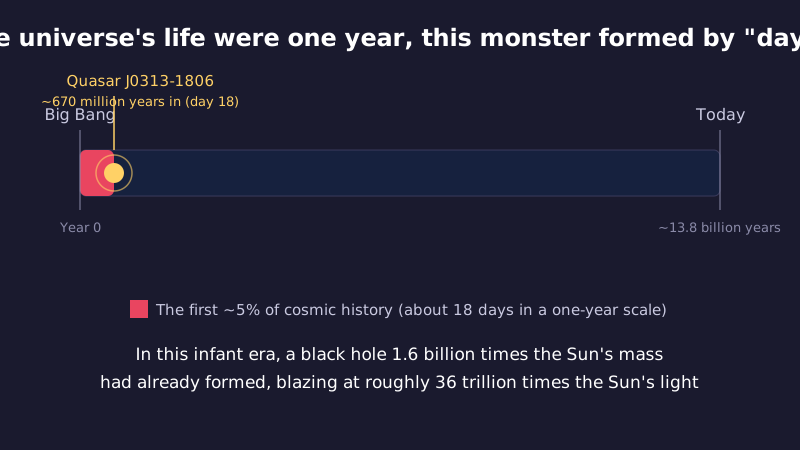
Reported in 2021, this object sits at a redshift (a measure of how much its light has been stretched) of z = 7.642. According to the research team, that corresponds to a snapshot of the universe roughly 670 million years after its birth.
The number alone doesn’t mean much until you put it in context. The universe is about 13.8 billion years old, so 670 million years is only around 5 percent of that. Compress the entire cosmic lifespan into a single year, and this moment falls on day 18 — practically the day the universe was born.
And in that infancy, the black hole at the center had already reached 1.6 billion solar masses. It was devouring surrounding gas with such ferocity that its light output reached about 36 trillion times the Sun’s brightness. A galaxy might hold hundreds of billions of stars, but this single point outshines all of them combined.
When I first saw this number, I assumed it was a typo. A newborn universe, and already a fully formed monster sitting in it. And something that should be too far away to see — why can we see it at all?
To look far is to look back in time
That “too far to see, yet we see it anyway” puzzle is actually astronomy’s best trick.
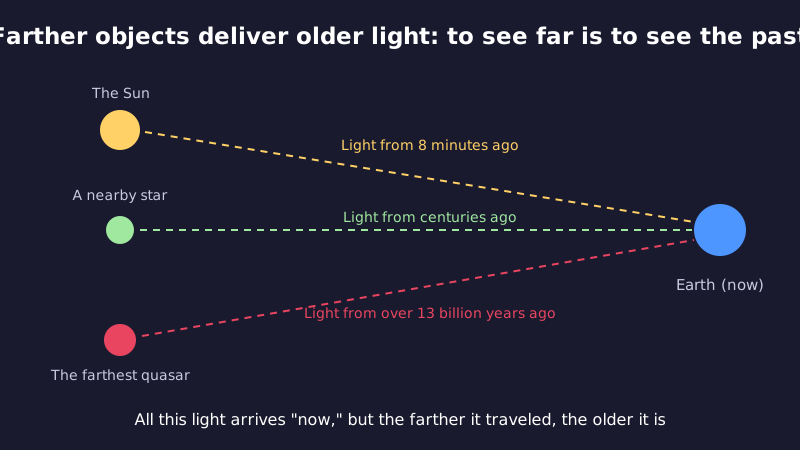
Light travels fast, but on cosmic scales it’s surprisingly slow. Sunlight takes about eight minutes to reach Earth. So the Sun you see at noon is really the Sun as it looked eight minutes ago.
For the stars at night, that delay stretches much further — decades, centuries, sometimes millennia since the light left its source and finally reaches your eye. Looking up at the sky is, quite literally, an act of looking into the past.
Pause on this for a second. Light from a quasar more than 13 billion light-years away set out on its journey more than 13 billion years ago. Catching it now is the equivalent of peering directly into the universe as it existed 13 billion years back.
That’s exactly why we can observe J0313-1806 at all — because it’s far away, which means it’s ancient. A telescope aimed at distant space doubles as a time machine pointed at the cosmic past.
Imagine standing at the point where that light first departed — in a 670-million-year-old universe. Galaxies are still sparse, the sky dotted with newborn stars. And right in the middle of it all, a single point burns with tens of trillions of times the Sun’s light. It’s the kind of scene that gives you a small chill just to picture.
But the original question comes right back around. How could a black hole this large have existed, this early?
A quasar is the glow of a black hole’s “meal”
Before diving into the mystery, it helps to understand how a quasar actually shines. This part gets a little technical, but skip it and the rest won’t quite land.
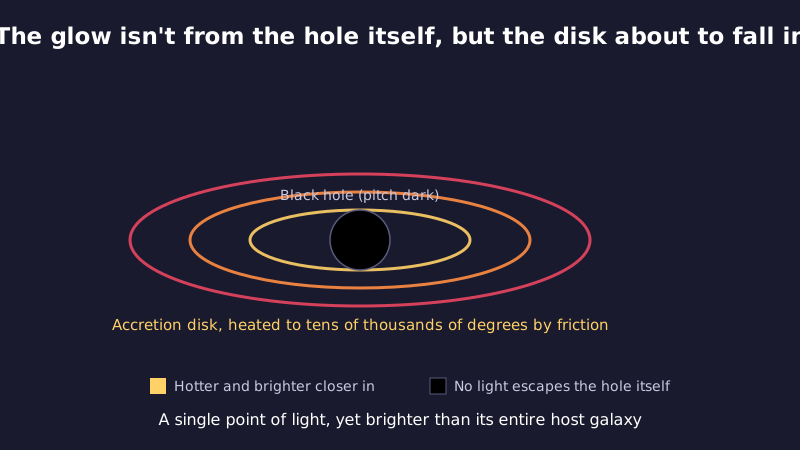
A black hole by itself is a pitch-black void — not even light escapes it. So why is a quasar one of the brightest categories of object in the universe? Because the light doesn’t come from inside the hole. It comes from just outside it.
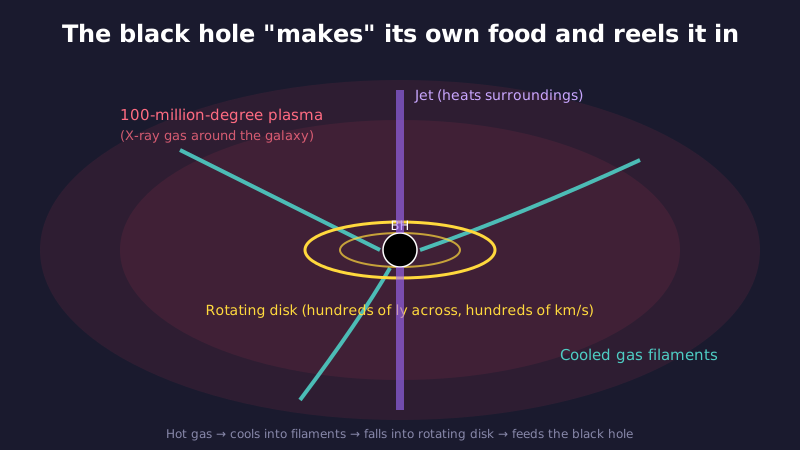
Gas on the verge of falling in spirals around the black hole, forming a swirling structure called an accretion disk. Friction within that disk heats the gas to tens of thousands of degrees or more, and it blazes with light in the instant before it’s swallowed.
The word “quasar” is short for “quasi-stellar object.” Through a telescope it looks like a single point of light, like a star — but what you’re actually looking at is the core of an entire galaxy. A point that outshines the galaxy surrounding it. That contradiction is precisely what makes quasars so visible across the depths of the universe.
But there’s a catch: a black hole can’t just keep getting brighter forever by eating more. Feed it too fast, and the pressure from the disk’s own light starts pushing gas away before it can fall in. This speed limit on feeding is known as the Eddington limit.
In other words, every black hole has a built-in brake on how fast it can grow. And that very brake is what makes J0313-1806 such a headache.
There simply isn’t enough time
Here’s where things get genuinely interesting. Growing a black hole to 1.6 billion solar masses obviously takes time.
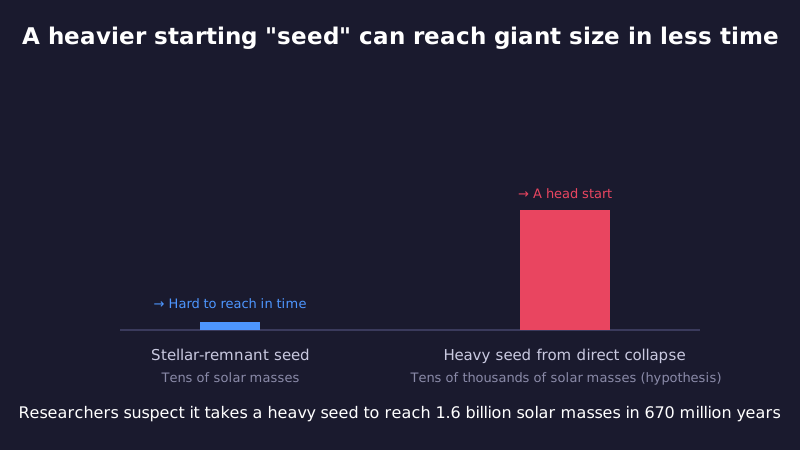
The seed black holes that start this process are thought to be the collapsed remains of massive dying stars — objects weighing, at most, a few dozen times the Sun’s mass. From there, that seed has to feed, and feed, and feed some more, until it’s grown 1.6 billion times heavier.
But with the Eddington limit capping the feeding rate, there’s a hard ceiling on how fast that growth can happen. By the research team’s estimates, even a normal seed growing at a normal maximum pace couldn’t possibly reach 1.6 billion solar masses within 670 million years.
Picture a newborn baby reaching full adult size within a few days. That’s roughly the scale of what would have to happen here — something biology simply doesn’t allow, yet the early universe apparently pulled it off.
Put another way: if you followed the recipe as written, you’d never make it to opening time. And yet the finished dish is already sitting on the table. The team that reported J0313-1806 put it bluntly: this object poses a serious challenge to theories of how supermassive black holes grow.
Observation says: it’s there. Theory says: it shouldn’t have had time. That gap is exactly what keeps astronomers up at night over these early-universe quasars.
A bet on starting with a heavier “seed”
So how do researchers explain it? The leading idea is that the starting seed itself may have been far heavier than assumed.
Instead of beginning as the remnant of a dead star, a massive cloud of gas might collapse directly, all at once, without ever forming stars first — producing a seed tens of thousands of times the Sun’s mass right from the start. Astronomers call this scenario “direct collapse.” Starting big leaves much more room to reach enormous sizes within a limited window of time.
There’s also a competing idea: that black holes might briefly exceed the Eddington limit, feeding at extreme rates for short bursts. Which explanation is correct is still an open question.
I’ll admit it — that unresolved uncertainty is my favorite part of this story. And J0313-1806 isn’t some lone exception, either. A bit earlier, in 2018, researchers reported another quasar, J1342+0928, holding a black hole 800 million solar masses at just 690 million years after the Big Bang.
Every time an older record gets broken, these black holes turn out to be even earlier, even bigger, than expected. The more we find, the deeper the “not enough time” problem gets. The infant universe, it seems, was running a lot faster than astronomers ever guessed.
Even the light you look up at tonight is a little old
Let’s bring this back down to where you’re standing.
Every star you see out your window tonight is showing you the past — some by a few years, some by centuries, and a few by light that left before humans invented writing. Looking at the sky always means looking backward in time.
At the far end of that same principle sits J0313-1806: light from when the universe was 18 days old, by the one-year calendar. How a monster weighing 1.6 billion Suns managed to exist there, nobody can say with full confidence — not yet.
But an unanswered question is also a promise. The next time a telescope peers a little farther, it will catch a glimpse of an even younger universe. Somewhere past that 13-billion-year horizon, in the dark, the answer is still quietly shining.