Tucked in a corner of the Milky Way sits a colossal ball of roughly 10 million stars, packed together into a single spherical swarm. Near its center, seven of those stars are moving fast enough that they should be flying off into open space. Instead, they stay put.
Something invisible, and extraordinarily strong, is holding them back.
When astronomers measured that something, they found a dark object weighing in at a minimum of 8,200 Suns.
Stars that should have escaped — but didn’t
The setting is Omega Centauri, one of the largest globular clusters in the Milky Way — an ancient, densely packed spherical swarm of stars roughly 17,700 light-years from Earth. About 10 million stars sit bound together by their mutual gravity.
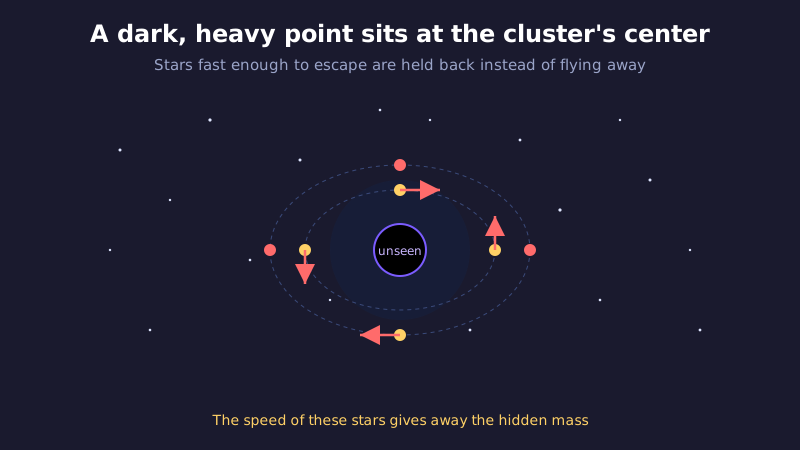
In 2024, a team led by Maximilian Häberle at the Max Planck Institute for Astronomy in Germany published a paper in the journal Nature (July 10, 2024). Near the cluster’s center, they had spotted seven stars moving at unusually high speeds.
How fast is unusual? According to the team, all seven exceed the cluster’s escape velocity — the threshold speed at which an object breaks free of a gravitational pull for good.
In other words, these stars should have been ejected from the cluster long ago, scattered into the darkness of interstellar space.
Instead, they linger stubbornly near the center. And that leaves only one explanation: something impossibly massive is hiding there, hauling the escaping stars back by brute force. The catch is that no telescope, however powerful, can capture this object as light. It simply doesn’t shine.
Weighing something invisible by watching what moves around it
How can you claim something exists if you can never see it? This is where the story gets interesting.
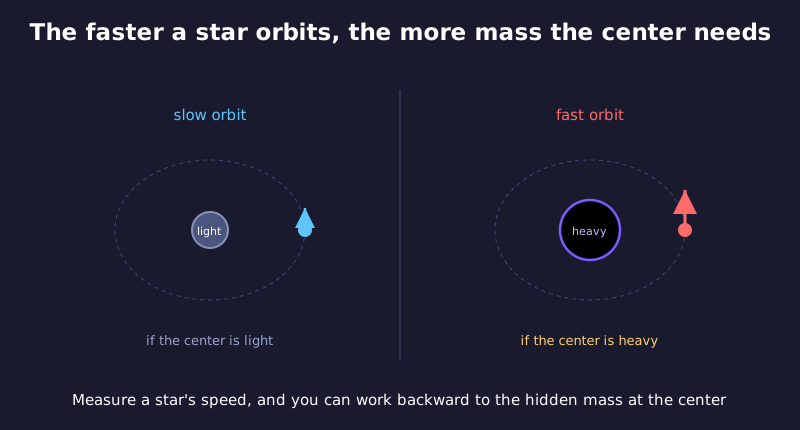
The trick lies not in the stars themselves, but in how they move. Picture swinging a ball on a string. The faster you spin it, the harder your hand has to pull inward — otherwise the string slips and the ball flies off.
Run that logic in reverse: if something keeps spinning fast without flying away, that alone proves a powerful force is pulling it toward the center.
Gravity works exactly the same way. The faster a star orbits some object, the more mass that object must have at its core to keep the math consistent. Astronomers have long used this relationship to back-calculate the mass hiding at the centers of galaxies and star clusters — even when nothing there emits a single photon.
So the team’s approach, in principle, was simple. Measure how fast the stars near the center are moving, then calculate how much mass would be needed to explain that motion. Do that, and a dark, massive object emerges — not as an image, but as a number.
8,200 Suns — still a fraction of what sits at a galaxy’s core
So what number did the calculation actually produce?
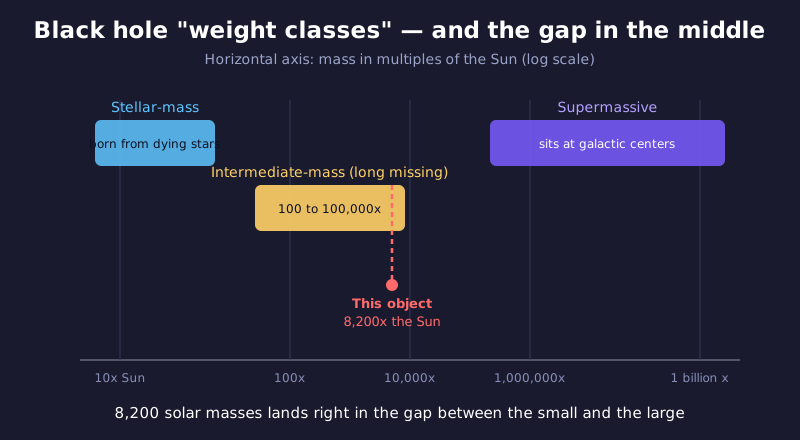
The team concluded that this invisible object weighs at least 8,200 times the mass of the Sun. Consider that the Sun itself already outweighs Earth by roughly 330,000 times — and now multiply that by another 8,200. No everyday scale comes close to describing a mass like this.
It’s worth pausing here to recall the “weight classes” of known black holes. Historically, two categories have dominated the conversation.
The first is the stellar-mass black hole, formed when a massive star collapses at the end of its life. These typically weigh a few to a few dozen times the Sun’s mass, and the universe has plenty of them. The second is the supermassive black hole, anchoring the centers of galaxies. The Milky Way’s own Sagittarius A* weighs in at about 4 million solar masses; in larger galaxies, that figure can reach billions.
The trouble has always been what sits between the two.
Intermediate-mass black holes — theoretically somewhere between 100 and 100,000 solar masses — should exist on paper. Yet solid evidence for them has remained frustratingly hard to pin down. The newly measured 8,200 solar masses slots neatly into exactly that gap.
The “missing middle” of black holes
I’ll admit it: for a long time, I didn’t take this “missing middle” problem very seriously. If small black holes exist and big ones exist, surely medium ones must be scattered around too, right?
Turns out, it’s not that simple.
Black holes emit no light of their own, so finding one means catching the effects it has on its surroundings. Stellar-mass black holes often betray themselves by stealing gas from a companion star and blasting out X-rays, or by merging with another black hole and sending ripples through spacetime — gravitational waves. Supermassive black holes announce themselves differently: as they swallow enormous quantities of surrounding gas, they light up a galaxy’s center in dramatic fashion.
Intermediate-mass black holes tend to do neither. They’re not voracious enough to blaze brightly, and they don’t merge often enough to send out detectable gravitational waves. In a universe full of noisy phenomena, they’re oddly quiet.
And the best hiding spot for a quiet black hole happens to be exactly where visibility is worst: the crowded center of a globular cluster, packed with stars. A silent black hole lurking there would simply vanish into the glare of countless neighboring suns — which is exactly why definitive proof has been so elusive.
The absence of evidence, it turns out, wasn’t evidence of absence. It was a failure of method. This new discovery seems to say as much.
Digging through 20 years of old photographs
So how did the team finally catch this quiet object?
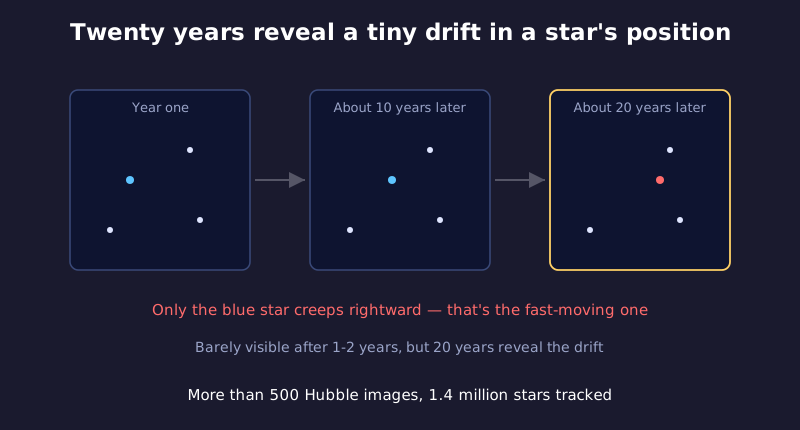
They didn’t point a new telescope at it. Instead, they mined the Hubble Space Telescope’s own archive of Omega Centauri — more than 500 images, spanning roughly two decades.
Stars within the cluster do shift position over time, but the distances involved are so vast that a single year or two shows almost no visible movement. That’s where two decades of data pays off: the longer the gap between observations, the more clearly a tiny drift stands out.
Using this method, the team painstakingly tracked the motion of 1.4 million individual stars, assembling one of the largest stellar-motion catalogs ever built for a single cluster. Out of that vast dataset, seven stars racing around the center at extraordinary speed quietly rose to the surface.
Take a moment to imagine standing at the center of Omega Centauri. The night sky there wouldn’t look anything like “stars scattered across the dark.” It would be a solid wall of sunlike stars, packed edge to edge, hundreds of times brighter than any night on Earth. And somewhere in the middle of that blinding sea of light, an invisible, massive point holds everything in its grip, spinning stars around it in silence.
Old telescope records, reread decades later from a completely new angle — this is the kind of work astronomy does best. Time itself becomes a research tool.
Why finding a “medium” black hole actually matters
Before wrapping up, it’s worth touching on why this discovery matters beyond the numbers.
The bigger mystery here is how supermassive black holes — the ones anchoring galactic centers — got so massive in the first place. It’s hard to imagine one being born already weighing millions of Suns. Far more likely, they started small and grew, step by step, from a much smaller seed.
That in-between growth stage is precisely what an intermediate-mass black hole represents. If objects of this size genuinely exist, they could be the missing link connecting small black holes to the giants that eventually dominate galactic centers. The research team sees this object in Omega Centauri as a rare natural laboratory for studying exactly that growth process.
The light we’re seeing from Omega Centauri’s core right now left its source 17,700 years ago — back when humanity was still living through the last ice age.
Buried in that ancient light was an invisible point, quietly gripping stars that should have escaped long ago. And what finally exposed it wasn’t a new telescope at all. It was a barely perceptible drift, tucked away in the corner of a 20-year-old photograph.