Say “black hole” and most people picture a vacuum cleaner, sucking up everything within reach. The real problem is the opposite. If food doesn’t fall its way, a black hole simply starves.
So where does that food come from, and how does it get there?
JWST recently peered into the center of one galaxy with unprecedented precision and, for the first time, traced the delivery route in detail. It turns out the black hole was catering its own meal — out of gas it had exhaled itself.
Starving is the hard part, not swallowing
A black hole’s gravity is genuinely ferocious. But that grip only really bites at close range, much closer than you’d expect. To gas sitting even a little farther out, the black hole is just one more massive object among many.
The trouble is that gas rarely falls straight in. It’s almost always circling with sideways momentum, something physicists call angular momentum — literally, the amount of spinning motion something carries.
Think of water draining from a sink. Pull the plug, and the water doesn’t shoot straight down the drain. It swirls, and swirls, and takes its time getting there. The same standoff plays out at the center of a galaxy.
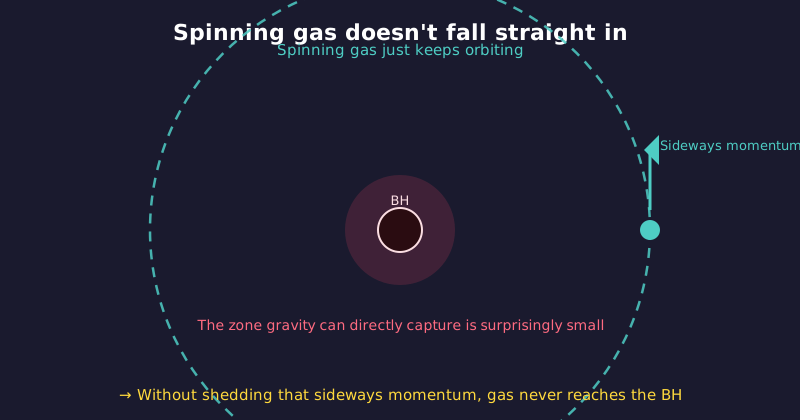
Gas with enough spin will just keep orbiting the black hole indefinitely. To actually fall in, it has to shed that sideways momentum somewhere along the way.
So the real mystery was never “how does a black hole suck things in.” It’s “how does gas get stripped of its spin and carried all the way to the black hole’s doorstep?” That question had stayed stubbornly unanswered.
JWST maps NGC 4696’s core in 33-light-year pixels
The team that finally caught this delivery system in action was led by Julie Hlavacek-Larrondo at the Université de Montréal. Their target was NGC 4696, the brightest galaxy sitting at the heart of the Centaurus galaxy cluster.
They used JWST’s NIRSpec instrument, a near-infrared spectrograph that splits incoming light by wavelength, to observe a patch roughly 618 parsecs (about 2,000 light-years) across, centered on the galaxy’s core.
The resolution came out to about 33 light-years per pixel — meaning that 2,000-light-year patch was carved into a grid of roughly 60 cells. For comparison, the nearest star to the Sun is about 4 light-years away, so this is roughly eight times finer than that. On a galactic scale, that’s like squinting through a needle’s eye.
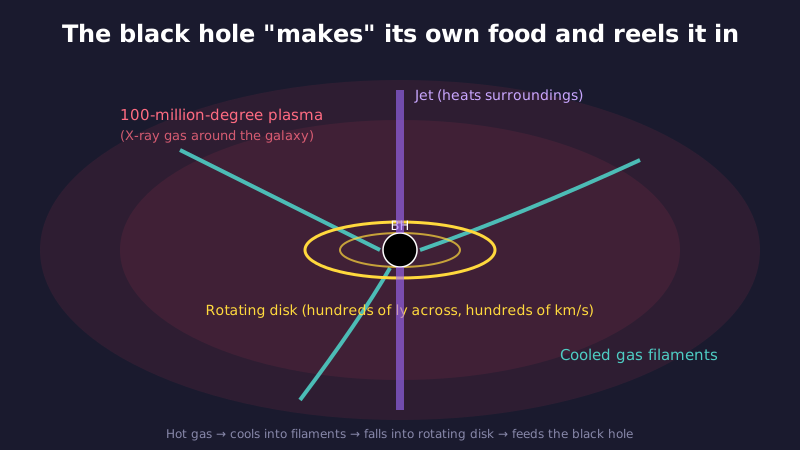
What emerged was a picture of thin gas filaments streaming toward the center and merging into a rotating disk. The team calls this structure the circumnuclear disk (CND) — a ring of rotating gas that wraps around the black hole.
According to their measurements, this disk spans several hundred light-years, with gas inside it whipping around at hundreds of kilometers per second.
Hundreds of kilometers per second doesn’t mean much until you compare it to something familiar: Earth orbits the Sun at about 30 km/s. This gas disk spins more than ten times faster — fast enough to cross the distance between Tokyo and Osaka in less than the blink of an eye.
Follow the thread back to 100-million-degree plasma
Here’s where it gets interesting. Trace one of those infalling filaments outward, and its root connects straight back to the scalding halo of gas enveloping the entire galaxy.
The galaxy at the center of a cluster sits inside a cloud of thin plasma — gas so hot its atoms have been stripped apart — reaching temperatures of 100 million degrees. It’s so hot it’s invisible except in X-rays, an unseen soup surrounding everything.
When part of that soup cools, it becomes denser than its surroundings and sinks, condensing into thin threads. The team found that this network of filaments spans tens of thousands of light-years — threads roughly the length of an entire galaxy, dangling down toward the center.
The real surprise: within a single filament, temperature spans six orders of magnitude — a millionfold range.
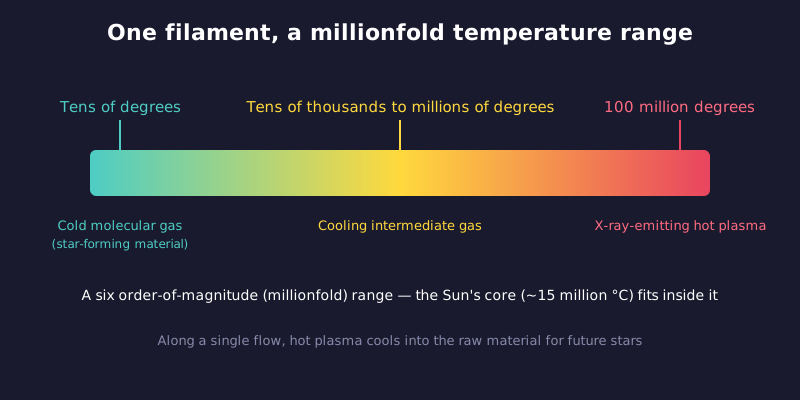
At the outer edge sits 100-million-degree plasma. Moving inward, it cools steadily, eventually reaching the cold molecular gas that eventually seeds new stars. For reference, the Sun’s own core, at roughly 15 million degrees, would fit comfortably somewhere in the middle of that range.
Gas spanning such wildly different temperatures and states, all strung together in one continuous structure, is called multiphase gas. Hot plasma cools into filaments; filaments shed momentum and fall into the disk; the disk feeds the black hole. For the first time, the whole delivery chain snapped into a single coherent picture.
The black hole’s own jets are cooking the meal
So why do these filaments form at all? This is where the study gets genuinely clever.
Many black holes, while feeding, funnel some of that energy into narrow jets shooting outward in opposite directions. These jets churn up and heat the surrounding plasma violently.
You’d think heating the gas would just stop it from ever cooling into food. I got stuck on that exact point at first too. But it works the other way around: this heating is precisely what keeps the gas from cooling too much, too fast.
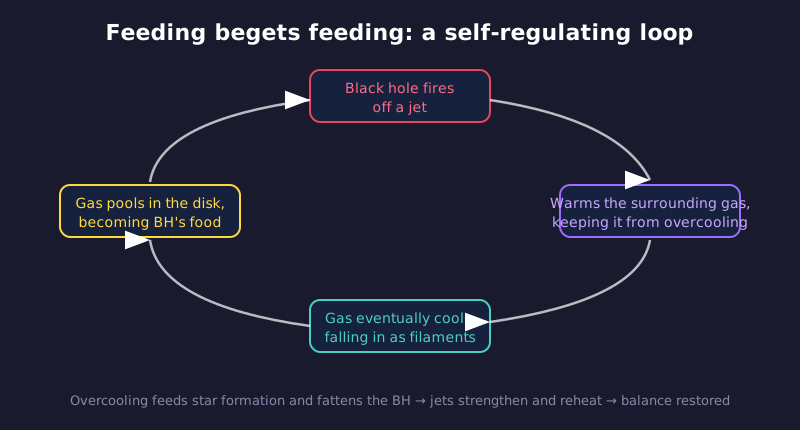
The mechanism resembles a thermostat. Left unchecked, plasma would cool rapidly and collapse inward all at once, triggering an explosive burst of star formation. The jets push back against that collapse with heat.
But overheat things, and the food stops arriving — the black hole starves. That weakens the jets it would otherwise fire, heating stops, the gas starts cooling again, and filaments start falling once more.
Too much heat, and the system brakes itself. Too little, and it steps on the gas. The team concludes this heating-cooling balance forms a self-regulating loop: the black hole manufactures its own food from its own exhaust, then feeds on what it made.
A predicted picture finally meets a real one
This kind of self-regulating loop has actually shown up in computer simulations for years — theory said it should work this way.
What’s new is catching it in a single galaxy’s core, measured continuously from hot plasma down through cold molecular gas to the rotating disk itself, all in one connected observation. That’s how the team frames the achievement: a long-predicted picture finally overlaid with a real photograph.
This isn’t just a story about one black hole. Supermassive black holes at galactic centers and the galaxies that host them seem to grow in lockstep, their masses tracking each other in ways that have puzzled astronomers for years. Something has to wire the two together.
This heating-cooling loop may be part of that wiring. When a black hole acts up, it heats the surrounding gas and dampens star formation. When it quiets down, gas cools and drifts back to the center. The two are tied together by a single feedback loop.
What’s been observed so far is just one galaxy, NGC 4696. Whether this feeding mechanism is universal depends on whether astronomers find the same delivery route at work in other galaxies.
Somewhere in the night sky, threads are still hanging
The image of black holes as monsters that devour everything is only half right. They have plenty of gravity to pull in food that’s already nearby, but the machinery to actually deliver that food to their doorstep is something they have to build themselves.
That machinery turns out to be a roundabout kind of self-sufficiency: heat your own exhaust, let it cool, spin it into threads, and reel it back in. Before swallowing anything, the black hole is busy catering its own meal.
Somewhere in the direction of Centaurus, deep inside NGC 4696, 100-million-degree plasma is cooling right now, condensing into thin threads that keep sinking quietly toward the rotating disk. Next time you look up and find that patch of sky, remember: behind that single point of light, threads are slowly hanging down, keeping something from going hungry.