Dead center of the Milky Way, barely half a light-year from a black hole that swallows everything nearby, an old star was quietly busy making water and dust.
That’s right next door to one of the most violent neighborhoods in the galaxy. In a place where you’d expect anything delicate to get scorched instantly, this star kept building things anyway. The James Webb Space Telescope caught it in the act.
Honestly, when I first read about this, my reaction was something like: wait, there? Let’s take it step by step.
Right Next Door to the Galaxy’s Most Dangerous Address
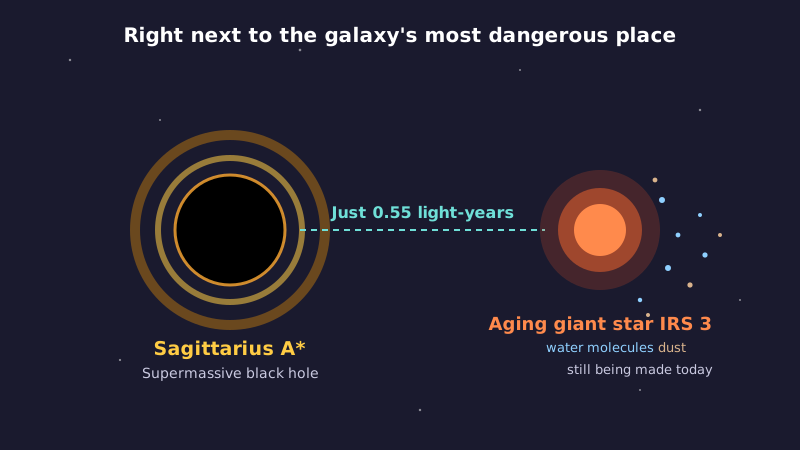
At the center of the Milky Way sits Sagittarius A*, a supermassive black hole millions of times heavier than the Sun. It’s the gravitational anchor of the entire galaxy.
The star at the center of this story sits only about 0.55 light-years away from it. That’s still more than six months at the speed of light, but on cosmic scales, it counts as basically next door.
Just how close is that? Proxima Centauri, the nearest star to our Sun, is 4.2 light-years away. So 0.55 light-years is roughly an eighth of that distance.

Convert that to kilometers and you get about 5.2 trillion km — a number that’s hard to wrap your head around. But the takeaway is simple: near the galactic center, a supermassive black hole and a star are packed in at that kind of close range. If our own solar neighborhood were this crowded, the night sky would be nothing but stars.
So what’s it actually like in that neighborhood? That’s where the real story begins.
Why This Place Was Supposed to Be Sterile
Mention “near a black hole” and most people picture a place that swallows everything and leaves nothing behind. In many ways, that image fits the galactic center pretty well.
Around Sagittarius A*, young, massive stars are packed in at unusually high density, and they blast out intense ultraviolet and high-energy radiation. On top of that, the black hole itself radiates fiercely as it feeds on surrounding gas.
Put it all together and this is one of the most radiation-soaked regions in the entire galaxy. Fragile molecules and freshly formed dust grains should get torn apart almost as soon as they appear — intense light is more than capable of ripping molecular bonds apart.
A place that strips material away rather than lets anything new get built: that was the reasonable expectation.
Here’s where it’s worth pausing, because that expectation just got overturned.
What JWST Found: Water and Dust
The observation relied on MIRI, the Mid-Infrared Instrument aboard JWST. It’s built to pick up the faint infrared glow of cold dust and molecules — light invisible to our eyes. The galactic center is buried under thick layers of gas and dust that ordinary telescopes simply can’t see through. Infrared light, though, can pierce that fog.
MIRI trained its gaze on a star called IRS 3, an aging giant well into the final stretch of its life. Born at roughly six times the mass of the Sun, it’s now estimated to be about 72 million years old — elderly, as stars go.
And around this star, JWST clearly detected two things. One was silicate dust — tiny grains rich in silicon and oxygen, the raw material of rocky worlds. The other was water molecules.
According to the research team, this is the first time water has been clearly detected around this particular star. In a place expected to be the galaxy’s most hostile environment, the raw ingredients of rock and water were being freshly made.
So how does a dying, elderly star manage to pull that off?
Aging Giants Are the Universe’s Dust Factories
Here’s the twist: stars like IRS 3 are already well known as cosmic dust factories. Astronomers call this stage of stellar life the asymptotic giant branch, or AGB phase — the closing chapter of a star’s story.
Stars roughly the mass of the Sun swell up dramatically as they age, their outer layers ballooning into a loose, extended envelope. From that surface, they continuously shed gas into space. As the outflowing gas cools, it condenses into dust grains and water molecules — not unlike steam rising from a pot condensing into droplets on a cold windowpane.
Around IRS 3, there’s a clear temperature gradient: about 1,200 K (roughly 930°C) close to the star, cooling to around 100 K (roughly -173°C) at the outer edge. It’s this drop from hot to cold that provides the stage where new matter takes shape.
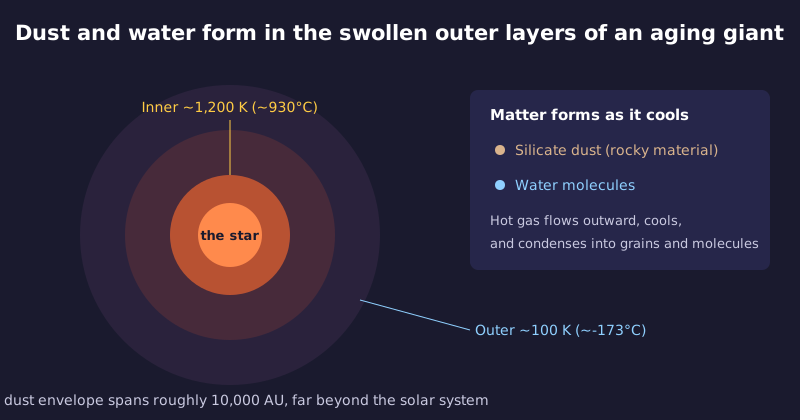
The shed material forms a dust envelope estimated to span roughly 10,000 astronomical units. One astronomical unit is the Earth-Sun distance, about 150 million km — so this envelope is 10,000 times that. Neptune, for comparison, orbits at only about 30 astronomical units. In other words, this star is wrapped in a cocoon big enough to fit hundreds of solar systems.
Up to this point, it’s all fairly standard behavior for an aging star. The real surprise was the location.
Manufacturing That Wouldn’t Quit, Even in a Danger Zone
In a spot bathed in this much radiation, you’d expect any dust or water to get destroyed almost as fast as it forms. That’s exactly what the research team was watching for.
Instead, the observations showed that IRS 3’s dust production was, in the team’s words, “surprisingly resilient.” The harsh environment hasn’t managed to shut down this old star’s manufacturing process. If anything, the star just keeps churning out material at its own pace, indifferent to how chaotic its surroundings are.
The research was led by Florian Peißker at the University of Cologne, with results published in the journal Astronomy & Astrophysics on August 11, 2026. The team frames it as evidence that even in an extreme environment like the galactic center, an aging star can keep supplying material to its surroundings. IRS 3 was captured in detail as part of MICONIC, an observing program dedicated to surveying the galactic center in depth. Until fairly recently, it wasn’t even clear that a star this far along in its life cycle existed there at all.
This is honestly my favorite part of the story. Right next to the most destructive spot in the entire galaxy, the quietest possible act — building something — was happening without fanfare. Drama and diligence, coexisting at a distance of just 0.55 light-years.
Picture it for a second. If you could stand near IRS 3, you’d look up and see the galaxy’s dominant black hole and a scattering of blazing, turbulent young stars overhead. And yet, right at your feet, the aging star wrapping around you would be quietly breathing out flecks of rock and droplets of water.
That Dust Will Someday Be Underfoot for Someone Else
Why does this understated discovery matter so much? Because the dust and water an aging star scatters becomes the raw material for the next generation.
Cosmic dust gathers to form new stars, and planets assemble in the disks around them. Silicates become the building blocks of rocky planets; water becomes oceans and ice. Earth itself was built from the dust of stars that died before the Sun was even born. The rock beneath your feet, and many of the heavier elements that make up your own body, weren’t just lying around in space to begin with — stars handed them down across generations to get here.
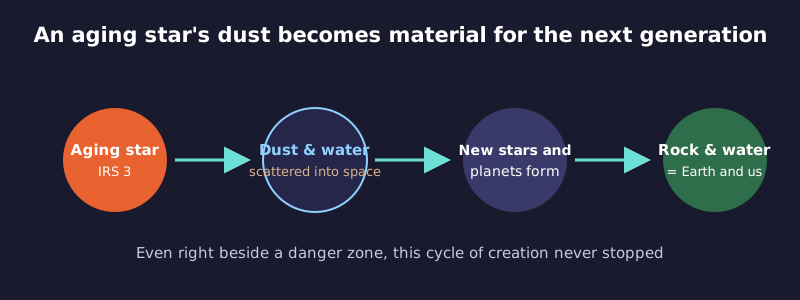
So this observation captured a single frame of that larger cycle: even in a battered environment like the galactic center, material for future stars and planets can still be supplied. The research team sees it as an important clue for understanding how such extreme environments actually work.
The calcium in your bones, the water in the glass on your desk — trace them back far enough, and you land on dust made by some aging star, somewhere. The manufacturing happening today in the galaxy’s most dangerous corner isn’t a distant curiosity. All of us are, in the end, something that got made this way.