On a launch pad in Florida, a precision machine that took more than a decade to build is about to be bolted onto a rocket. Once it’s up there, nobody can touch it again.
On August 30, 2026, the Nancy Grace Roman Space Telescope is scheduled to launch aboard a SpaceX Falcon Heavy. It’s a new set of eyes on the universe, operated by NASA’s Goddard Space Flight Center.
Take a moment to picture it: thousands of people, more than ten years of work, all riding on a handful of minutes during one single launch.
The scariest few minutes of the whole project
I’ve always thought this was the most nerve-wracking stage.
In the minutes after ignition, before the rocket reaches space, the spacecraft absorbs stresses it will never feel again on the ground. Violent vibration, a deafening roar, and G-forces that make everything aboard feel many times heavier than it is.
A mirror polished over ten years, an instrument assembled with extraordinary precision, gets shaken hardest right here. The most fragile part of the mission has to survive the roughest moment to ever reach space. There’s something almost cruel about that irony.
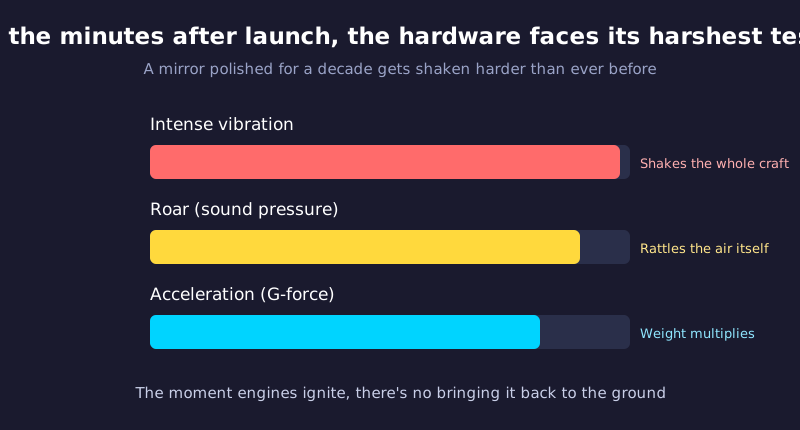
And the instant the engines ignite, there’s no turning back.
A cooking show can always reshoot a botched scene. A rocket launch is live television, with exactly one take and no rehearsal. In mission control, all anyone can do is stare at the numbers on their screens and wait.
The one-shot gamble starts long before liftoff
I’ll admit it: I used to think of launch day as the main event.
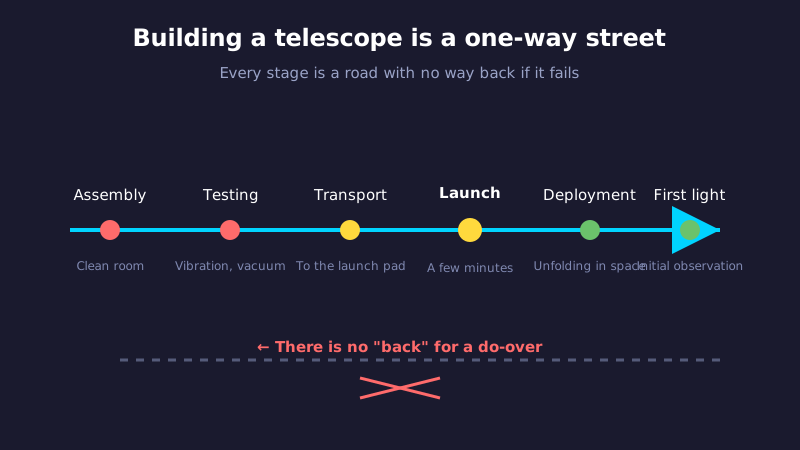
But the real high-stakes moments start much earlier. Assembly, testing, and the trip out to the launch pad are all one-way streets too. Fail at any of these, and there’s no arrow pointing back.
The telescope is built in a clean room where not a single speck of dust is tolerated. One grain of dust on the mirror’s surface is enough to degrade the quality of every observation it will ever make. Technicians work in masks and full protective suits, moving carefully enough that not even a strand of hair falls loose.
Once assembled, the telescope faces a battery of ground tests designed to torture it. Engineers expose it to vacuum, cycle it through extreme heat and cold, and shake it as violently as launch itself will. Any weakness that shows up here can still be fixed. In fact, this is the last chance to fix anything while the telescope is still on Earth.
Transport is just as tense. Think about the concentration it takes to move fine china during a house move without breaking a single plate — now multiply that by an order of magnitude, and you have some idea of what it’s like to move a space telescope. Drop it, and a decade of work ends in an instant.
That’s why the telescope travels to the launch pad in a specially built container, its vibration, temperature, and humidity monitored down to the smallest detail. Everything up to this point still belongs to the world where mistakes can be corrected. Past the launch that follows, human hands can no longer reach it.
The moment it “opens” in space is still to come
Even a flawless launch doesn’t mean the hard part is over.
A telescope this large can’t fit inside a rocket fully assembled, so it launches folded up and unfolds only once it reaches space. This “deployment” has to work — only then does the telescope actually become a telescope.
Here’s where it gets interesting. Roman isn’t headed for low orbit just above Earth; it’s aiming for a vantage point much farther out, from which to survey the cosmos. Being that far away also means that if anything goes wrong, no one can fly out to fix it.
Consider Roman’s predecessor, the Hubble Space Telescope. Because Hubble orbited so close to Earth, astronauts were able to visit and repair it multiple times over the years. Roman won’t have that luxury. Deployment, and every adjustment that follows, has to succeed remotely, on the first try.
Imagine sitting in mission control, sending the command to unfold, and then waiting minutes for confirmation to come back. Holding your breath through that silence is its own particular kind of fear — different from launch day, but no less real.
And finally comes first light: the moment the telescope opens its eyes to the cosmos for the first time and captures its very first photons. Every step before this one has to go exactly right to arrive here.
Even so, first light doesn’t instantly produce a beautiful image of the universe. The telescope needs time to fine-tune its mirrors and instruments to the realities of space before it can perform at its best. It’s the final touch on a very long preparation.
What is Roman actually built to see?
All this risk, all this one-way commitment to send something so far from home — it exists because the payoff is worth it.
Roman’s single greatest strength is the sheer size of its field of view. According to NASA, it’s more than 100 times wider than Hubble’s.
That number doesn’t mean much on its own, so let’s translate it. Hubble was like peering at the night sky through a narrow straw: sharp, but able to take in only a tiny sliver at a time. Roman can capture 100 times that area in a single image, at the same image quality. What would take Hubble 100 separate shots stitched together, Roman captures in one frame.
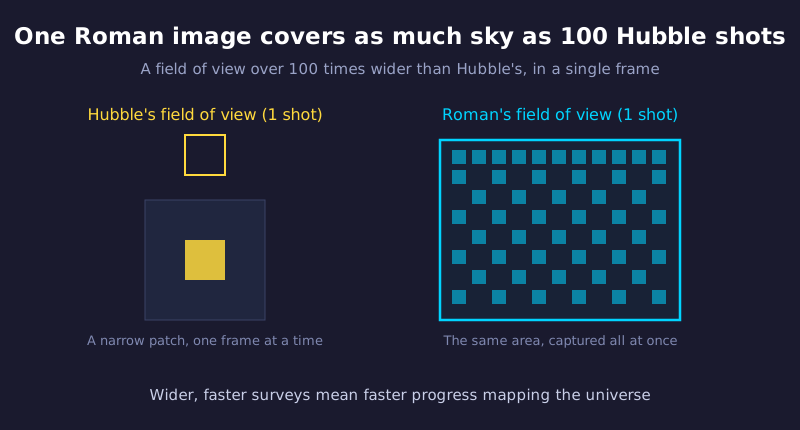
Wider, faster surveys mean faster progress toward mapping the universe. NASA says that over its operating lifetime, Roman will measure light from roughly a billion galaxies. To put that in perspective, counting to a billion at one number per second would take more than 30 years. One telescope is set to gather light from that many galaxies.
Why does counting on such a massive scale matter? NASA describes Roman as a telescope built to get at cosmic phenomena that are otherwise invisible. By using the light of stars and galaxies as clues, it can edge closer to identifying things we can’t observe directly. Looking deeply at a narrow patch of sky isn’t enough for that job — the sheer breadth of the survey is itself part of the answer.
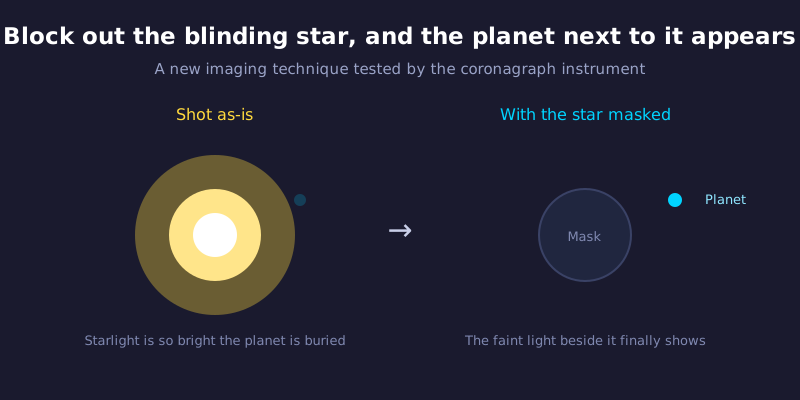
Roman also carries an unusual instrument: a coronagraph. It’s essentially a technology demonstration, an attempt to directly photograph planets orbiting nearby stars.
The problem is that stars are blindingly bright. The faint light of an orbiting planet gets completely swallowed by its host star’s glare. The coronagraph’s solution is to physically block the star’s overwhelming light. Once that glare is blotted out, the faint light beside it — previously invisible — can finally come into view.
A name, and a baton being passed
This telescope is named after Nancy Grace Roman.
She served as NASA’s first chief astronomer and helped pioneer the very idea of observing stars from space with a telescope. Now, a mission bearing her name is about to launch into the sky she helped make possible.
Incidentally, Roman’s launch is arriving nine months ahead of its original schedule. In an industry where delays are the usual story, that’s a refreshingly rare piece of news.
And NASA isn’t alone in this gamble. The Jet Propulsion Laboratory and the Space Telescope Science Institute are both involved, along with Europe’s ESA, Japan’s JAXA, and research institutions in France and Germany. A decade of work from people across different countries and different roles all comes down to riding on a single rocket.
August 30: everything rides on a few minutes
Look up at the night sky, and the stars always seem quietly, permanently there — as if nothing about them has changed in centuries.
And yet the instrument built to look at that stillness in a whole new way has to survive an almost absurdly risky chain of events to get there. Assembly with zero tolerance for dust. Testing designed to break it. Transport where one drop ends everything. A live, one-take launch. Remote deployment with no second chances. And finally, first light. None of these steps can be redone.
There was always the option of locking the finished machine away in the safest warehouse imaginable. Instead, people choose to send it out into a sky it can never return from. Presumably because what they want to see only exists out there.
On August 30, 2026, on a launch pad in Florida, the first domino falls. A rocket carrying thousands of people’s decade of work will climb into a sky with no way back. And somewhere in mission control, someone will be staring at the numbers on a screen, quietly holding their breath.