Imagine launching the most advanced telescope ever built, brand new, today. Even so, there’s one photograph it will never be able to take.
Jupiter, ten years ago.
No mirror is big enough and no sensor is sharp enough to shoot backward in time. And that fact alone explains why we keep old space telescopes running long after newer, flashier ones exist.
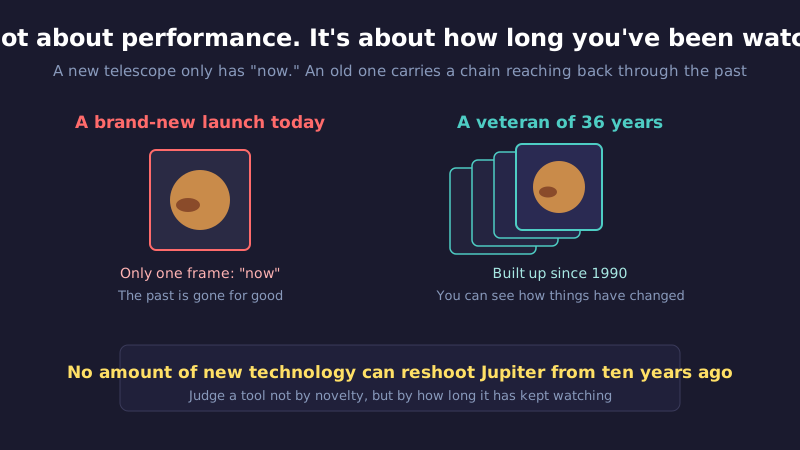
Even the best telescope in the world can’t get everything
Newer usually means better. That’s true for cameras, laptops, phones — almost any tool you can name.
I’ll admit it: I used to assume space telescopes worked the same way. Retire the old hardware, swap in something sharper, and call it progress.
But there’s one thing a new space telescope can never buy back: the past.
How did Jupiter’s storms shift since last year? When exactly did that swirling vortex on Neptune vanish? Only a telescope that happened to be pointed at the sky in that exact moment could have caught it. Bring in the newest, sharpest instrument afterward, and the vanished vortex simply isn’t there anymore.
That’s the strange twist at the heart of this story. Part of a telescope’s value has nothing to do with performance. It comes down to how long it has kept looking.
A single snapshot can’t show you change
So why does “time spent watching” matter so much? The answer lies in something astronomers call baseline monitoring.
Baseline monitoring means observing the same target, the same way, over and over. In astronomy, this kind of multi-year effort is called a long-baseline observation: you draw a reference line across years, then measure how things drift from it.
Here’s a familiar comparison. Think of marking a child’s height on a doorframe with a pencil, year after year.
One mark alone tells you nothing — you can’t even say whether the kid is tall or short for their age. But keep marking the same spot every year, and the gaps between the lines start to speak for themselves, tracing out exactly how much growth happened. A single line carries no story. A column of them tells you everything.
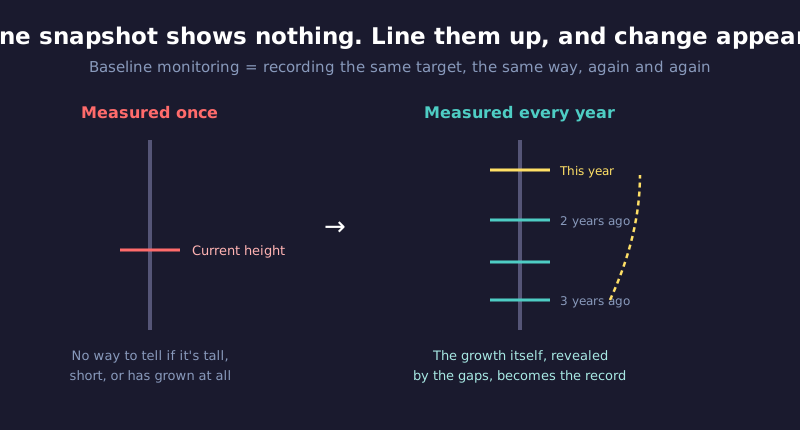
Space telescopes work exactly the same way. A single observation is just one pencil mark — however sharp the image, it can’t show change. Change only becomes visible once you line up two or more snapshots taken years apart.
Which means a telescope with a long observational history is, in effect, the doorframe itself — the one covered edge to edge in decades of marks.
Thirty-six years of Jupiter’s diary, courtesy of Hubble
The clearest example is the Hubble Space Telescope.
According to NASA, Hubble launched on April 24, 1990. As of 2026, it has been working in orbit for roughly 36 years — the equivalent of a person photographing the same patch of sky every single year from birth well into middle age.
Over that span, Hubble has repeatedly observed Jupiter, Saturn, Uranus, Neptune, and Mars. NASA notes that this long operational life, combined with regular observations, has made it possible to study how these planets’ atmospheres are constantly changing. In other words, Jupiter and its neighbors now have a thick diary of entries behind them.
Here’s where it gets interesting.
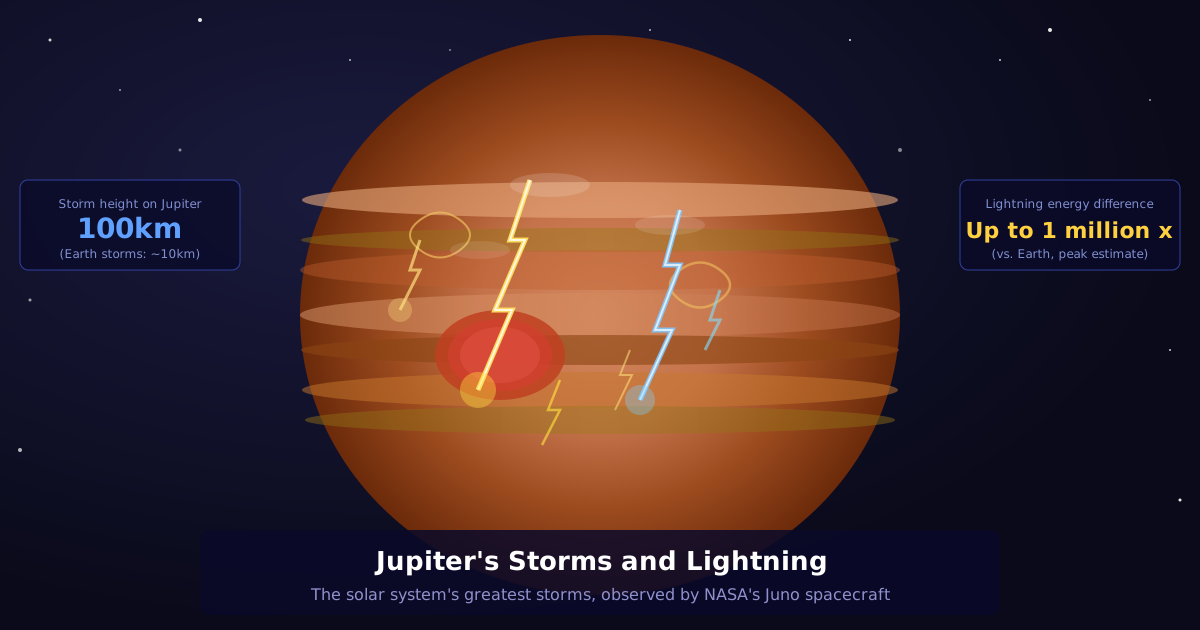
Flip through that diary, and you find a slow-motion change in Jupiter’s Great Red Spot — a storm big enough to swallow the entire Earth, one that has been swirling for centuries. NASA reports that between 2009 and 2020, the average speed of winds circling the outer edge of the Great Red Spot increased by as much as 8%.
An 8% shift might sound minor. But that number represents an incremental drift that unfolded over eleven years. Zoom into any single year’s photo as much as you like, and you won’t spot it. Only by comparing two snapshots does the slight acceleration in the wind come into focus.
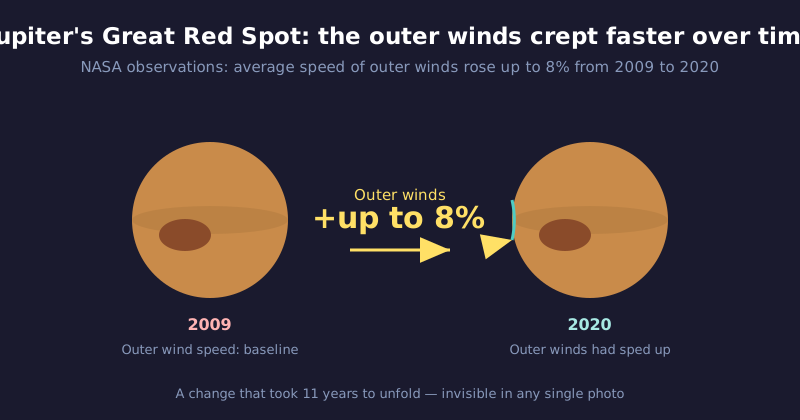
Picture this: if you had photographed Jupiter once a year, every year, since 1990, and then flipped through those images like a flip-book, you’d watch the storm slowly reshape itself and the winds gradually pick up speed. That motion is invisible in any single frame. It only exists across the whole sequence.
Slow drifts and repeating cycles — both need a long record
Jupiter’s winds aren’t the only thing a long record reveals.
Take Neptune. NASA has observed that a large dark storm in the planet’s southern hemisphere, known as the Great Dark Spot, disappeared in 1994, only for a different dark vortex to appear later. When exactly does a vortex form, and when does it fade? Catching that full life cycle takes years of continuous watching. A telescope that happens to glance at Neptune just once has almost no chance of being there for the disappearing act.
Mars tells a similar story. NASA credits Hubble with documenting the planet’s shifting dust storms, along with the seasonal swelling and shrinking of its polar ice caps.
The key point here is that a long record enables two very different kinds of discoveries. One is a slow drift, like the acceleration of Jupiter’s winds. The other is a recurring cycle, like the seasonal rhythms on Mars.
Neither is distinguishable from a short observation window. Was that unusual snapshot a rare, one-off event, or just another turn of an annual season? Only a long diary lets you tell the difference.
Honestly, this is my favorite part of the whole picture. An old telescope isn’t valuable simply because it’s old. Every extra year it operates adds to its unique ability to catch both slow drifts and recurring cycles — the two kinds of phenomena that only reveal themselves over time.
You can’t buy back a long record
So why can’t a brand-new, high-performance telescope simply take over this record?
The answer is straightforward. No matter how advanced it is, any telescope launched today starts its record at zero. You can buy a bigger mirror or a sharper sensor with enough money. What you cannot buy is thirty-six years of continuity — that only comes from waiting thirty-six years. It’s an obvious fact, and yet still strangely striking: money can buy performance, but it can’t fast-forward through time.
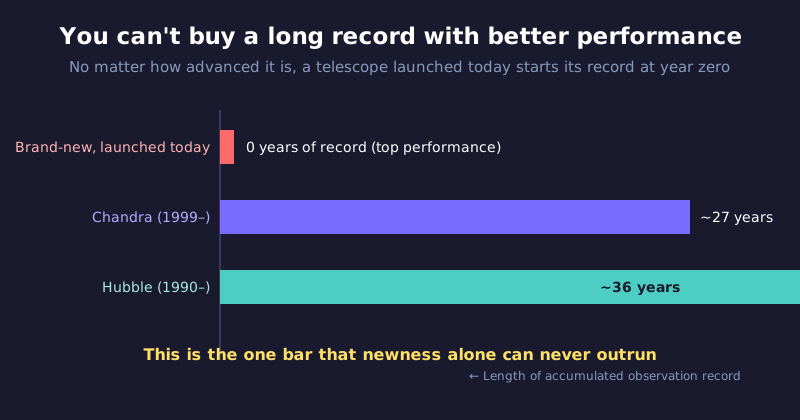
For what it’s worth, the Chandra X-ray Observatory is in a similar position. NASA notes it launched on July 23, 1999, making it a roughly 27-year veteran keeping watch over the universe’s most violent, invisible-to-the-eye phenomena in X-rays. It, too, has been quietly building up the one asset no new spacecraft can replicate: a long record.
None of this comes for free, of course. Keeping an old instrument alive costs something. Fuel for maintaining orientation runs low. Components age. Even the faint trace of atmosphere lingering in orbit slowly drags the telescope’s altitude down over time. Operating it takes money and effort, and how long to keep extending its life is a judgment call that research teams and NASA weigh again and again.
On one side of that scale sits the cost of upkeep. On the other sits a continuation of the record that no brand-new instrument could ever recreate. Swap in something newer, and performance improves instantly — but the diary’s continuity breaks at that exact moment, and the next year’s worth of change is lost forever, blank. Do you measure a tool by how new it is, or by how long it has kept going? Space telescopes are a rare kind of instrument where those two yardsticks point in completely different directions.
The doorframe only grows more valuable the more marks it holds
Honestly, learning this changed how I look at telescopes.
We’re drawn to newness and raw performance almost by instinct — faster, bigger, sharper, whatever the numbers say. But that pencil-marked doorframe only becomes harder to give up the more marks it accumulates. Any single mark is a meaningless scratch of graphite. Thirty years of them together become a record that can never be recreated.
That’s exactly what old space telescopes are protecting. Tonight, another page gets added to Jupiter’s diary — one that began back in 1990. And that single new entry will probably matter most to someone who hasn’t been born yet, flipping through the pages ten years from now.