Nagi could think of nothing but grilled dumplings.
The festival had already started. Lantern light from the square bled red through the paper screens of every house. “Go fetch old Sue,” her mother had told her, and Nagi trudged up the hill, dragging her feet. She just wanted to get it over with and eat the hottest dumpling on the stall before anyone else did.
Old Sue lived alone, up where the town gave out, in a house on a rise. Nagi opened the door and found her exactly where she always was — at the window, ignoring the festival entirely, eyes fixed on the darker half of the sky.
“Grandma Sue. Festival’s starting. Mom wants you.”
“Mm. …I’m right in the middle of something.”
Sue lifted her glasses to her forehead and stared at one point in the sky with her bare eyes. Then she reached for the notebook on her lap and marked it with a single dot. Nagi couldn’t help but sigh.
What Sue watched, night after night, was what the town called the Ghost Lantern.
Far out across the sky hung a single red light — from some town on the other side, they said. But the light took roughly a human lifetime to reach here. What people saw now was ancient light, sent from a town that had probably burned out and vanished long ago. A ghost, more or less. That’s why people in town kept their shutters closed on that side of the house after dark. Bad luck to look at a dead thing, they said.
Not that Nagi had ever met a kid in town who’d actually looked at it properly. Grilled dumplings were a far better use of anyone’s evening. She’d always assumed the same herself.
“So — fifty years of watching that thing. Has it ever changed?”
The words came out sharper than she meant. Sue didn’t seem to mind.
“Not once. Not a bit.”
And she smiled, looking strangely pleased about it.
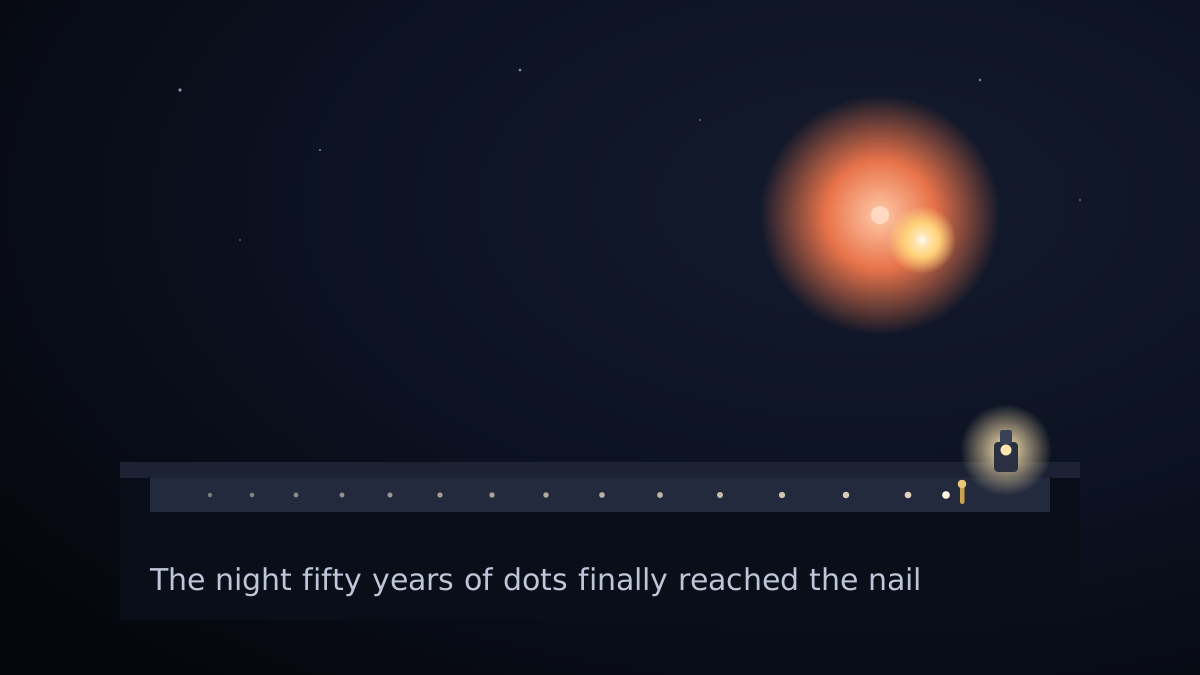
The notebook on her lap was packed edge to edge with dots. A whole shelf held more just like it. Look closely, though, and the scattered dots resolved into a faint, curving line — creeping, year by year, toward the edge of the window frame. A small nail was driven into the sill there.
“Kiku hammered that in,” Sue said.
She ran a fingertip gently over the nail. Kiku — her older sister’s name, Nagi gathered. The sister who’d left for that faraway town long ago and never come back.
“The day she left, she drove that nail in and said, ‘When my light finally reaches here, look for my answer.’”
None of it made sense to Nagi. If the light took a whole lifetime to arrive, how could anyone ever hear back? All Sue had really done, as far as Nagi could tell, was spend fifty years staring at her sister’s ghost. It struck her, for a second, as almost sad.
That was when Sue’s hand froze mid-motion.
The red light sat exactly on the nail. Fifty years of dots had finally, finally reached the edge of the frame.
And right beside the nail — one more. A small, trembling point of light had just switched on.
It hadn’t been there a moment ago.
Sue stared at it for a long time, glasses still pushed up on her forehead. Then she pulled an old lamp out from the back of the shelf — dusty, its oil gone thick and cloudy. She struck a match, lit the wick, opened the window, and aimed the small flame straight out into the dark.
”…An answer came,” she said, to no one in particular.
Nagi had completely forgotten about the festival. Maybe, right now, that other town called this side the Ghost Lantern too, and had its own shutters closed against it. Maybe someone over there, behind those dark shutters, had spent fifty years turning this very window into nothing but a row of dots.
Sue held out her pen.
“Here. Tonight’s dot — you make it.”
Nagi took the pen and, carefully, marked her own dot just beneath the new one by the nail. Outside the window, Sue’s small light was only now, at last, setting out into the dark.