Somewhere in the spiral arms of M51, the Whirlpool Galaxy, a newborn star cluster is tearing its way out of the gas cocoon that surrounds it. Point an ordinary telescope at that spot, though, and you’ll see almost nothing. Young clusters are wrapped in such thick gas and dust that hardly any visible light escapes.
Here’s the interesting part: how fast a cluster breaks out of its cocoon varies a lot from one to the next. And heavier clusters get out faster.
A 2026 analysis, built on a census of thousands of individual clusters, just pinned down why.
Star Clusters, Buried in Their Own Birth Material
Stars form when the dense patches of a giant molecular cloud collapse under their own weight. They rarely form alone — they form in groups. Those groups are star clusters.
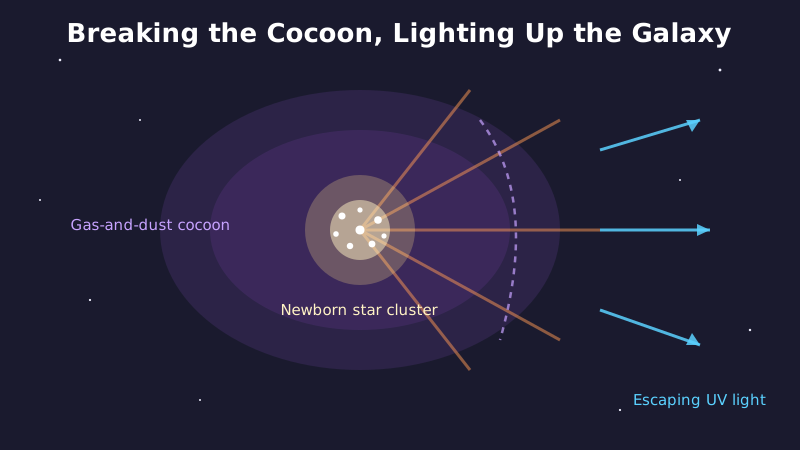
Right after birth, a cluster is still wrapped in the leftover gas and dust from its own construction. That cocoon blocks visible light, so conventional telescopes can’t see through it. In fact, this study found that a substantial fraction of clusters were still completely buried — invisible in optical light altogether.
That’s where infrared comes in. Infrared light slips through dust, which means it can pick out clusters hidden deep inside their cocoons. The research team combined observations from the Hubble Space Telescope (HST) and the James Webb Space Telescope (JWST), surveying thousands of young clusters across four nearby galaxies: M51, M83, NGC 628, and NGC 4449. The trick was counting both kinds of clusters — the ones glowing in visible light and the ones only infrared could reach.
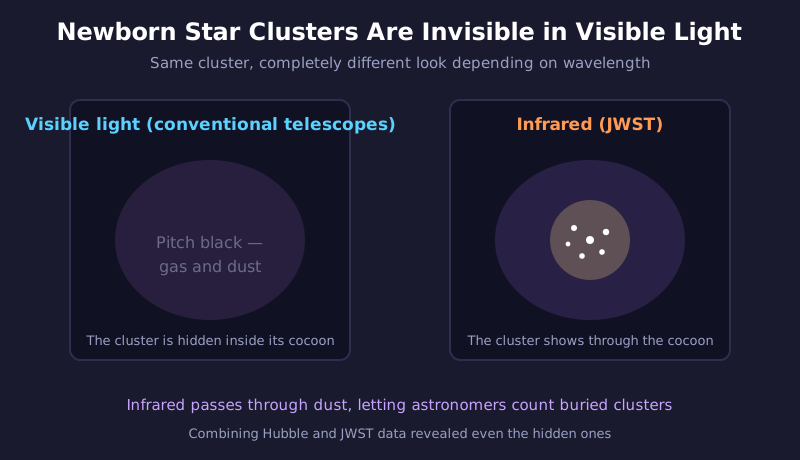
The very first stage — fully buried, with not even ultraviolet light leaking out — is thought to be brief, on the order of just 1 to 2 million years by the team’s estimate. The real question is what comes next: when does a cluster finally blow its cocoon apart and show its true face? And what determines how fast that happens?
Massive Clusters Break Free Millions of Years Sooner
This is the heart of the finding. Sort clusters by mass — the combined mass of all their stars — and measure how long it takes each to clear its cocoon, and a clean pattern emerges.
Massive clusters break free in about 5 million years. Lighter clusters take 7 to 8 million years. That’s a gap of several million years, with the heavier clusters consistently first out. The work was led by Alex Pedrini, Angela Adamo, and colleagues at Stockholm University, who report a strong correlation between a cluster’s mass and how quickly it escapes.
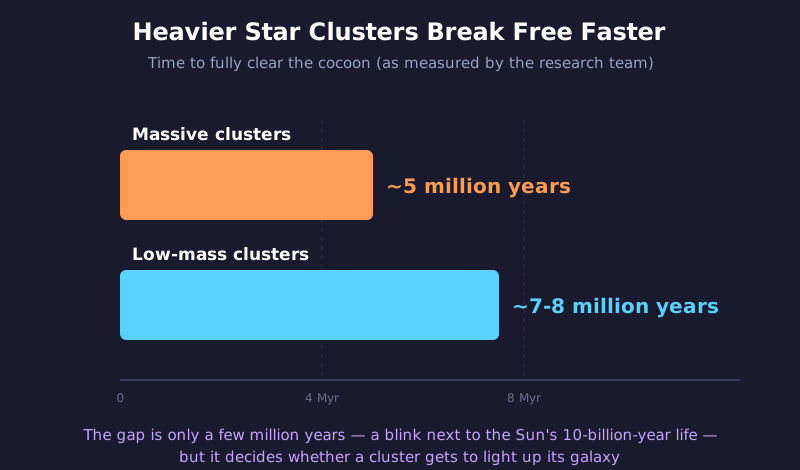
A few million years might not sound like much. But the Sun has a roughly 10-billion-year lifespan. Next to that, both 5 million and 8 million years are barely a blink.
That said, mass alone doesn’t decide everything. Among the four galaxies studied, M51 stood out as slower overall — some of its clusters took nearly 9 million years to clear out — suggesting the surrounding environment matters too. Measuring this clearing time at all is genuinely hard, which is exactly why it matters: it’s a fundamental yardstick for understanding how stars are born and raised. The team notes that their results pose a real challenge for star-formation and feedback simulations, since current models still don’t fully capture how a cluster gets from birth to a cleared-out cocoon.
And yet that tiny gap — just two or three million years — ends up deciding what role a cluster gets to play afterward. Why do heavier clusters win the race? The answer lies in where the cocoon-breaking force actually comes from.
What Breaks the Cocoon Isn’t the Supernova — It’s the Light and Wind That Come Before It
Inside any cluster, the real demolition crew is a small minority of very massive stars. Stars more than about 15 times the Sun’s mass pump out staggering amounts of energy into their surroundings.
They do it several ways: blasting the gas with intense ultraviolet light that ionizes it, driving high-speed stellar winds off their surfaces, and pushing gas around with the sheer pressure of their own light — radiation pressure. Eventually, they end their lives as supernovae. Collectively, astronomers call all of this “stellar feedback.”
Heavier clusters simply contain more of these massive stars. More muscle, faster demolition. The logic is straightforward.
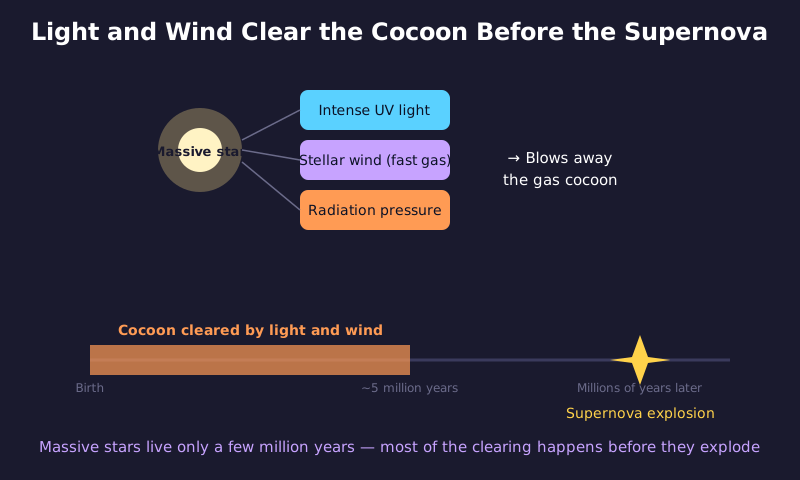
Here’s a detail worth pausing on, because it changes the story. Massive stars themselves only live a few million years. They burn through their fuel fast and eventually go out as supernovae. So it’s tempting to assume the supernova blast is what finally clears the cocoon.
But the timing runs the other way. Clusters break free in roughly 5 million years — right around when, or even before, their massive stars go supernova. Most of the cleanup is already done by ultraviolet light, stellar winds, and radiation pressure alone, well before any explosion. The quiet work of light and wind finishes the job before the fireworks even start.
Once Free, a Cluster Becomes a Light Source for the Whole Galaxy
While a cluster is still trapped inside its cocoon, its ultraviolet light gets absorbed by its own surrounding gas and never escapes. The moment the cocoon breaks, everything changes. The wall that was holding it back disappears, and ionizing ultraviolet radiation floods out into the galaxy all at once.
This is where a fast exit really pays off. The sooner a cluster breaks free, the more likely its massive stars are still actively pumping out UV light when they finally get the chance to shine on the galaxy. A slow exit means the brightest stars may already be fading by the time the light gets a path out. The research team emphasizes that massive clusters play a central role in letting ionizing radiation escape into the wider galaxy.
Once that ionizing radiation escapes, it lights up the surrounding gas and helps paint entire regions of a galaxy bright. How much ultraviolet light actually gets out depends heavily on when — and in what condition — each cluster clears its cocoon. That’s exactly why measuring this escape timing across thousands of real clusters matters so much, the team argues.
I’ll admit, I started reading this expecting a story about the internal life of star clusters — a kind of local, self-contained drama. It turned out to be the opposite. When a cluster breaks free of its cocoon directly determines how much ultraviolet light fills an entire galaxy. A small population of massive clusters, it seems, holds much of the answer to what lights a galaxy up.
Even Baby Planets Are Running on a Timer
There’s another layer to this story that hits closer to home: planets.
When a star forms, leftover gas and dust settles into a disk around it. That disk is a planet’s raw material. Earth and the Sun themselves are thought to have assembled from just such a disk, roughly 4.5 billion years ago.
Try imagining this for a second: if our solar system had formed inside a cluster packed with massive stars, the intense ultraviolet radiation from its neighbors would have eroded that planet-forming disk from the outside, cutting off the supply of fresh gas. The research team points out that in the environment of a massive cluster, the window for building planets gets sharply limited.
In other words, the exact moment a cocoon clears and ultraviolet light starts flying — that timing reaches all the way down to determine the fate of any planets forming nearby. Our own Sun most likely formed inside a cluster too, before eventually drifting away from its siblings. If that cluster had been just a bit heavier, Earth might never have finished forming. It’s a strange thought, but somewhere behind the speed of a cocoon breaking open, our own existence is quietly tangled up.
A Record of Cocoon-Breaking, Written in Light
M51 and M83 sit tens of millions of light-years from Earth. Which means the light arriving in our telescopes right now left those galaxies tens of millions of years ago.
Bundled into that light is a mixed record: clusters that had already broken free and shown their true faces, alongside others still trapped in their cocoons. Massive clusters escaping first, in a few million years; lighter clusters still struggling inside theirs — that mismatch in timing is baked directly into a single snapshot of a distant galaxy.
Next time you come across a photo of a spiral galaxy, take a moment to notice the boundary between the bright patches and the dim ones. Somewhere along that boundary, a newborn star cluster is, right now, tearing its way out of its own cocoon from the inside.