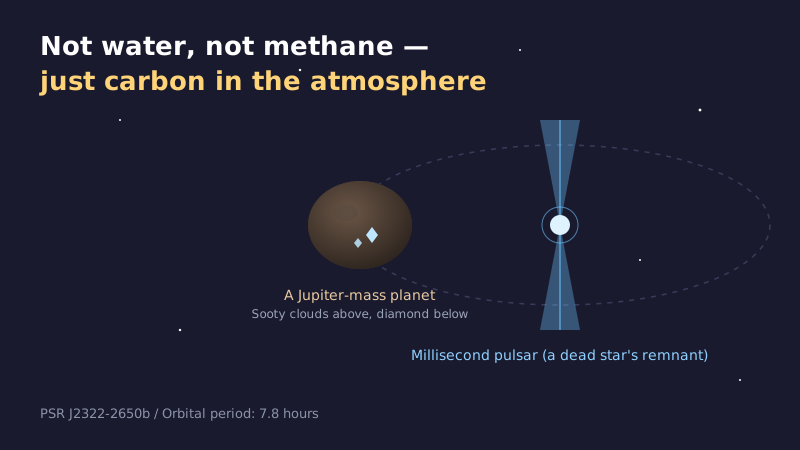
Somewhere out there is a star that already died in a supernova. Circling its smoldering remains is a Jupiter-sized planet that completes a full orbit in just 7.8 hours. When the James Webb Space Telescope looked into that planet’s atmosphere, it found no water, no methane, and no carbon dioxide.
Instead, it found helium — and bare carbon itself.
That’s never turned up in an exoplanet atmosphere before, not once among the roughly 150 worlds astronomers have examined this way. And there’s a bigger problem: existing theories of how planets form can’t easily explain what’s going on inside this one. Let’s walk through what’s happening here, step by step.
An “impossible” reading from the atmosphere
The planet in question is PSR J2322-2650b, an exoplanet — a world orbiting a star other than our Sun. JWST studied its atmosphere using spectroscopy, a technique that reads which wavelengths of starlight get absorbed as they pass through a planet’s air, revealing what that air is made of.
Normally, gas giants like this one show traces of water vapor, methane, and carbon dioxide. This time, those signatures barely showed up at all.
What did show up was helium, along with something called molecular carbon — C2 and C3, bare carbon atoms bonded in pairs or triplets, with nothing else attached.
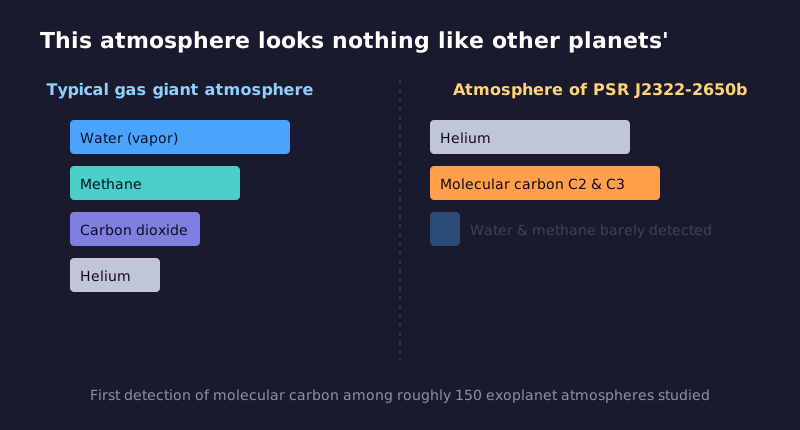
The first time researchers saw this composition chart, they reportedly wondered if they’d misread it. An atmosphere that skips straight past water and carbon compounds to bare carbon molecules is that unusual.
According to NASA, PSR J2322-2650b is the first exoplanet, among roughly 150 whose atmospheres have been studied, to show a clear signature of molecular carbon. Out of that whole sample, this one world stands apart. So what made its atmosphere turn out this way?
Why current theory falls short
Planet formation follows a rough script. Inside the disk of gas and dust surrounding a young star, material clumps together and grows into planets over time. Scientists have generally assumed this process determines, fairly predictably, which elements end up in a planet and in what proportions.
Follow that script, and a gas giant like Jupiter should end up with hydrogen and helium dominating its atmosphere, with some water and methane mixed in. An atmosphere where bare carbon shows up in bulk simply doesn’t fall out of the standard models.
And that’s what makes this discovery so compelling. The composition astronomers actually measured doesn’t match what current theories of planet formation predict.
The research team suspects the planet may simply be carbon-rich to an unusual degree. But why that would be the case remains unclear. What’s been observed is the fact that molecular carbon is present in the atmosphere — explaining the cause is now up to theorists to catch up on.
The findings appeared in The Astrophysical Journal Letters on December 16, 2025, led by Michael Zhang and colleagues at the University of Chicago. The team argues that this single example has punched a hole in our understanding of how planets form.
As it turns out, the star this planet orbits is just as strange as the planet itself.
The host star is a corpse
PSR J2322-2650b doesn’t orbit an ordinary star like the Sun. It orbits something called a millisecond pulsar.
A pulsar is really a neutron star — what’s left after a massive star exhausts its fuel, explodes as a supernova, and its core collapses into an impossibly dense remnant. It carries roughly as much mass as the Sun, but squeezed into a sphere small enough to fit inside a single city.
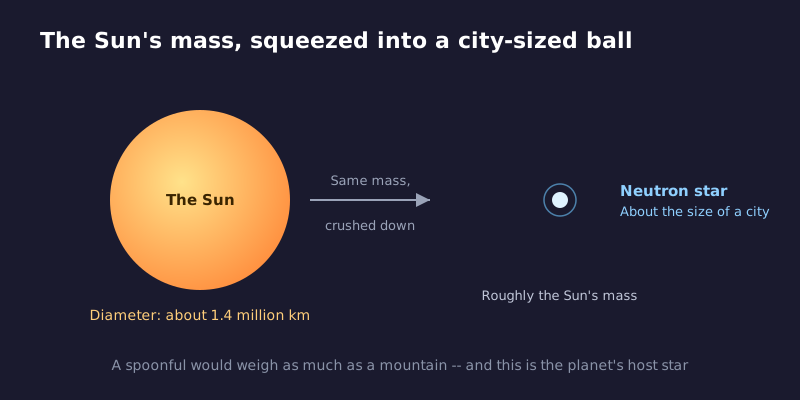
Try picturing that for a second: the entire mass of the Sun, packed into a ball roughly the size of a large metropolitan area. A single spoonful of that material would weigh as much as a mountain. This object also spins rapidly, flashing out radio pulses with clockwork regularity — hence the name “pulsar,” short for pulsating star.
Which means this planet orbits the corpse of a star that already died. That’s a fundamentally different setup from anything in our own solar system, where planets circle a living, still-burning Sun.
Astronomers know of roughly 6,000 confirmed exoplanets. Among all of them, NASA notes that PSR J2322-2650b stands out as one of the few known cases where a gas giant appears to orbit a pulsar. This is a planet with an unusually strange origin story.
A scorching lemon, one lap every 7.8 hours
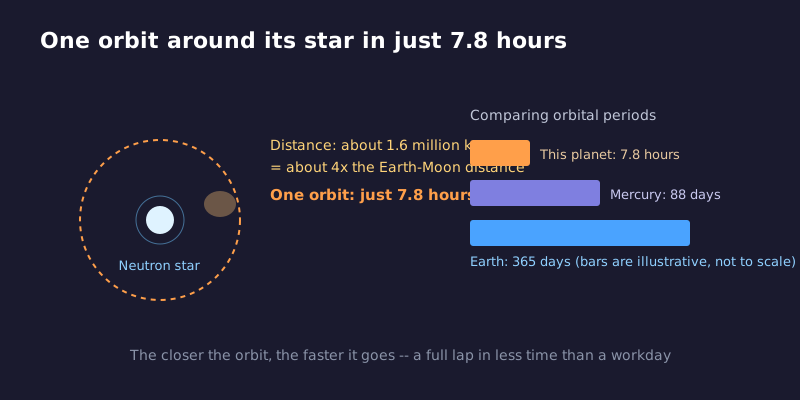
The planet sits only about a million miles — roughly 1.6 million km — from the neutron star. That sounds like a lot until you compare it to the distance between Earth and the Moon (about 380,000 km): it’s only about four times that. Compare it to Mercury’s roughly 58 million km from the Sun, and the gap is enormous — this planet is vastly closer to its star.
Being that close means orbiting fast. Absurdly fast. One full lap takes just 7.8 hours. Earth needs 365 days to circle the Sun; this planet manages it in about the time it takes to work a single shift.
At that distance, the planet is almost certainly tidally locked, keeping one face permanently turned toward its star. One side bakes in perpetual daylight; the other sits in perpetual dark. JWST measured roughly 1,200°F on the coldest nightside and about 3,700°F on the hottest dayside — around 650°C to 2,040°C.
Pause on that for a second. 650°C is well past the melting point of lead, and that’s the “cool” side. At 2,040°C on the dayside, even iron would melt.
Strong tidal forces are also thought to stretch the planet out of a perfect sphere into something closer to a lemon shape. Scorching, misshapen, and spinning through a full orbit every 7.8 hours — if you somehow floated in that orbit, you’d watch day give way to night every few hours, in a sky that never sits still.
Soot clouds above, diamond below
So what happens to a carbon-rich atmosphere at temperatures like these? The research team pictures soot clouds drifting through the upper atmosphere — chemically, the same stuff as the black smudge that curls off a candle flame.
And here’s the part that’s genuinely my favorite detail in this whole story.
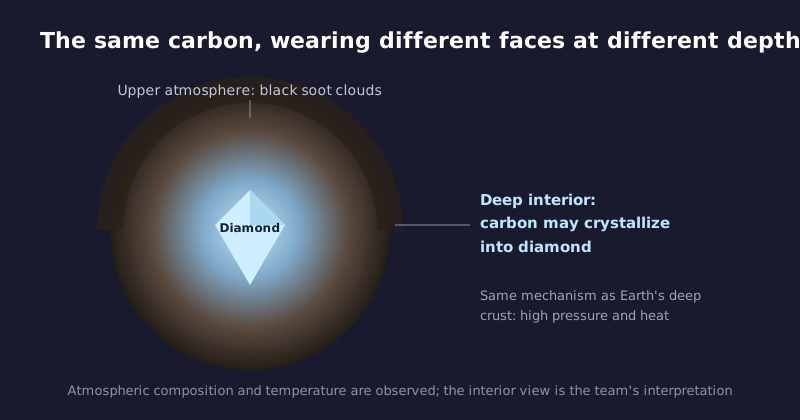
Squeeze carbon hard enough and it crystallizes. That’s the same basic physics that forms diamonds deep inside Earth, where pressure and heat do the work. The research team believes that deep within this planet, where pressures run extremely high, carbon could be crystallizing into diamond.
Soot drifting above; diamond forming below. Same element, completely different form, depending on how deep you go.
On Earth, making a diamond takes billions of years and immense pressure underground. On this planet, with carbon this abundant, the process would presumably operate on a much grander scale. It’s almost a shame there’s no one around to mine it.
To be clear, nobody has looked directly inside this planet. This is an interpretation the team built from what’s visible in the atmosphere, combined with the extreme temperatures and pressures involved. What the observations actually confirm is the atmosphere’s composition and temperature — nothing more. Still, once you’ve heard of a world where soot and diamond coexist, it’s hard to forget.
The theory is what needs rewriting
Roughly 6,000 exoplanets have been discovered so far. By sheer numbers, that’s not rare anymore. And yet, every so often, a single oddball planet exposes a gap in the theories astronomers have spent decades building.
PSR J2322-2650b is exactly that kind of oddball. Its carbon-heavy atmosphere, with no water and no methane, doesn’t fit cleanly into current models. And the question here isn’t really about the planet — it’s about whether our theories are good enough to explain it.
When a real-world example doesn’t match the accepted playbook, that’s not an inconvenience. It’s the good kind of problem, because a gap in theory is exactly where the next discovery tends to hide.
Somewhere out there, a planet with diamond buried beneath sooty clouds circles the corpse of a dead star, cycling through day and night every 7.8 hours. And that single observation is quietly rewriting a chapter of the textbook on how planets are made.