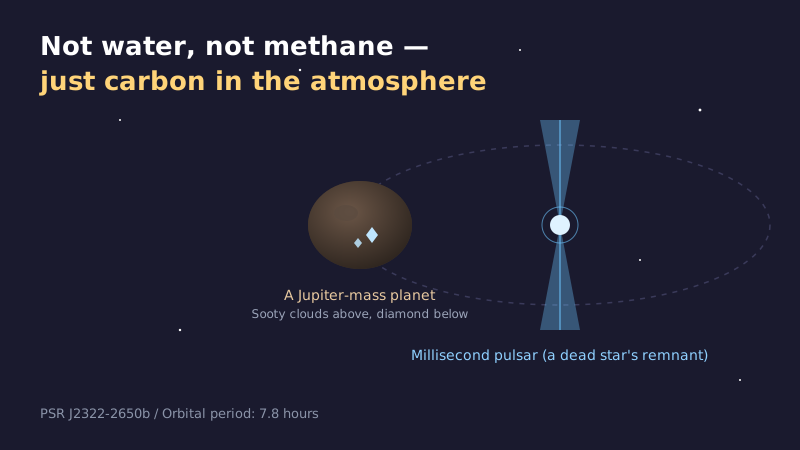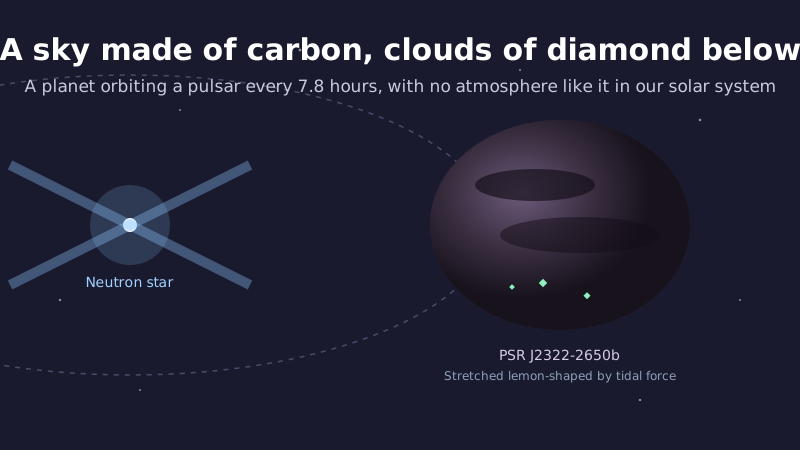
A Jupiter-sized world circles a pulsar, a rapidly spinning neutron star, once every 7.8 hours. When astronomers examined its sky, they found neither hydrogen nor nitrogen but a mix of helium and carbon. Deep in the atmosphere, that carbon appears to be compressed into clouds of diamond.
Nothing in our solar system has a sky like this.
When the James Webb Space Telescope first captured this object, the research team’s reaction was reportedly something like “what on earth is this.” It turns out everything we assume about “sky” is far more local to Earth than we realized. Here’s that story.
Our solar system only has three kinds of sky
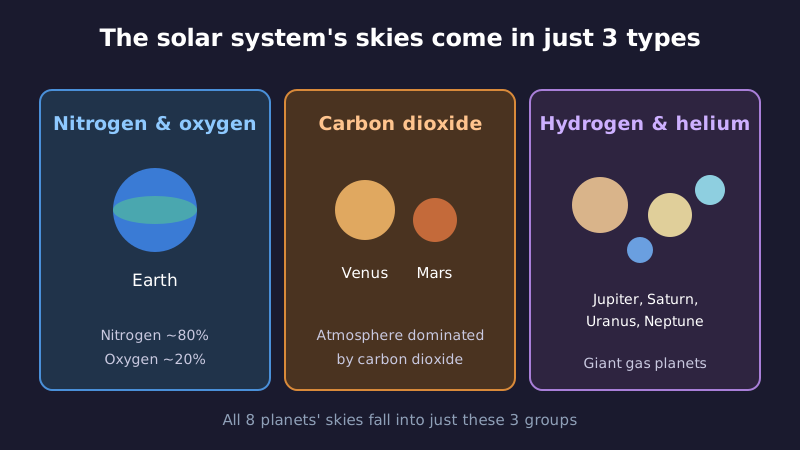
Let’s start close to home. The air we breathe is roughly 80 percent nitrogen and 20 percent oxygen. Those two gases alone explain almost everything about Earth’s sky.
But look around the rest of the solar system, and skies like ours turn out to be the exception. Venus and Mars are both dominated by carbon dioxide. The giant planets, Jupiter, Saturn, Uranus, and Neptune, are puffed up with hydrogen and helium.
So the skies of all eight planets fall into roughly three buckets: nitrogen-and-oxygen, carbon dioxide, or hydrogen-and-helium. It sounds like a lot of variety, but it really isn’t. Having grown up on Earth, we built our entire mental picture of “what a sky is” from this narrow sample.
Could a sky exist that fits none of these three categories? As it turns out, yes.
A sky made of helium and carbon
The planet in question is called PSR J2322-2650b, a Jupiter-mass world orbiting a pulsar. In December 2025, a team reported their JWST analysis of its atmosphere in The Astrophysical Journal Letters.
How do you even figure out what’s in a distant planet’s sky in the first place? The trick is light. When starlight passes through a planet’s atmosphere, splitting it apart reveals which molecules absorbed which colors. Every atmosphere leaves behind its own fingerprint, and reading that fingerprint in infrared is exactly what JWST does best.
In this case, the fingerprint was bizarre. Exoplanet atmospheres usually turn up familiar molecules like water, methane, or carbon dioxide. This one had none of them.
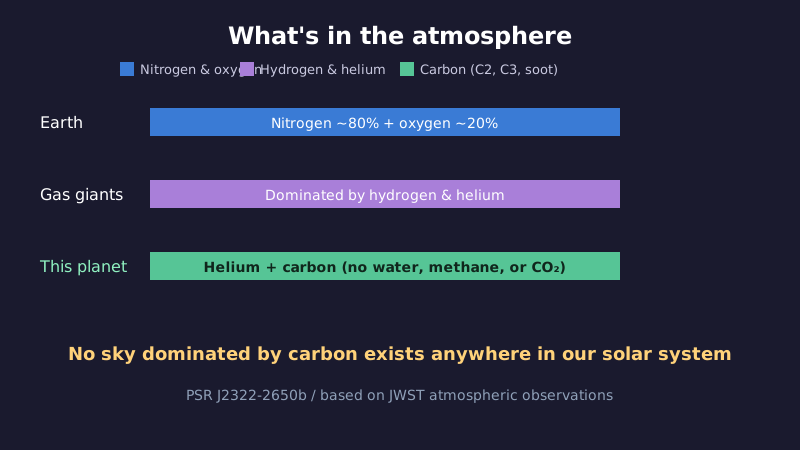
Instead, the telescope picked up molecular carbon: C2, with two carbon atoms linked together, and C3, with three. There were even clouds made of soot, fine particles of carbon. Lead researcher Michael Zhang of the University of Chicago reported detecting molecular carbon in place of the water, methane, and carbon dioxide you’d normally expect.
It’s easy to see why the team’s first reaction was bewilderment. This is a sky dominated by carbon, and it fits none of the solar system’s three categories.
Diamond clouds rain down at the bottom of the sky
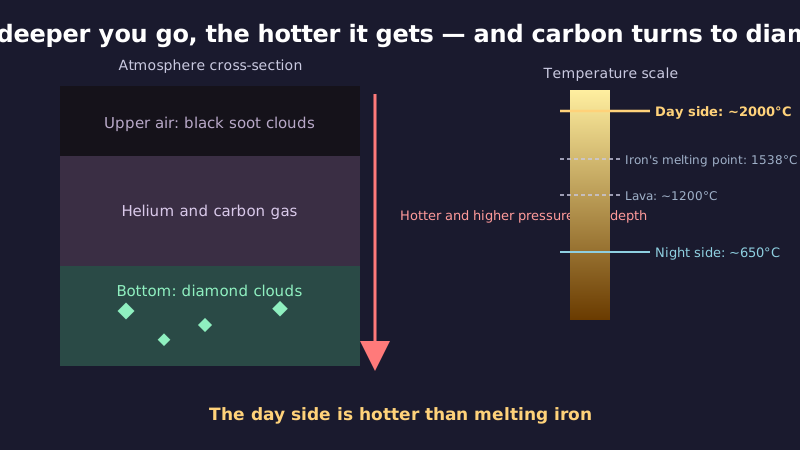
Here’s where it gets really interesting. The research team believes clouds of crystallized carbon, essentially diamond, form deep in this planet’s atmosphere.
The underlying physics is simple enough. Under enough heat and pressure, carbon turns into diamond crystals. On Earth, that happens more than 100 kilometers underground, in conditions that are both hot and intensely pressurized. The same basic process seems to be playing out here, just at the “bottom of the sky” instead of underground. Black soot clouds sit up high, diamond clouds lie beneath them, and the whole atmosphere becomes a showcase of carbon in different forms.
Don’t picture a cool, glittering jewel box, though. The day side reaches roughly 2,000°C, well past iron’s melting point of about 1,538°C. Even the night side sits around 650°C, hotter than flowing lava. That day-night split exists because the planet is thought to always show the same face to its star, so one side bakes constantly while the other stays in permanent night.
To make matters stranger, the star’s tidal force, the way gravity pulls differently depending on distance, is thought to stretch the planet into a lemon-like shape. If you could somehow stand under this sky, you’d see black soot clouds overhead, diamonds crystallizing far below your feet, and a temperature all around you hot enough to melt iron. Just imagining it is enough to make your knees buckle.
Its companion is a city-sized neutron star
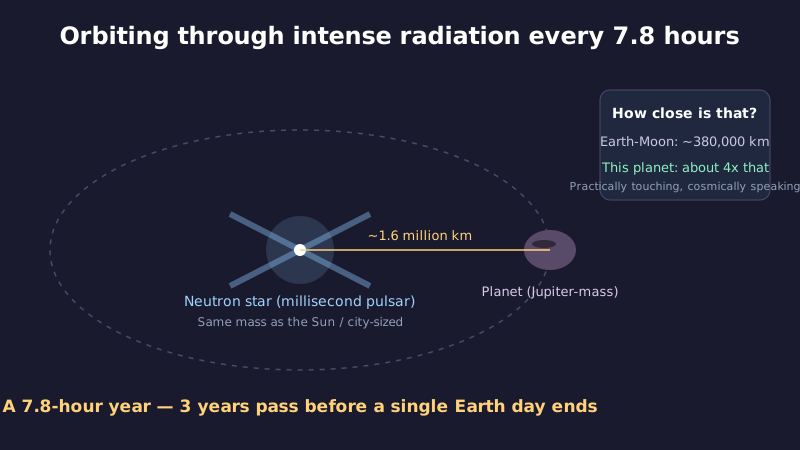
The star this strange-skied planet orbits is just as strange. It’s a millisecond pulsar: a neutron star that packs roughly the mass of the Sun into something the size of a city, spinning rapidly while blasting out gamma rays.
All that mass, shrunk down to the footprint of a single city. It’s hard to even picture how densely packed that is. And this object is also spraying high-energy particles and intense radiation out in every direction as it spins.
The planet orbits about 1.6 million kilometers from the neutron star, a little over four times the distance between Earth and the Moon (about 380,000 kilometers). On a cosmic scale, that’s practically touching.
Its orbital period is 7.8 hours. Before a single day passes on Earth, this planet has already completed three full years. It’s circling at tremendous speed, at point-blank range, through punishing radiation the whole way. That environment alone might be the culprit behind its bizarre sky.
Nobody can explain how it formed
With a planet this strange, the next question is obvious: how did it even form? And here’s the frustrating part: nobody knows.
Zhang’s team considered two possibilities and ruled out both. Did it form the ordinary way, condensing out of gas and dust like most planets? No, its composition is too far removed from anything that process would produce. Did a neutron star strip away the outer layers of a companion star, the way it happens in so-called “black widow” systems? That doesn’t work either, because nuclear fusion simply doesn’t produce pure blobs of carbon.
The team suspects something is actively pushing oxygen and nitrogen away from this system, but what that something is remains a mystery. Among the more than 6,000 confirmed exoplanets discovered so far, this appears to be the only gas planet known to orbit a pulsar.
It’s worth pausing on that. Astronomers usually make sense of a new object by slotting it into an existing category. This planet doesn’t fit into any drawer. The team is being refreshingly honest that their theories simply haven’t caught up yet.
In short, a sky exists that no known formation process can explain. We’ve found “planets that shouldn’t exist” before, like TOI-5205b, a Jupiter-sized world clinging to a small red star. But finding a sky whose very ingredients sit outside current theory is rare indeed.
The word “sky” turns out to be a local term
When we hear the word “sky,” we picture something blue, dotted with clouds, occasionally raining. But that’s just one local scene produced by Earth’s particular mix of nitrogen and oxygen.
Somewhere out there, among the more than 6,000 confirmed exoplanets, there’s a world with a sky made of carbon, diamond clouds forming at its base, orbiting a city-sized neutron star. Every new planet we find stretches the meaning of the word “sky” a little further. Add in newcomers like a temperate gas giant with Earth-like temperatures, and it starts to feel like our solar system was never more than a small corner of a much larger showroom.
As JWST reads more atmospheres using the same technique, we might find more carbon skies out there, or we might conclude this one planet really is one of a kind. Either way, the discovery gives us new material to rethink how planets form in the first place. It’s less “one more mystery” and more “the boundaries of normal just got wider.”
Tonight, the familiar sky outside your window is just one pattern among countless possibilities scattered across the universe. Once you know that, that ordinary blue sky starts to look a lot more remarkable.