By the third sunset of the day, Haru could tell the time without even looking up from his homework. On this planet, the sky changed color constantly — green in the morning, pale violet by noon, red once around snack time. To Haru, the sky was like television. Keep watching, and something happens.
“Haru, the curtains.”
His grandmother, Tsune, had come to draw them shut again.
“Eating dinner under a sky that flickers like that can’t be good for your eyes.”
“It’s fine. I tell time by it.”
“You poor thing.”
You poor thing was Tsune’s favorite phrase. Haru had heard it maybe forty times in three days. She didn’t mean any harm by it — which somehow made it worse.
Tsune had traveled here from a distant planet, and she clearly didn’t approve of the one her son, Kou, had settled on after starting a family.
“Back home, the sky stays properly blue all year round. Morning, noon, dawn — same blue, every single time. That’s what a decent sky looks like.”
“Uh-huh.”
“When you’re older, Haru, you should come see it. A real sky.”
Personally, Haru found the idea of a sky that never moved far creepier. No drifting clouds, no shifting colors — just blue, forever. Just thinking about it made him yawn.
In the kitchen, Kou washed the dishes and occasionally shrugged.
“Mom. That’s enough.”
“Oh, but it’s true, isn’t it? I don’t know how you stand living under a sky like this.”
“I got used to it.”
“You shouldn’t have to get used to it. You poor thing.”
Day by day, Tsune’s bragging grew bolder, until eventually she started weighing in on Haru’s schoolwork too.
“A restless sky makes for restless children, you know. So, Haru — what did you learn at school today?”
“Planet research! We’re studying planets with weird skies. Like one where three suns set, and one where it rains glass.”
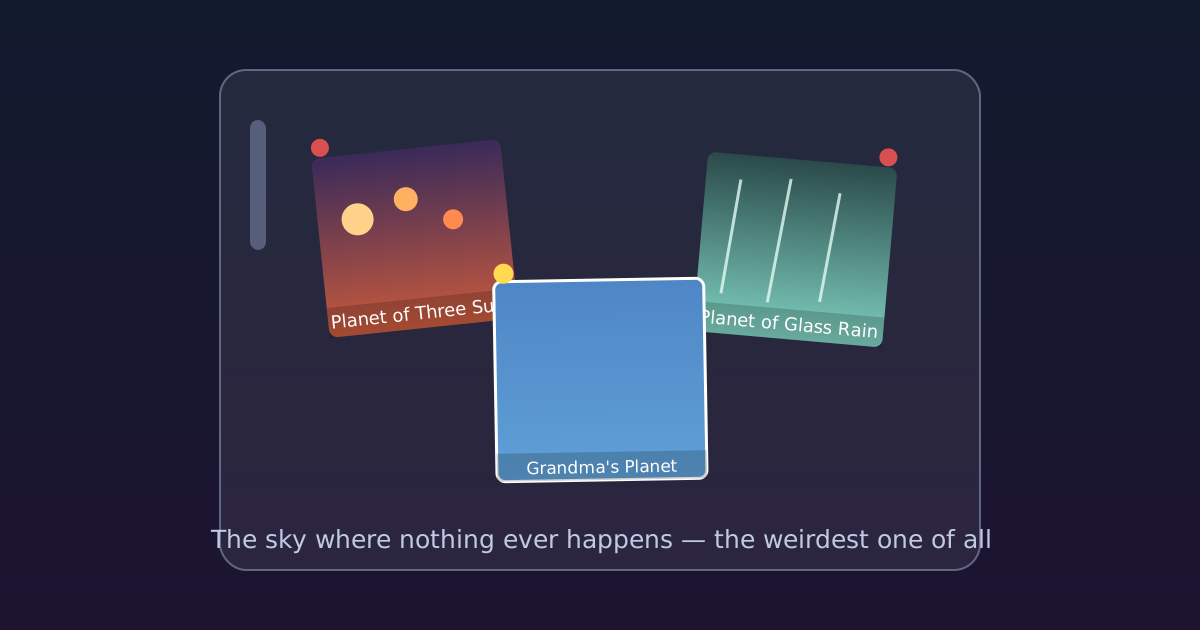
He pointed at the fridge, its door covered edge to edge with postcards held up by magnets — planets he was dying to visit, every one of them wonderfully strange.
“I want to go to all of them.”
“Goodness, how frightening. Nothing but oddball planets. You should visit somewhere decent, like Grandma’s planet.”
Haru’s hand froze.
”…Wait. Which planet is Grandma’s, exactly?”
Tsune named it, a little proudly. Haru’s eyes went round as saucers.
“Wait, that’s Once-Is-Enough Planet!”
”…I’m sorry?”
“Everybody in class knows about it! The sky never changes at all, right? Morning, noon, night, same blue, nothing ever happens. If you can watch it for a whole hour, you’re basically a hero. But everyone gets bored after five minutes, so nobody ever goes back twice!”
Kou stopped mid-dish and burst out laughing.
“Grandma, please — next time, bring me a postcard of it. The sky where absolutely nothing happens!”
”…Oh — now, Haru. That’s a perfectly decent sk—”
The word decent seemed to catch somewhere in Tsune’s throat, and the rest of the sentence never came.
Haru wasn’t listening anymore. He pulled a blue crayon from the drawer and colored a blank card edge to edge — no clouds, no sun, just blue.
“This is Grandma’s planet! It’s super rare!”
He pinned the plain blue card up between the planet of three suns and the planet of glass rain. From that day on, Tsune’s “decent sky” was the strangest planet on the whole fridge.