A crisp, ten-sided ripple now circles Saturn’s south pole — a polygon so clean it looks drawn with a ruler. And it isn’t a finished picture sitting still. It’s getting sharper by the year, right in front of us.
A planet’s sky, tracing a shape that precise. And we get to watch it being built, in real time. Honestly, the image made me gasp out loud.
What’s happening at Saturn’s south pole right now
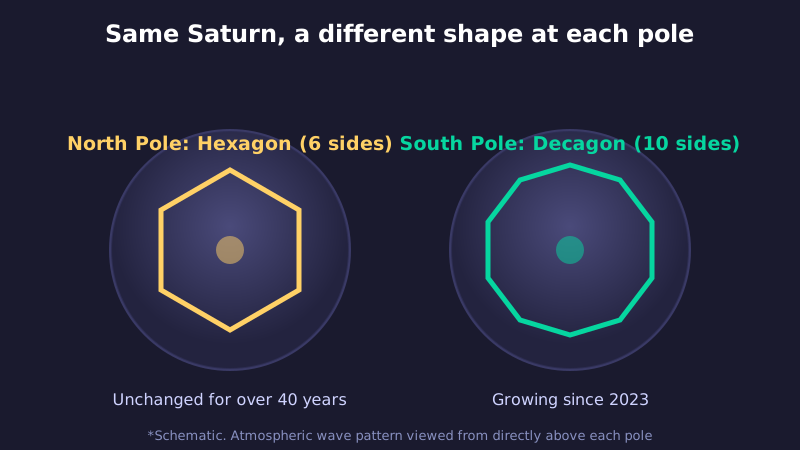
The star of this story is the Hubble Space Telescope, jointly run by NASA and ESA. Its observations have confirmed a huge, ten-sided wave wrapping around Saturn’s south pole — a decagon.
This isn’t a trick of color or a shape someone imagined into existence. The jet stream circling the pole — a fast, narrow band of wind — has arranged itself into a polygon with straight edges and sharp corners. According to the research team, this is the first time such a large, regular jet-stream pattern has been clearly spotted in Saturn’s southern hemisphere.
If you’re thinking “wait, isn’t Saturn’s hexagon the famous one?” — you’re right, and that’s exactly why we need to start with the north pole’s senior resident before this new southern shape makes sense.
The north pole’s hexagon has been “in charge” for 40 years
Saturn’s north pole has carried a hexagon-shaped jet stream for a very long time. It was first spotted in images sent back by the Voyager probes in the 1980s, and it’s since become one of the most famous shapes in the solar system.
What’s startling is how long it’s lasted. Observers have tracked this hexagon for more than 40 years, and it has kept essentially the same six-sided form the whole time. It doesn’t flare up and fade like a storm — it’s more like a permanent resident that never changes address.
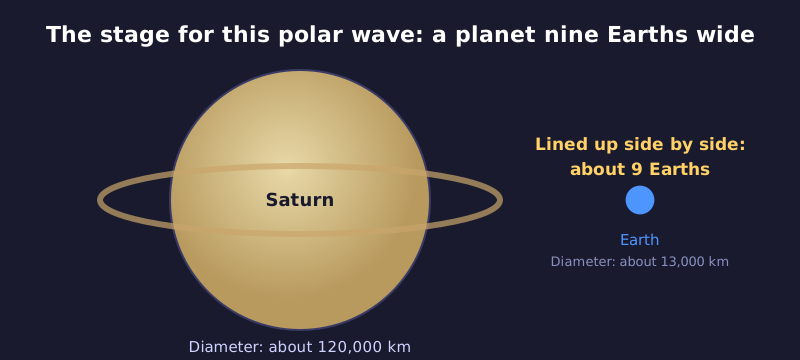
The scale is staggering, too. Saturn itself spans roughly 120,000 kilometers across — about nine Earths lined up side by side. A wind pattern that wraps clean around that planet’s pole, bent into a hexagon with sharp corners, isn’t some small eddy. Picture it as a belt cinched around the entire planet.
Earth has its own jet streams too — the high-altitude winds that let airliners catch a tailwind and fly faster. Every planet has bands of wind like this, but on Saturn, the one at the pole bends into hard angles. Earth’s jet stream meanders with the seasons, but it never locks itself into something as geometric as a decagon. Saturn’s precision is, frankly, a little unreasonable.
So if the north has such an impressive hexagon, surely the south should have matched it by now. That turned out to be one of the longer-running puzzles.
Forty years of searching, and the south had no match
According to the research team, Hubble has been searching for a northern-style pattern at the south pole ever since it began operating in 1990 — part of its long-running OPAL (Outer Planet Atmospheres Legacy) program, which keeps watch on the outer planets year after year.
The Cassini spacecraft added to the search too, orbiting Saturn from 2004 to 2017 and getting an especially close look at the south pole over those thirteen years. And still, nothing. No long-lived, regular shape to match the north’s hexagon ever turned up. The south pole just looked oddly featureless.
Stop and sit with that for a second. Same planet, same spin, same atmosphere — and yet the north has a 40-year-old hexagon while the south has nothing. It’s the kind of imbalance you’d notice in a house where one room is perfectly furnished and the other sits completely empty.
Then, into that empty room, a decagon walked in.
A rare chance to watch a shape being built
Here’s the part that makes this genuinely exciting: the decagon didn’t show up fully formed.
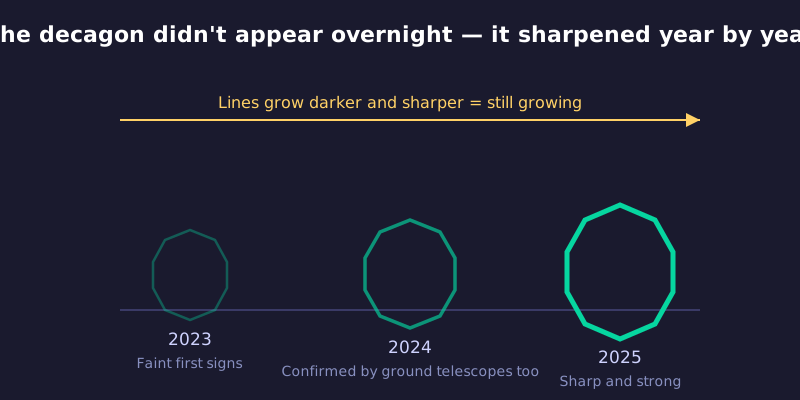
Digging back through Hubble’s archive, researchers found the faintest trace of it already present in 2023. By 2024, ground-based telescopes could pick it out too. By 2025, it had sharpened into something unmistakable. Like a pencil line being traced over again and again, the shape has been filling itself in.
Amy Simon of NASA’s Goddard Space Flight Center, who took part in the research, described it as “a rare opportunity to see a giant atmospheric pattern intensify and solidify.”
Why does that matter so much? When humans first noticed the northern hexagon, it was already complete — nobody witnessed its birth. The southern decagon is different. We can trace it, year by year, from its first faint hint to its current sharpness. It’s a rare chance to document how a planet-scale pattern actually comes together.
If the northern hexagon is a 40-year unbroken record, the southern decagon is a scene still being shot. One is the finished film; the other is still on set. Watching both at once, on opposite poles of the same planet, is a strange kind of luck.
Worth noting: images from amateur astronomers Trevor Barry and Jean-Paul Auger also contributed to this discovery. Long-term planetary monitoring is more than professional observatories can cover alone, so backyard telescopes end up doing real scientific work on planet-scale phenomena. Honestly, that’s my favorite part of this whole story.
Why do planets build “angular” shapes at all?
So why does a jet stream fold itself into a hexagon or a decagon in the first place? And why six sides at the north and ten at the south?
To be honest, nobody fully knows yet. One idea is that when certain kinds of waves overlap in the wind circling a pole, they can lock the flow into a polygon with straight edges and sharp corners — a bit like a winding river that, depending on how its ripples line up, ends up kinking into hard angles instead of smooth curves. The number of sides seems to depend on things like wind speed and the width of the jet stream. But a clean explanation for why the north stays at six sides while the south settled on ten? Science isn’t there yet.
Simon herself noted that the question of why this shape suddenly appeared at the south pole now remains open. The study behind this discovery was published in the journal Science Advances in September 2026, led by Agustín Sánchez-Lavega of the University of the Basque Country in Spain.
It’s worth keeping two things separate here. That a decagon appeared at the south pole and has sharpened year by year is an observed fact, caught plainly on camera. Why it takes that particular shape is still an open question researchers are actively working through. Keeping those two apart is, I think, the key to reading science news like this without getting ahead of it.
A sky that’s both meticulous and unpredictable
A planet’s sky can apparently be precise enough to draw a polygon with a ruler’s edge — and unpredictable enough to produce a completely different answer at each pole, holding one shape for 40 years while quietly growing a brand-new one at the other. That combination of strict order and sheer unpredictability is, for me, the best part of this whole story.
If you could float high above Saturn’s south pole right now, you’d see, far below, an enormous ten-sided cloud pattern slowly turning beneath you — its outline growing crisper over the span of a few human years. On Earth, clouds lose their shape in minutes. Here, corners take years to sharpen.
If you spot Saturn tonight as a small yellow point of light, know that its top and its bottom are keeping time with two different polygons, moving at two different speeds. Why opposite poles of the same planet grow shapes with different numbers of sides is a question nobody can answer yet.
How far will this shape grow? We happen to be the generation watching, which means we get to find out. A shape this precise, appearing and changing on a whim — there’s something in that mystery that almost wants to become a short story of its own.