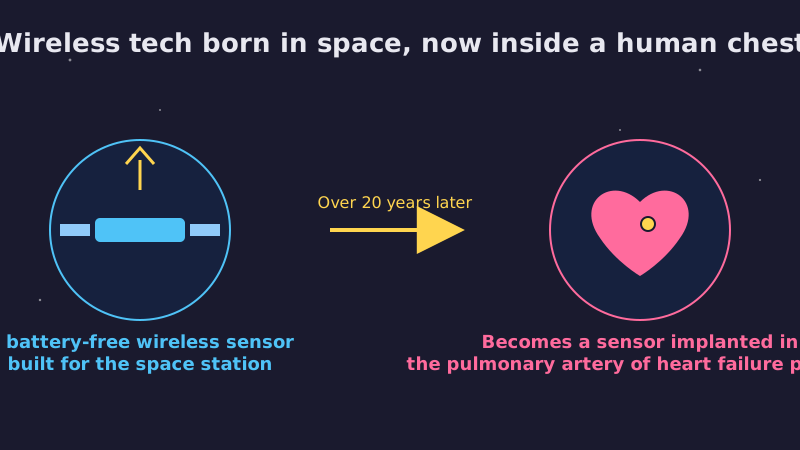
Somewhere right now, someone is living with a tiny sensor tucked inside the blood vessel that carries blood from their heart to their lungs. The design behind that sensor wasn’t dreamed up in a hospital. It started as wireless technology meant for a space station.
There’s no battery inside it. No major surgery was needed to put it there. And yet, from somewhere deep in the chest, it quietly sends out a single number every day.
The first time I heard that number, I assumed I’d misread it. A year after implantation, heart failure hospitalizations dropped by 73 percent. How does a technology built to monitor astronauts end up lodged in a patient’s heart on Earth? That detour is worth telling.
In space, the battery is the enemy
The story starts at NASA’s Glenn Research Center in Cleveland, Ohio. Two engineers led the wireless communications work there: Dr. Rainee Simons, a microwave communications specialist, and Dr. Felix Miranda, also at Glenn.
When you’re running equipment in space, power is always the headache. Batteries are heavy, they degrade, and swapping them out takes a human hand. Add one more cable and you’ve added launch weight and one more thing that can fail.
So Simons and Miranda set out to build a sensor with neither a battery nor wiring. Hit it with a radio signal from outside, and it wakes up just long enough to take a reading and send that value back riding on the reflected wave. No onboard power source at all — a fully passive design.
What the two engineers refined was a combination of a radio-frequency integrated circuit and a small antenna. An incoming radio wave hits the antenna, and that tiny burst of energy is enough to complete one brief transmission. Because the device never needs to run continuously, it never needed a power source to begin with.
Here’s the strange part: that stripped-down, “give it nothing” philosophy is exactly what makes it work inside a human body. Put a battery inside someone’s chest, and sooner or later you’re watching the charge level, and eventually you need surgery just to replace it. Skip the battery from the start, and that whole problem disappears. A constraint that engineers hated in orbit turned into a weapon in another place where swapping batteries is just as hard — the human body.
Woken by radio, answered by radio
Stripped down to its basics, the mechanism is almost disappointingly simple.
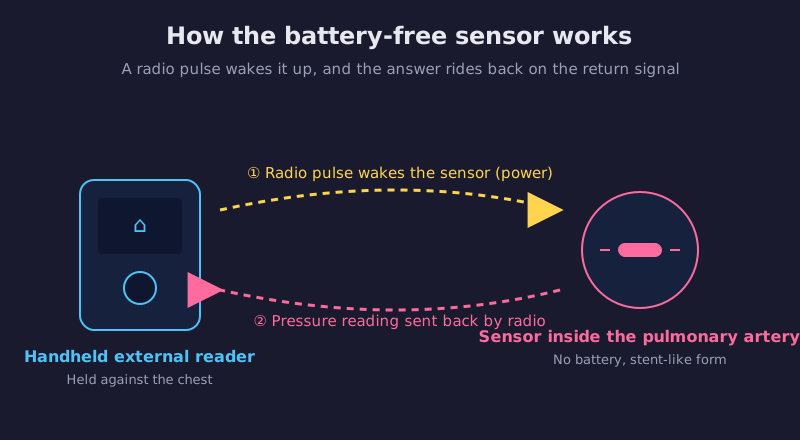
The patient holds a palm-sized reader against their chest. The reader sends out a radio pulse. The sensor inside the blood vessel wakes up using that energy, measures the pressure it’s sensing at that instant, and radios the answer back. That’s the whole process.
The product is called the Cordella Pulmonary Artery Sensor System. “Pulmonary artery” refers to the large vessel that carries blood from the heart to the lungs, and that’s exactly where the sensor sits.
Despite the word “implant,” this isn’t open-heart surgery. Dr. Simons has described the procedure as similar to placing a stent — a thin catheter is guided through the blood vessels. No major operation is required, and the device is simple enough that patients can operate the reader themselves at home.
Checking the pressure inside a blood vessel turns out to be about as routine as stepping on a bathroom scale. I’ll admit, before learning this, I assumed an implanted sensor would be a much bigger deal.
Why pulmonary artery pressure, specifically?
Here’s where the story gets interesting, and honestly my favorite part. The sensor isn’t tracking weight or pulse. It’s tracking pressure in the pulmonary artery, and that choice matters.
When heart failure worsens, the body follows a sequence. Pressure in the vessels leading to the lungs climbs first, quietly, before anything visible happens. Shortness of breath and swollen legs — the symptoms people actually notice — show up later. According to NASA, that pressure rise can begin days to weeks before a patient needs to be hospitalized.
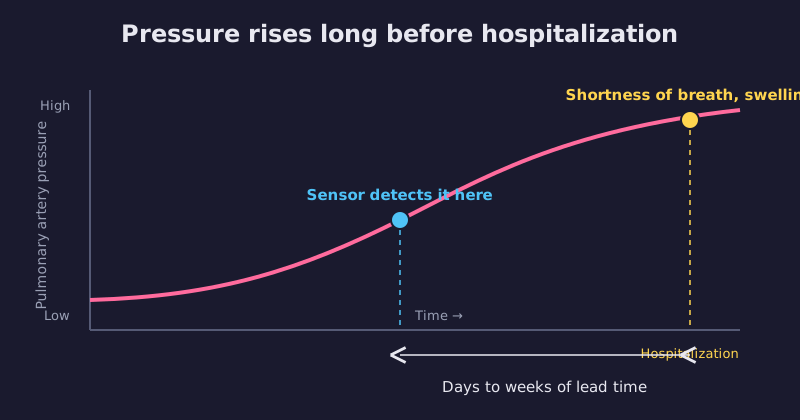
In other words, the sensor can flag trouble while the patient still feels fine. Once pressure starts rising, doctors can adjust medication before anyone needs a hospital bed. Instead of rushing in once symptoms hit, it’s more like closing the windows before the storm arrives.
The older approach — watching body weight and swelling — only catches the problem after symptoms have already started. By the time the morning scale ticks up, fluid has already begun building in the body. The sensor is watching further upstream: the pressure inside the vessel itself.
Why does catching it one step earlier matter so much? Think of worsening heart failure as a ball starting to roll down a hill. Catch it before it moves and one finger can stop it. Let it pick up speed and you need a hospital bed. The sensor is standing on that quiet slope, before the ball starts rolling. That one earlier step is what produces the next number in this story.
73% fewer hospitalizations in one year
Which brings us back to where we started. In a clinical trial of more than 600 patients, NASA reports that heart failure hospitalizations dropped 73 percent in the year after the sensor was implanted.
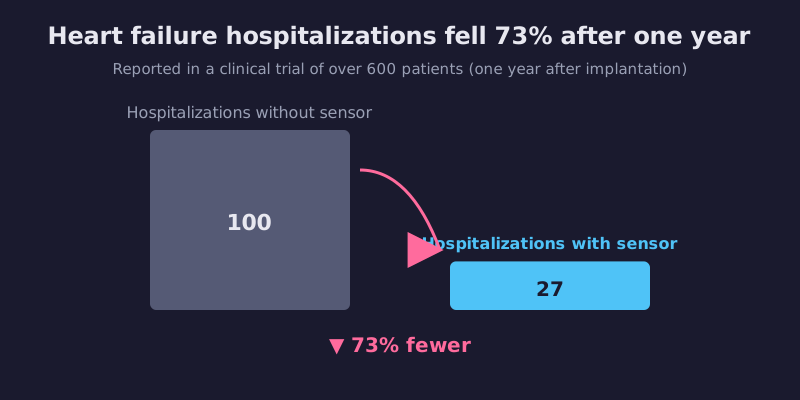
Picture ten hospital stays shrinking to three or fewer. Heart failure hospitalizations don’t just cause suffering — each one weakens the body further and sets up the next one. The cycle gets steeper each time it repeats. A small sensor sitting in someone’s chest is narrowing the very first entrance to that downward spiral.
Looked at purely as numbers, this reads like a medical-device success story. But underneath it is a constraint born in space: the decision to leave the battery out entirely. In a setting where engineers would normally just add a battery, choosing to go without one produced a device that could live safely inside the body for years.
A constraint turned into an advantage that eventually helped someone else entirely. That kind of reversal shows up again and again when space technology makes its way down to Earth.
Twenty-plus years from a lab radio signal to a human heart
Still, the road from a lab idea to a patient’s chest was anything but short.
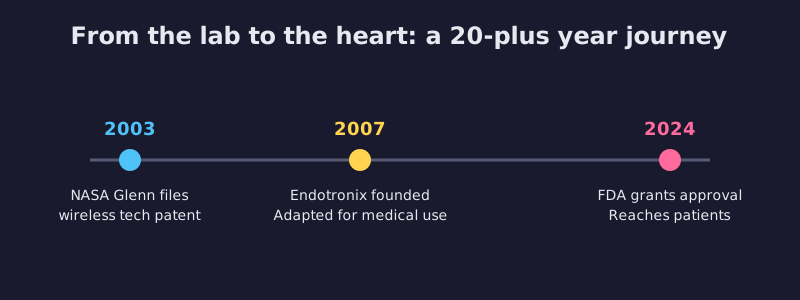
The patent for the wireless power-and-signal technology was filed in 2003. Endotronix, founded in 2007 and now part of Edwards Lifesciences, took that idea and developed it into a medical device. The U.S. Food and Drug Administration approved the sensor in June 2024. More than twenty years passed between the original concept and that approval.
Technology rarely becomes useful the moment it’s invented. Someone has to recognize a different use for it, carry it into another field entirely, and verify its safety step by step before it can go inside a human body. A wireless sensor built for space took that long, and passed through that many hands, before settling into a blood vessel near the heart.
Endotronix got its start in Naperville, Illinois, licensing NASA’s wireless power and signal transmission technology and rebuilding it as an implantable medical device. The space hardware blueprint didn’t go straight into a human heart unchanged — the materials and shape had to be redesigned for safe use in the body, and the device went through years of clinical trials before earning approval.
NASA logs dozens of these technology transfers to industry every year. This sensor stands out as a case where a constraint born in space and a genuine need on Earth lined up almost perfectly. A design stripped down for the demands of orbit turned out to fit exactly where it was needed most on the ground.
A piece of space hardware, quietly at work inside a chest
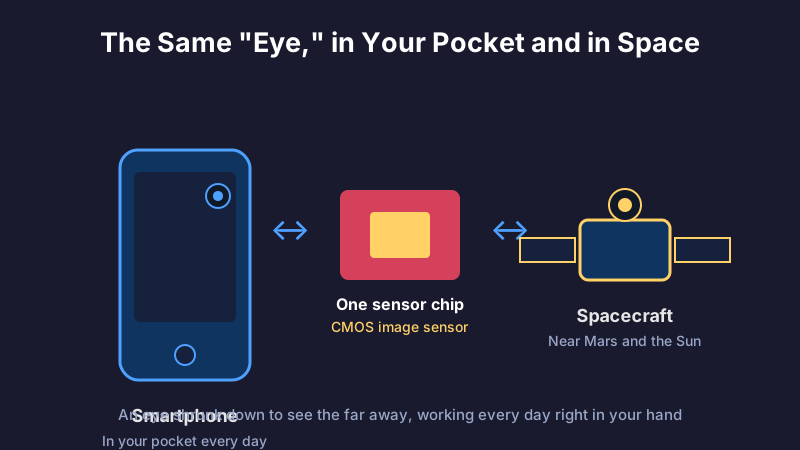
GPS, the image sensors inside smartphone cameras — technology refined for spaceflight slips into everyday life more often than people realize. Accurate directions, sharp photos: trace either one back far enough and you’ll likely find a space program behind it. But most of those spinoffs stay on the convenient side of life, outside the body, in your hand.
This one is different. A mechanism designed for a space station now sits inside a human blood vessel, quietly working to prevent one of the heaviest events in a patient’s life: hospitalization.
Imagine someone close to you living with heart failure. One morning, they hold a small reader against their chest and read off a number. They’re probably not thinking about space at all. But the thinking behind that small device traces straight back to an effort to monitor astronauts’ bodies without a battery. An idea once aimed at the sky beyond us is now working silently inside the chest of someone who needs it the most.