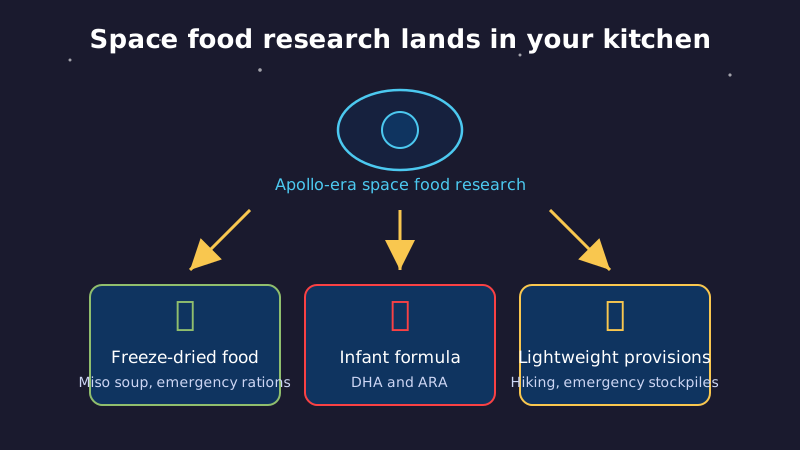
Pull a packet of freeze-dried miso soup off the shelf and pour hot water over it. The dried, shrunken bits of tofu and seaweed puff back to life in the steam. That unremarkable breakfast trick traces straight back to space food research from the Apollo program.
The same thing happens in a can of infant formula. The tiny “DHA/ARA” line on the nutrition label has its roots in space exploration too.
Space feels far away. But your kitchen cupboard is a lot closer to it than you’d think.
The Apollo program’s “how do we dry this” problem
The story starts in the 1960s, during the race to put people on the Moon. Feeding astronauts through missions that stretched over several days turned out to be a surprisingly hard problem.
Heavy food means a heavier, costlier launch. Spoiled food means a sick astronaut. NASA needed meals that were light, shelf-stable, and still nutritious enough to sustain a crew in a cramped capsule, so the agency poured serious effort into space food research for these long missions. One of the techniques that came out of it was freeze-drying: freezing food first, then pulling out the moisture to leave something light that lasts.
Here’s where it gets interesting. A company called Action Products took that technology and turned it into consumer snacks, including, by some accounts, the first freeze-dried ice cream.
According to NASA records, those freeze-dried snacks sold in museums and at NASA visitor centers, got exported to multiple countries, and brought in several million dollars a year. Food built for astronauts had become a treat sold at the gift shop. It was the first small step of space food making its way down to Earth.
Why 98% of the nutrition survives
So why does drying food out actually work, nutritionally? Leave something out in the sun to dry and you’d expect both the flavor and the nutrients to take a hit.
The trick is in the order of operations: freeze first, then pull the water out. According to NASA, freeze-drying starts by cooking the food, then flash-freezing it. The frozen food then goes into a vacuum chamber and gets warmed gently. Under those conditions, the frozen water skips the liquid stage entirely and turns straight into vapor.
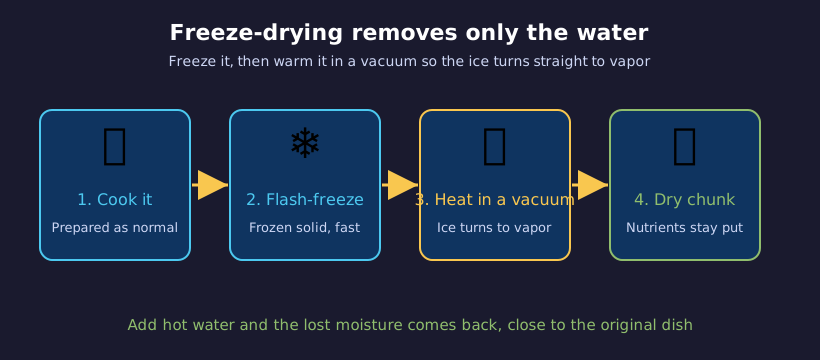
Only water leaves. Because there’s no simmering or boiling involved, the nutrients and flavor compounds mostly stay put. And once the frozen water sublimates away, it leaves tiny gaps behind, turning the food into something like a dry sponge. That’s why hot water soaks in so readily, and why the dried food barely changes shape in the process.
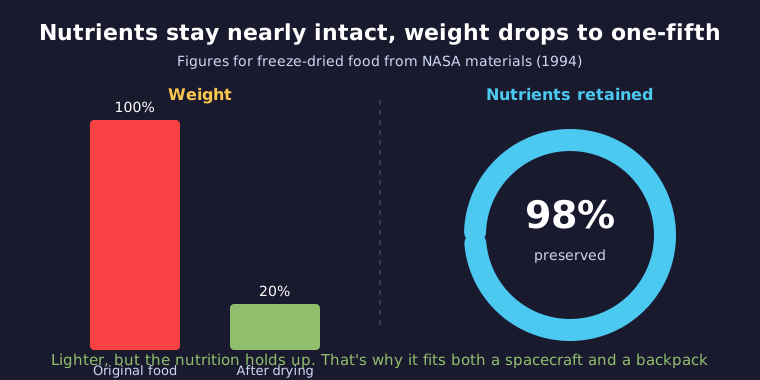
The numbers back this up. NASA reports that finished freeze-dried food retains 98% of its nutrition while dropping to 20% of its original weight, a fifth of what it started at. I’ll admit that when I first saw “98%,” it sounded too good to be true. But once you understand that only water is being removed, the math checks out.
Add hot water, and the moisture that left comes rushing back, bringing the dish close to its original form. That’s exactly what’s happening over your bowl of miso soup at breakfast.
Light, shelf-stable, and still nutritious: a combination that pays off on Earth too
Worth pausing here for a second. The reason this technology mattered to astronauts wasn’t flavor. It was weight and shelf life.
Picture packing days’ worth of food for a trip into space, where every kilogram you bring along is strictly rationed. Carrying the same nutrition at a fifth of the weight is a massive advantage, it means you can fit roughly five times as many meals into the same backpack. Pulling out the water also makes food far less prone to spoiling.
That combination, light, long-lasting, and nutritionally intact, turns out to matter just as much back on the ground.
Take hiking and camping. Anyone fighting the weight of their own pack appreciates a fifth of the mass as much as an astronaut does. Boil some water at the summit, and a dry, shrunken block turns back into a hot meal. Disaster preparedness is another obvious fit: food that keeps for years, stays light, and only needs water or hot water to become edible is ideal for an emergency stockpile. It survives being forgotten in the back of a cupboard, and it doesn’t take up much space when you actually need it. Properties refined to solve a constraint in space ended up fitting a completely different constraint on Earth.
“Space food” sounds like it belongs to a different world. But it’s already sitting in your emergency kit or your camping gear. Every time you grab a cup of instant soup from the dried-goods aisle, you’re picking up a descendant of space food without even realizing it.
The nutrient hiding in a can of baby formula
So far, this has been a story about food’s physical form. There’s a second, completely separate route, one where the nutrition itself, not just the shape of the food, came down from space.
NASA’s own account notes that connecting interplanetary travel to baby food sounds like a stretch, but the link is real. One of the nutrient supplements found in commercial infant formula traces back to NASA-funded research.
That research was originally about something else entirely: whether algae could serve as a recycling tool on long spaceflights, cycling air and materials through a closed spacecraft environment.
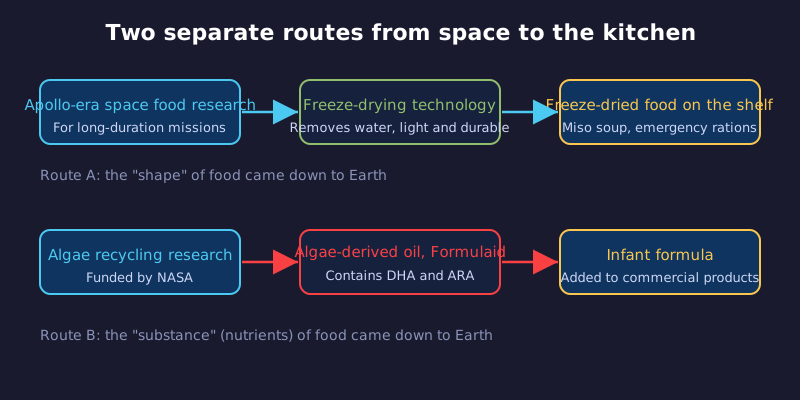
Out of that work came Formulaid, an algae-derived oil. According to NASA, it was developed and manufactured by Martek Biosciences in Columbia, Maryland, whose founders and key scientists picked up their algae know-how while working on NASA-related projects.
Formulaid’s active ingredients are two fatty acids: DHA (docosahexaenoic acid) and ARA (arachidonic acid). The names are a mouthful, but both occur naturally in breast milk and, until Formulaid came along, were largely absent from infant formula. Many researchers believe they play a role in brain and vision development, according to NASA’s account.
A nutrient added to bring formula closer to breast milk, made from algae, using know-how developed for recycling materials in space. What started as a story about lightening food ends up being about the substance of nutrition itself. Research aimed at the Moon somehow made it all the way to a newborn’s bottle. That’s the detour hiding in the fine print on a formula can.
Why does space exploration keep trickling down to Earth like this?
Freeze-dried food and infant formula both trace back to the same space food research, but by completely different routes. One carried over the shape of food; the other carried over its nutritional substance.
What ties them together, I think, is that both emerged from extreme conditions. In space, weight, shelf life, and material cycling all get pushed to their absolute limits. An environment that tolerates zero compromise tends to force solutions nobody would normally think of.
And those solutions weren’t exclusive to space. Hikers want to cut weight just as badly as astronauts do. Stockpiled supplies need to resist spoilage just as much as a spacecraft’s rations. And nutrition that mimics breast milk matters to every baby on Earth, not just the ones whose parents work for NASA. Answers refined under extreme pressure have a way of overlapping with ordinary, everyday problems.
NASA has a name for this kind of technology trickling down from space exploration to everyday life: a spinoff. It’s a quiet channel through which something built for deep space ends up shaping daily routines without anyone noticing. Space food is just one easy-to-see example of it.
Your kitchen cupboard is more connected to space than you think
Let’s circle back to that morning kitchen one more time.
Miso soup that comes back to life with hot water. Three letters, DHA, printed in tiny type on the back of a formula can. Both are leftovers from people who spent years obsessing over weight, shelf life, and material cycling in the pursuit of the Moon.
It’s easy to think of space as something you only look up at. But next time you tear open a pack of freeze-dried food, or mix up a bottle of formula, take a second to remember: somewhere behind that rising steam, there’s a table set for an Apollo astronaut.